
Magento replatform discussions usually start when performance drops, development slows, or technical issues begin to affect revenue. These situations create pressure, which often leads teams to assume the platform itself is the problem. Magento is widely used by large and complex retailers, which shows that the platform can scale when it is implemented and maintained properly.
This article explains how to decide between Magento replatform and deep optimisation using operational evidence, realistic constraints, and long-term impact rather than assumptions or trends.
Table of Contents
What Is Magento Replatform?
Magento replatform means moving your store away from Magento to a different e-commerce platform while keeping your products, customers, and commercial model largely unchanged.
A typical Magento replatform includes:
- Rebuilding frontend templates and user journeys
- Recreating custom business logic on the new platform
- Replacing Magento extensions with new tools/apps
- Reworking ERP, PIM, CRM, and integrations
- Updating internal workflows for content, promos, and releases
Because of this, replatforming affects technology, teams, and processes at the same time.

Common Reasons Businesses Consider Replatforming
Businesses usually begin considering Magento replatform after repeated friction rather than a single issue.
Common reasons include:
- Rising development and maintenance costs
- Slow delivery of new features or campaigns
- Frequent bugs after updates or releases
- Ongoing performance issues that impact conversion
These signals highlight real problems, but they often point to how Magento has been implemented rather than Magento itself.
What Is Deep Magento Optimisation?
Deep Magento optimisation focuses on improving how the platform operates day to day.

This work typically includes:
- Reviewing and refactoring custom modules
- Removing unused or conflicting extensions
- Improving database structure, indexing, and queries
- Adjusting caching, search, and queue configuration
- Improving deployment and release processes
The goal is to align Magento with the way the business actually runs, rather than forcing the business to work around technical limitations.
Problems Optimisation Is Designed to Fix
Optimisation is designed to resolve issues caused by accumulated technical debt.
These issues often include:
- Slow page loads caused by inefficient queries
- Checkout failures linked to third-party extensions
- High infrastructure costs due to poor scaling decisions
- Instability during peak traffic periods
When these problems are addressed directly, Magento often performs reliably without the need for replatforming.
Magento Replatform vs Deep Optimisation: Key Differences
The key difference between Magento replatform and deep optimisation is the level of change involved. Each approach affects technology, teams, and delivery in different ways.
Magento Replatform
Magento replatform replaces the entire e-commerce system and introduces a new operating model. Core platform behaviour, limitations, and workflows change, even if the business model stays the same.
This approach often involves:
- Rebuilding frontend and backend functionality
- Replacing extensions and integrations
- Training teams on new tools and processes
While replatforming can remove long-standing technical debt, it also increases delivery risk and extends the time needed to see results.
Deep Optimisation
Deep optimisation improves the existing Magento platform rather than replacing it. The focus is on fixing inefficiencies in code, extensions, infrastructure, and configuration.
This approach allows businesses to:
- Keep internal knowledge and workflows
- Deliver improvements in smaller, controlled phases
- Reduce risk and operational disruption
Optimisation typically produces faster results because it works within the current platform instead of introducing a new one.
When Magento Replatform Is the Right Option
Magento replatform becomes a valid option when Magento cannot support business goals without constant workarounds.
Clear signs include:
- Core features require heavy and ongoing custom logic
- Platform upgrades regularly break essential functionality
- Planned expansion is blocked by platform constraints
- Development effort increases while output declines
In these situations, optimisation may reduce pain but will not remove the underlying limitations.
Real-World Business Scenarios
Businesses moving towards complex subscription models, multi-vendor marketplaces, or highly composable architectures may find Magento restrictive over time.
If each new requirement requires structural changes rather than configuration, Magento replatform can reduce long-term complexity and technical risk.
When Deep Optimisation Is the Better Choice
Deep optimisation is usually the better option when problems are concentrated.
Strong indicators include:
- Performance issues linked to specific modules or features
- Checkout or payment issues caused by extension conflicts
- High hosting costs driven by inefficient architecture
- Teams with strong Magento knowledge already in place
In these cases, optimisation often delivers faster and more predictable results.
Real-World Business Scenarios
Retailers experiencing slow performance during promotions often discover that caching, indexing, or search configuration is the root cause.
Fixing these areas stabilises performance without changing platforms or retraining staff, protecting revenue during peak trading periods.
Important Factors Often Overlooked
Replatforming does not improve how teams work together.
If testing, documentation, or deployment processes are weak, similar problems will appear on a new platform. Optimisation combined with process improvements often delivers better long-term results.
Data and Integration Complexity
Data migration is one of the most underestimated parts of Magento replatform projects.
Challenges often include:
- Inconsistent order history
- Custom pricing and promotion rules
- Customer segmentation and reporting logic
Validating and reconciling this data takes time and introduces risk.
SEO and Traffic Risk
Magento replatform changes how pages are structured and rendered.
Without careful planning, this can lead to:
- URL changes
- Loss of internal linking signals
- Changes in crawl behaviour
These issues can impact organic traffic for several months.
Platform Perception vs Reality
New platforms often appear simpler during early evaluation.
As requirements grow, limits around customisation, integrations, and pricing tiers become clearer. These constraints often replace Magento’s complexity with different trade-offs.
Optimisation as a Diagnostic Step
Deep optimisation often reveals whether Magento is truly the constraint.
This insight helps businesses decide if replatforming is necessary or if further optimisation will continue to deliver value, reducing unnecessary risk.
Cost, Risk, and ROI Comparison
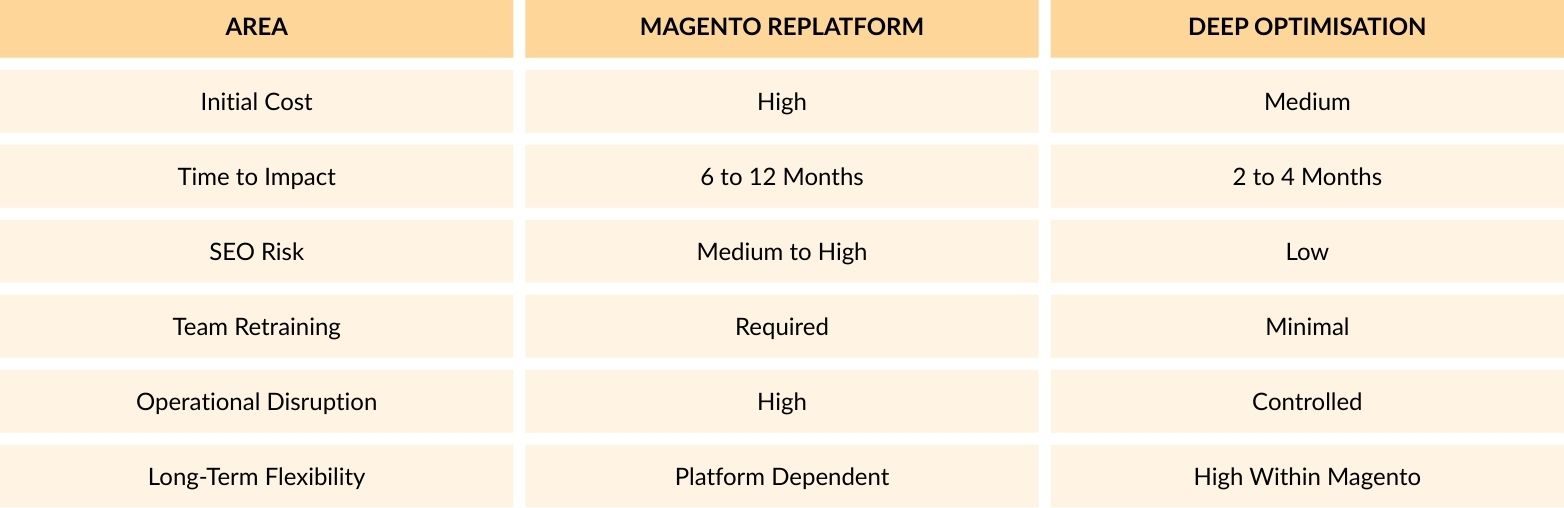
A Practical Decision Framework
Step 1: Identify the Real Constraint
Start by identifying the single issue limiting growth today.
If the issue relates to delivery quality or stability, optimisation is usually enough. If Magento cannot support planned features, Magento replatform may be required.
Step 2: Audit Before You Commit
A structured Magento audit often shows that:
- Most performance issues sit in a small part of the codebase
- Some extensions create disproportionate risk
- Infrastructure decisions no longer match traffic patterns
This insight can change the direction of the decision.
Step 3: Compare Opportunity Cost
Compare the revenue impact of:
- Delayed improvements during a long replatform
- Faster gains delivered through optimisation
This comparison is often missed but critical.
Step 4: Assess Internal Capability
Replatforming introduces new tools and processes.
If internal teams lack the time or skills to adapt quickly, replatforming may slow progress rather than speed it up.
Step 5: Decide Based on Evidence
Avoid decisions based on trends or competitor behaviour.
Metrics, audits, and operational data should guide the final choice.
Conclusion
Magento replatform is a structural change that affects technology, teams, and operations. Deep optimisation is a focused approach that improves performance within the existing platform. If Magento limits your business model, replatforming may be justified. If issues stem from technical debt and implementation quality, optimisation is usually the better first step. Making this decision using clear constraints and realistic impact protects revenue, limits risk, and supports long-term growth.
Need a eCommerce Specialist?
- By Andrea Perez