

Ecommerce growth is harder to lead when the basics keep shifting, consent rules reduce signals, attribution reports disagree, product feeds drift, stockouts and returns eat margin, and teams respond with more promos or more spend but profit still does not move. Leaders seeing consistent gains usually take the opposite approach by stabilising measurement first, treating product data as a performance asset, tightening the pages that do the selling, building repeat purchase so paid media has room to breathe, then scaling with simple operating rules that protect service levels and margin.
This roadmap gives you that sequence, plus the weekly scorecard and ownership model that keeps it moving. It is designed to work across Shopify, WooCommerce, Magento, and Adobe Commerce, with practical actions you can assign and measure.
What Does Ecommerce Growth Mean
Ecommerce growth means improving profit and repeat purchase while keeping delivery standards high. It shows up as higher conversion on key pages, fewer stockouts, fewer returns, and reporting leaders trust. The outcome is steadier planning with less reliance on constant discounting.
What Leaders Should Optimise For
Most teams push revenue first, then fix problems later. That sequence often creates margin pain. A better order is
- Data the team trusts
- Products presented clearly
- Conversion improvements on the pages that matter
- Retention that reduces paid pressure
- Scale that operations can support
A simple test helps. If revenue rises and weekly firefighting drops, ecommerce growth is moving in the right direction.
Which Numbers Should Leaders Track for Ecommerce Growth
Leaders should steer ecommerce growth with a small weekly scorecard that links marketing activity to profit and customer outcomes. Use metrics that trigger decisions. GA4 also relies on recommended ecommerce events to populate ecommerce reports, so measurement needs consistent event tracking.
A Practical Weekly Scorecard
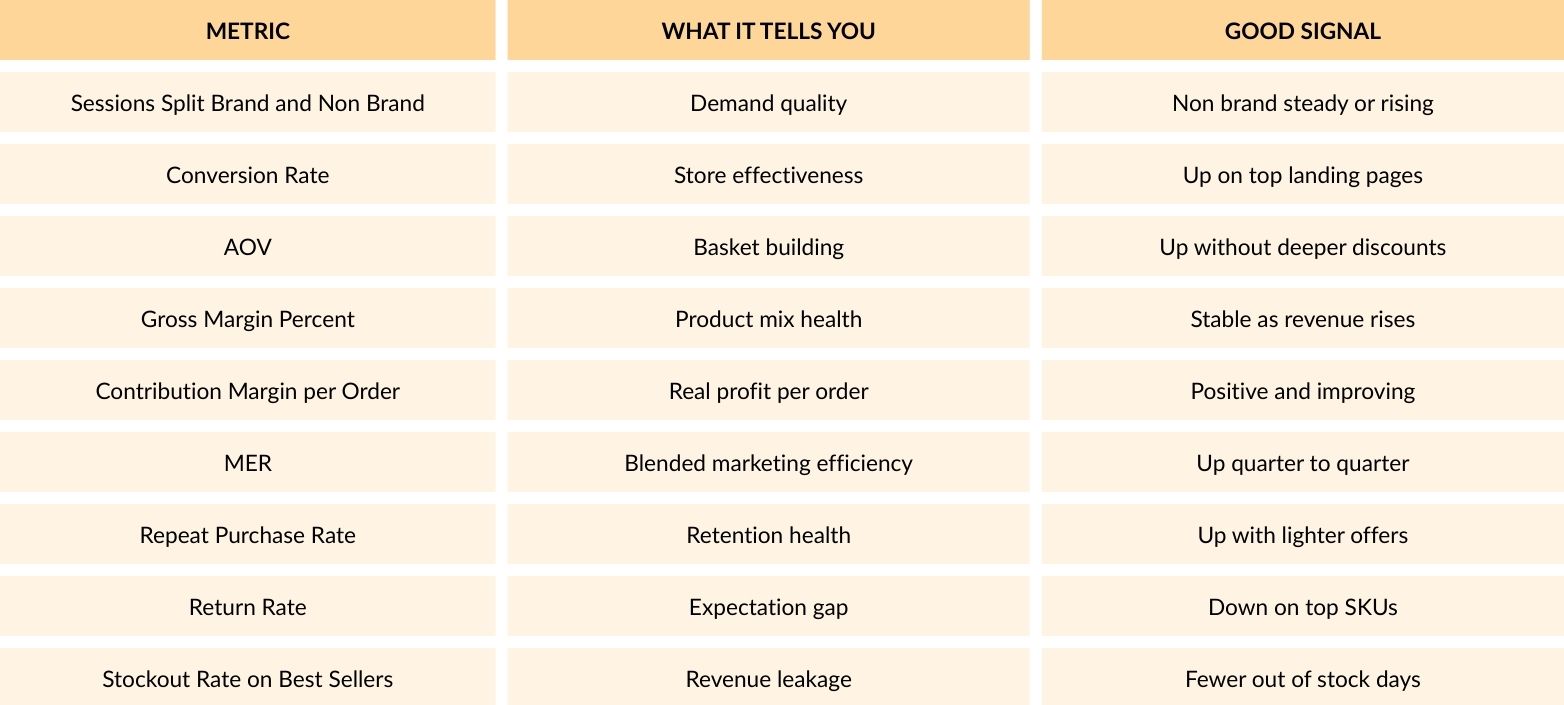
MER in Plain Terms
Marketing Efficiency Ratio is a blended efficiency metric. It equals total revenue over total marketing and advertising spend across a set period. It helps leaders set budget guardrails when platform attribution is noisy.
One Uncommon Metric That Improves Decision Quality
Return Adjusted Contribution Margin per order
Take contribution margin per order, then adjust it using return rate and return handling costs per category. This stops you scaling products that look profitable until refunds land.
How Do You Set Growth Targets That Protect Profit
Set growth targets that protect profit by setting your limits first, then choosing revenue targets that stay inside them. Use contribution margin per order, return rate, and stock coverage as non negotiables so ecommerce growth stays profitable.
1. Outcome Targets
Outcome targets define what “good” looks like at board level, so the team is not chasing revenue that loses money. Set a revenue goal alongside a contribution margin goal, then review both weekly to keep scaling controlled.
2. Guardrails
Guardrails are the rules that stop growth activity damaging margin or customer experience. Agree limits such as maximum discount rate, minimum contribution margin per order, maximum return rate per category, and stock coverage rules for best sellers.
3. Leading Indicators
Leading indicators are early signals that tell you if you are on track before the month ends. Track conversion on top landing pages, checkout completion, repeat purchase, email and SMS share of revenue, and stockout days so you can fix issues quickly.
4. One Constraint per Quarter
One constraint per quarter means choosing the biggest blocker to profitable growth and making it your main focus. Fixing one issue properly beats small improvements across ten areas and makes ecommerce growth easier to repeat.
How Do You Fix Tracking and Consent So Teams Trust the Data
Fix tracking and consent using consent aware tagging, aligned GA4 ecommerce events, and a weekly revenue reconciliation between analytics and backend orders. Google states consent mode was updated and includes additional parameters tied to advertising user data and personalisation.
The Minimum Measurement Standard
These basics unlock reliable reporting
- Consent banner connected to tags with consent mode behaviour
- GA4 recommended ecommerce events implemented consistently
- Ecommerce event parameters aligned, including items arrays
- Weekly revenue variance check between GA4 and order system
- UTM rules that reduce misattribution and inflated direct traffic
What This Looks Like in Practice
Run a weekly 20 minute measurement review
- Revenue variance percentage
- Top 3 causes of gaps
- One fix to ship this week
- One validation check to confirm the fix worked
If your store runs on Magento or Adobe Commerce, release control matters because tracking breaks when deployments are unpredictable. Magento support can help stabilise that side.
How Does Product Data Unlock Ecommerce Growth in Shopping and SEO
Product data unlocks ecommerce growth because it improves query matching, product visibility, and shopper trust. Google Merchant Center guidance stresses accurate titles that match the landing page and advises against promotional text such as free delivery in titles.
A Product Data Governance Approach That Stays Simple
Treat the feed like a product with a clear owner and a weekly quality check.
Start with the top sellers
- Top 50 SKUs or the top revenue drivers
- Fix these first, then template the rest
Use a consistent title pattern
- Brand
- Product type
- Key attribute
- Size or colour
Fix variant grouping
- Consistent size and colour values
- Correct grouping so variants sit together
Tighten identifiers
- GTIN where available
- Consistent brand values
- Clean MPN logic
A Useful Merchant Center Option
Google supports the structured title attribute alongside the standard title attribute. It is designed to clearly identify the product and can help where titles are generated at scale.
How Do You Lift Conversion Rate Without a Rebuild

Lift conversion rate without a rebuild using targeted fixes on the highest impact templates, not a full redesign. Focus on mobile speed, clarity, trust, and checkout errors. Google sets practical Core Web Vitals targets that leaders can use to guide improvements.
Core Web Vitals Targets Worth Using
- LCP within 2.5 seconds
- INP under 200 milliseconds
- CLS under 0.1
Google also confirmed INP replaced FID as part of Core Web Vitals in March 2024.
A Conversion Triage Plan
Pick the pages that drive revenue and paid spend first
- Category Pages: Filters, sorting logic, load speed, clear collection naming
- Product Pages: Delivery and returns clarity, reviews, clean variant selection, strong images, clear specs
- Basket and Checkout: Fewer form fields, address lookup, payment options, better error messages
- Onsite Search: Synonyms, zero results handling, better ranking rules
One Uncommon but High Value Lever
Use onsite search diagnostics to spot conversion issues early.
Track these three numbers weekly
- Zero results rate
- Search refinement rate
- Search exit rate
If any of these spike, conversion often drops shortly after. Fixing search rules can lift ecommerce growth quickly.
How Do You Grow Repeat Purchase Without Heavy Discounting
Grow repeat purchase without heavy discounting using post purchase education, tighter segmentation, and value based bundles. Start with three automated flows, then refine based on behaviour. This raises LTV and reduces the pressure to increase paid spend to keep ecommerce growth moving.
The Three Flows to Build First
- Welcome Flow: Set expectations and capture preferences
- Post Purchase Flow: Reduce returns with setup help, care tips, and delivery reassurance
- Winback Flow: Trigger based on category cycle and time since last order
A Leader Metric That Keeps This Honest
Second purchase rate within 90 days. This is the point where customers move into LTV. Improving it supports long term ecommerce growth.
How Do You Scale Acquisition Without Breaking Operations
Scale acquisition without breaking operations using stock, margin, and service capacity rules that pause spend when risk rises. Growth puts pressure on fulfilment, customer service, and returns handling. Keeping those stable protects conversion and repeat purchase, which keeps ecommerce growth profitable.
Operating Rules That Prevent Scale Problems
- Paid spend rules linked to stock coverage on best sellers
- Product level guardrails tied to return rate and margin
- Landing page checks so ad promise matches delivery and returns terms
- Weekly review of top return reasons and top SKUs
- Customer service load forecast for promotions
A Practical Compliance Angle for Cross Border Brands
The EU Ecodesign for Sustainable Products Regulation introduces Digital Product Passports as part of its wider framework. Product group rollout details will follow later, so improving product data structures now reduces future compliance work.
What Does the Ecommerce Growth Roadmap Look Like Quarter to Quarter
An ecommerce growth roadmap works best when it runs in a clear order. Build trusted measurement first, then improve product data, then focus on conversion and merchandising, then build retention, then scale acquisition with operational guardrails. This sequence reduces wasted spend and helps teams ship improvements every week.
Quarter 1: Measurement, Product Data, and Speed
Goals
- Decision grade reporting
- Fewer feed errors and mismatches
- Faster key templates on mobile
Work
- Consent mode update and validation
- GA4 ecommerce events and parameters standardised
- Weekly revenue variance checks
- Feed triage on top sellers
- Core Web Vitals work on top templates
Quarter 2: Conversion and Merchandising
Goals
- Higher conversion on top landing pages
- Better product discovery
- Cleaner checkout completion
Work
- Category sorting rules
- Filter improvements
- Product page clarity upgrades
- Checkout friction fixes
- Onsite search improvements with a weekly diagnostic
Quarter 3: Retention and LTV
Goals
- Higher repeat purchase
- Higher email and SMS revenue share
- Lower return rate on top products
Work
- Three core flows live and improving
- Segmentation tied to product category and margin
- Bundles that raise AOV without deeper discounts
Quarter 4: Scale and Resilience
Goals
- Stable growth without service strain
- Higher channel resilience
- Strong peak trading plan
Work
- Scale paid with product and stock guardrails
- Expand SEO landing pages aligned to intent
- Improve forecasting and replenishment rules
- Build playbooks that reduce manual work
What Should You Deliver in the First 30 Days

Deliver a strong first 30 days by fixing measurement basics, improving top seller product data, and shipping a small set of conversion fixes on key templates. You should leave the month with trusted reporting, fewer feed issues, and measurable storefront improvements. This creates momentum for ecommerce growth.
Days 1 to 10
- GA4 ecommerce events audit
- Consent mode review and update
- Revenue variance baseline
- Feed triage on top sellers
Day 11 to Day 20
- Checkout friction fixes
- Product page improvements on delivery and returns clarity
- Onsite search diagnostics baseline
Day 21 to Day 30
- Launch one conversion experiment on a top category page
- Launch or improve post purchase flow
- Lock quarter owners and a weekly scorecard rhythm
Conclusion
Ecommerce growth comes through a clear sequence that leaders can run every week. Start with trusted measurement and consent aware tracking, then tighten product data so Shopping and SEO traffic matches what you sell, then improve conversion on the templates that carry revenue, then build repeat purchase flows that protect margin, and finally scale acquisition only when stock, service levels, and returns are under control. Stick to that order and ecommerce growth becomes predictable, profitable, and easier to manage.