
An agency for growth is what most ecommerce brands want, yet many end up stuck managing separate specialists who never fully join the dots. When paid, SEO, CRO, dev, and analytics run in different directions, growth slows, costs creep up, and simple fixes take weeks. A full service team changes how decisions get made, how work ships, and how results stack up over time.
What Is an Agency for Growth in Ecommerce?
An agency for growth is a partner that owns the full commercial engine of ecommerce: the site, acquisition channels, retention, tracking, and ongoing optimisation. Instead of separate teams chasing separate KPIs, one team works towards the same revenue and profit goals with one clear plan and one reporting view.
The label “full service” means nothing unless it changes day to day execution. The real difference is not a longer service list. The real difference is tighter joins between teams so work compounds rather than colliding.

Why Do Siloed Agencies Stall Growth?
Siloed agencies stall ecommerce growth because each team optimises its own lane, then hands problems to someone else. That creates gaps, delays, and duplicated work. The brand ends up managing the joins, chasing answers, rebuilding context, and stitching performance into one story.
In ecommerce, those joins are where money leaks.
Paid Traffic Hits Slow Pages and Bounce Climbs
When paid campaigns drive clicks to slow mobile pages, users leave before they even see the offer. Google has reported 53% of mobile visitors leave pages that take longer than three seconds to load.
SEO Content Gets Held Back by Site Limits
SEO can bring high intent traffic, yet it falls flat if the site structure cannot support it. Common blockers include weak internal linking, messy filters, and indexation quirks that stop key pages being found or ranked well.
Tracking Breaks After Site Changes and Nobody Owns the Fix
Developers deploy updates that can break tracking, then marketing spends weeks arguing over unexplained drops. Data layer gaps and tag setup issues often sit at the centre, and shared ownership is missing.
Promos Go Out of Sync Across Channels
Email runs a promo, paid pushes a headline offer, the site shows something slightly different, and merchandising has its own priorities. Customers notice. Confidence drops, carts get abandoned, and support tickets rise.
Fixes Take Too Long Because Briefs Get Passed Around
Silos slow reaction time. When a landing page underperforms, a siloed setup often needs three separate briefs, design, dev, and paid. That is a week gone, sometimes two. Ecommerce does not wait.
What Does a Full Service Model Look Like in Real Life?

A full service model means one joined team runs the plan across the whole funnel: technical fixes, CRO, paid, SEO, content, email, and analytics. The point is not “doing everything”. The point is doing the right few things fast with clean handoffs.
The practical difference is accountability. When growth slows, you do not hear “that sits with the other agency”. You hear “here is the diagnosis, here is the plan, here is what we are changing this week”.
Where Full Service Wins: The 6 Growth Levers
1) One Goal, One Priority List, Fewer Conflicts
A strong agency for growth runs one prioritised list that links tasks to commercial impact. That removes the classic conflict:
- Marketing wants new landing pages
- Dev wants to clear tech debt
- CRO wants testing capacity
- Analytics wants tracking fixes
In a joined model, all four get ranked against revenue, margin, and effort. The result is less noise and a faster path to profit.
The quality of your priority list directly affects growth. If your queue is messy, your P&L often follows.
2) Measurement Architecture That Stops “Phantom Wins”
A lot of content talks about “better reporting”. The real win is measurement architecture that prevents bad decisions.
Common Pain: Paid says ROAS looks strong, finance says profit is flat, SEO says revenue is organic, and the truth sits hidden inside attribution quirks and broken events.
A joined team sets a single source of truth:
- Clean GA4 ecommerce events
- Tag governance and change logs
- Consistent UTM rules
- A defined KPI set (profit, contribution margin, LTV, CAC)
Governance beats dashboards. A dashboard built on shaky tagging still produces confident nonsense.
3) Speed and UX as Profit Drivers, Not Background Tasks
Many brands treat performance work as maintenance. Yet speed changes behaviour.
When mobile pages load slowly, users drop off fast. That hit often shows up as higher bounce, weaker add to cart rate, and fewer checkouts.
A full service approach wins here because it removes waiting. Marketing sees a drop, dev can act quickly, and analytics verifies impact with clean measurement.
4) Channel Mix Decisions Based on Marginal Return
Silo setups lead to channel protection. Each specialist fights for budget because value gets judged inside one lane.
A proper agency for growth looks at marginal return:
- If branded search starts cannibalising organic clicks, spend can shift.
- If SEO content pulls high intent traffic, remarketing can support it.
- If email drives repeat purchase, segmentation and post purchase flows deserve investment.
5) Promo Execution Without Chaos
Promos are where silo cracks show fastest.
Real world promo problems you see all the time:
- Ads mention 20% off, the site says 15%
- The discount applies late in checkout, yet messaging stays vague
- Stock sells out, ads keep running, email keeps sending
- Tracking cannot separate promo buyers versus full price buyers
A joined team treats promos like releases and uses a simple checklist:
- Offer logic tested in checkout
- Onsite messaging consistent across key pages
- Tracking validated
- Feeds updated
- Suppression rules set (stock, margins, exclusions)
Promos are product management. Treat them like releases and not marketing posts.
6) Retention Work That Does Not Compete With Acquisition
Brands often push acquisition hard, then wonder why growth plateaus. Scaling spend on top of weak retention usually ends in thin margins.
Lifecycle work needs three things at the same time:
- Reliable data
- Content and creative
- Channel execution
Silos struggle here. Email needs clean events. Dev owns events. Creative sits elsewhere. Strategy sits nowhere. A joined model keeps the loop tight so post purchase flows, replenishment nudges, and win back programmes run properly.
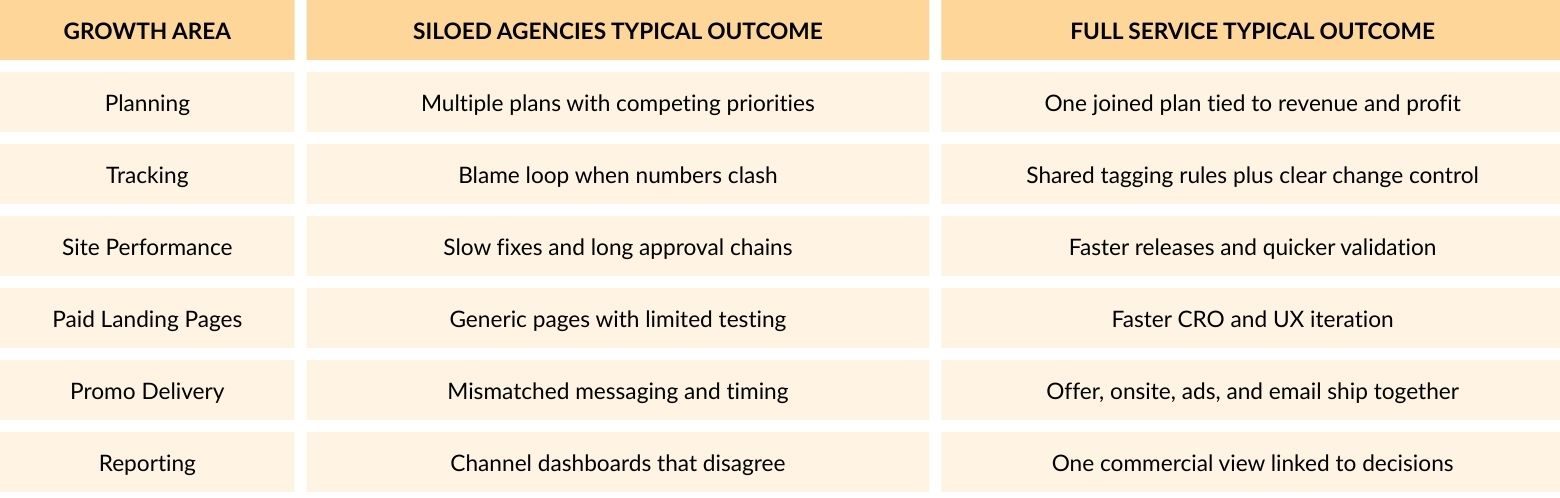
Full Service vs Siloed Agencies: A Practical Comparison
How to Pick an Agency for Growth Without Regret
What Should You Ask an Agency for Growth?
Ask how work runs week to week: planning, tracking, releases, and learning loops. Look for proof of joined delivery across marketing, dev, and analytics. You are hiring the system, not the service list.
Use this shortlist:
- How do you prioritise work against profit, not activity?
- What is your process for tag governance and tracking changes?
- How do you handle landing pages, CRO, and dev work alongside paid?
- How do you link content and SEO to commercial pages and promos?
- Who owns the final number for revenue impact and why?
Red Flags That Look Normal Until They Hurt
- “We can start paying now and fix the site later.”
- “Reporting will improve once we have more data.”
- “Dev work sits on a separate retainer with a different team.”
- “We do SEO and PPC, yet we do not touch tracking.”
If your goal is growth, the agency must be comfortable owning the joins.
Conclusion
A full service approach beats siloed agencies because ecommerce growth lives in the joins: speed, tracking, landing pages, promos, and lifecycle. An agency for growth aligns strategy, execution, and measurement inside one joined plan so improvements stack up and results arrive sooner. If you are tired of managing handoffs and chasing answers, one joined team is often the cleanest route to a profitable scale.