
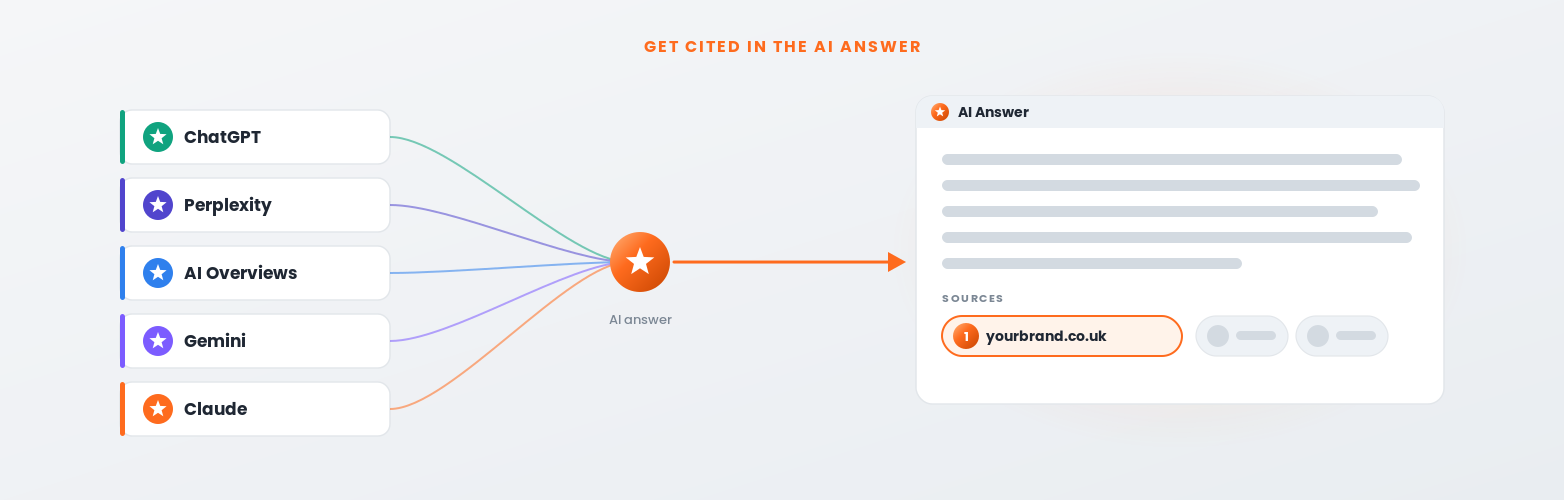
Generative engine optimisation is the practice of structuring your content so that AI answer engines, ChatGPT, Perplexity, Google AI Overviews, Gemini and Claude, quote and recommend it inside the answers they generate. Search is shifting from a list of ten blue links to a single synthesised answer, and if your brand is not in that answer, you are invisible to a fast-growing share of buyers. This guide explains what generative engine optimisation actually is, how AI search really chooses what to cite, and the concrete tactics that get your content pulled into AI answers.
It is written for marketers and store owners who can see AI search coming and want a plain-English plan, not jargon. At 5MS we are a UK eCommerce agency helping brands stay visible as search changes shape.
Year the term GEO was coined
Research paper
AI answer engines to target
ChatGPT, Perplexity, AI Overviews, Gemini, Claude
AI-cited pages that rank in Google’s top 10
The SEO-GEO gap
Of ChatGPT citations point to Wikipedia
Authority matters
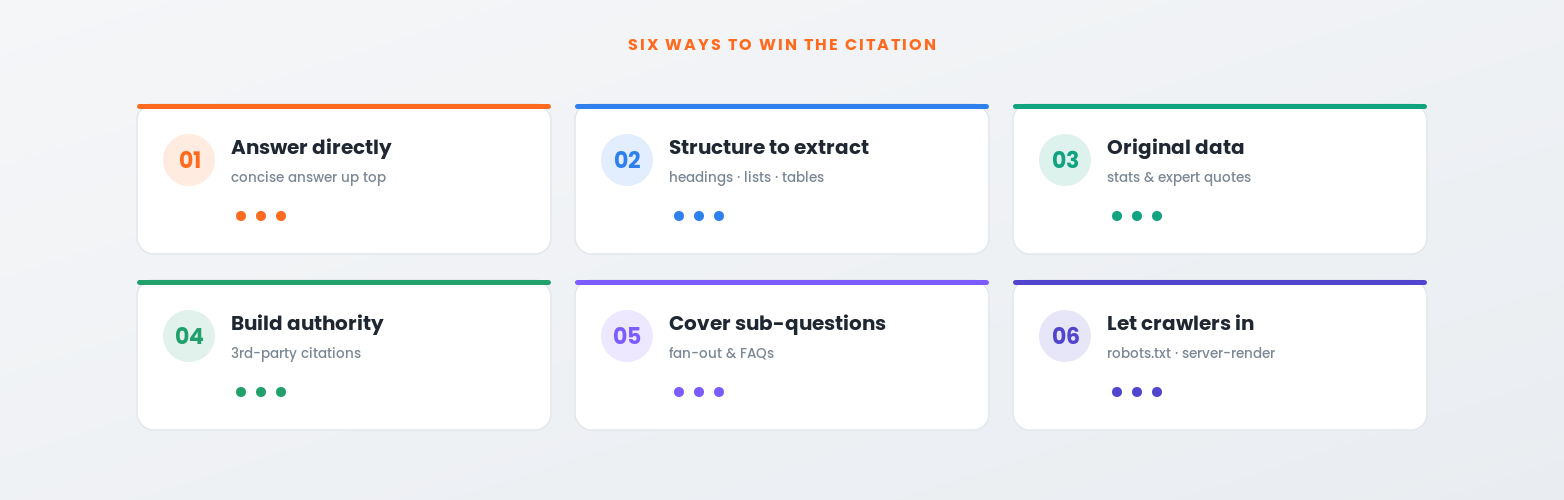
Generative engine optimisation (GEO) is the practice of structuring content so AI answer engines cite and recommend it. AI search retrieves and synthesises passages rather than listing links, so it favours content that answers a question directly, is clearly structured, carries original data and quotes, comes from an authoritative source, and is technically crawlable. To get cited: lead with a direct answer, use headings, lists and tables, add original statistics, build third-party authority, cover the follow-up sub-questions, and let AI crawlers read your pages. GEO sits alongside SEO, it does not replace it.
What Is Generative Engine Optimisation?
Generative engine optimisation, usually shortened to GEO, is the practice of structuring and publishing content so that generative AI answer engines cite it, quote it, or recommend it in the responses they produce. Where traditional SEO aims to rank a page in a list of results, GEO aims to make your content part of the AI’s answer itself. The term comes from a 2023 research paper that first framed optimisation for generative engines as a distinct discipline, and it has moved from academic idea to marketing priority as AI search has gone mainstream.
The mechanism underneath is retrieval-augmented generation (RAG). An AI engine breaks your page into passages, converts them into vectors, and retrieves the passages that are the closest semantic match to a user’s question before synthesising an answer and citing the sources it leaned on. That is why clarity, structure and self-contained claims matter far more for GEO than raw keyword density: the model is looking for the cleanest, most quotable passage that answers the question.
You will see generative engine optimisation called answer engine optimisation (AEO) or AI SEO. The labels differ but the goal is the same: being the source an AI quotes when it answers a question, not just a link it might list.
Why Generative Engine Optimisation Matters Now
More and more searches now end inside an AI answer. Google shows AI Overviews above the classic results, ChatGPT and Perplexity answer questions directly with citations, and a growing share of buyers research products and suppliers without ever clicking a traditional blue link. If AI is doing the summarising, the brands it cites win the attention, and the rest lose visibility they cannot easily win back with old tactics.
The uncomfortable part for anyone who has invested in SEO is that ranking well on Google does not guarantee you get cited by AI. Analyses of AI citations have found that fewer than 10% of the sources cited by tools like ChatGPT, Gemini and Copilot appear in the top 10 organic Google results for the same query. In other words, AI search visibility is a partly separate game, and treating generative engine optimisation as a bolt-on to SEO rather than a parallel discipline leaves citations on the table.
If you assume your Google rankings automatically carry over to AI answers, you will be surprised. The overlap between the two is small, so AI search visibility has to be earned deliberately.
How AI Search Engines Actually Cite Sources
Each engine sources information a little differently, and understanding those differences shapes how you optimise. Two behaviours matter most. First, engines increasingly use fan-out: they break a question into smaller sub-queries, retrieve passages for each, and stitch the answer together, so content that covers the follow-up questions gets cited more. Second, they lean on trusted, well-structured sources, which is why authority and clean formatting punch above their weight.
That superscript citation is the whole game. Generative engine optimisation is the work that puts your domain in that Sources row.
| Engine | How it sources | What it favours |
|---|---|---|
| ChatGPT | Training data plus live web search when enabled | Established reference and media sources; a large share of citations point to Wikipedia |
| Perplexity | Real-time web search on every query, numbered inline citations | Fresh, directly quotable pages that clearly answer the query |
| Google AI Overviews | Draws on Google’s index plus its own ranking signals | A distributed mix of sources; rewards clear, structured, authoritative pages |
| Gemini & Claude | RAG over web and training data | Well-structured, factual content with clear entities and sourcing |
The practical takeaway is that citations are fragmented: research across hundreds of millions of AI citations has found only around 11% of domains are cited by both ChatGPT and Perplexity. You cannot optimise for one engine and assume the rest follow, so GEO works best as broad, source-agnostic quality: clear answers, real authority and clean structure that any engine can trust.
Generative Engine Optimisation Tactics That Get You Cited
These are the practical moves that make content easy for an AI engine to retrieve, trust and quote. None of them is a trick; they are simply what clear, authoritative, well-structured content looks like.
Check your robots.txt for blanket disallows or AI-specific rules (for crawlers such as GPTBot and PerplexityBot). Blocking them may feel like protecting content, but it removes you from AI answers entirely. Decide deliberately, do not block by default.
Schema and Technical GEO
Structured data helps AI engines understand what your content is and how the entities on the page relate, which makes it easier to retrieve and trust. Schema is not a magic switch for citations, but it removes ambiguity, and less ambiguity means more confident use of your content.
Alongside schema, keep the technical basics right: fast, server-rendered pages, a clean site structure, accurate metadata and consistent entity naming. You can validate your markup with tools like Google’s structured data documentation and Schema.org. The same technical hygiene that helps SEO also underpins good generative engine optimisation.
Generative Engine Optimisation for eCommerce
GEO for eCommerce has a sharper edge than for content sites, because AI is increasingly where people compare products and shortlist suppliers. When a shopper asks an AI engine for the best option in your category, you want your brand and products in that answer. That means the same quality signals, applied to commercial pages.
This is also where GEO meets the wider shift toward AI-driven shopping. As agentic AI starts to browse and buy on shoppers’ behalf, being the source those agents trust becomes a commercial channel in its own right, a theme we cover in our guide to AI in eCommerce and our work on agentic commerce.
GEO vs SEO: Do You Still Need Both?
Yes, and they reinforce each other. SEO still drives the traditional organic traffic that converts, and a well-optimised, authoritative, technically sound site is also the foundation AI engines retrieve from. GEO does not replace SEO; it extends it to a new surface where the output is a cited answer rather than a ranked link.
The practical approach is to keep doing strong SEO, the technical health, the authority, the genuinely useful content, and then layer GEO habits on top: direct answers, quotable data, entity clarity, sub-question coverage and crawlability for AI bots. Because the overlap between what ranks and what gets cited is small, doing both is how you stay visible in classic search and in AI answers at the same time. Our eCommerce SEO work now builds GEO in from the start.
When to Use Generative Engine Optimisation Services
You can do a lot of GEO yourself, and much of it is simply good content practice. But generative engine optimisation services earn their keep when you need to move fast, measure AI visibility properly, and treat it as an ongoing programme rather than a one-off audit. Specialist help usually makes sense when you cannot see whether AI engines are citing you, when your content is not being picked up despite ranking well, or when you want GEO built into a wider SEO and content strategy rather than bolted on.
Good generative engine optimisation services do three things: audit your current AI visibility and crawlability, restructure and create content that engines want to cite, and track citations across ChatGPT, Perplexity, Google AI Overviews and the rest so you can prove progress. At 5MS we build this into our wider eCommerce services rather than selling it as a bolt-on. It is early, the tools are maturing, and the brands that start building AI search visibility now will have a real head start as this becomes mainstream.
Want to know if AI search is citing you, and how to change that?
Generative Engine Optimisation, in Short
Generative engine optimisation (GEO) is the practice of structuring content so AI answer engines like ChatGPT, Perplexity and Google AI Overviews cite and recommend it. Because those engines retrieve and synthesise passages rather than listing links, they favour content that answers a question directly, is clearly structured, carries original data and quotes, comes from an authoritative source, and is technically crawlable. To get cited: lead with a direct answer, use headings, lists and tables, add original statistics, build third-party authority, cover the follow-up sub-questions, and make sure AI crawlers can read your pages. Ranking on Google does not guarantee AI citations, so GEO runs alongside SEO as a parallel discipline, and for eCommerce it is quickly becoming a channel in its own right.
Frequently Asked Questions
Common questions about generative engine optimisation. Get in touch if yours is not here.
What is generative engine optimisation?
Generative engine optimisation (GEO) is the practice of structuring and publishing content so that AI answer engines like ChatGPT, Perplexity and Google AI Overviews cite, quote or recommend it in the answers they generate. Where SEO aims to rank a page, GEO aims to make your content part of the AI’s answer itself.
How is GEO different from SEO?
SEO optimises to rank a page in a list of search results; GEO optimises to be cited inside an AI-generated answer. They overlap in that both reward authority, clarity and technical health, but they are not the same: fewer than 10% of AI-cited sources rank in Google’s top 10 for the same query, so GEO is a parallel discipline, not a rename of SEO.
How do I get my content cited by ChatGPT or Perplexity?
Answer questions directly and concisely up top, structure content with clear headings, lists and tables, add original data and quotable statistics, build genuine authority and third-party mentions, cover the follow-up sub-questions, and make sure AI crawlers can access your pages. Clear, authoritative, well-structured content is what engines retrieve and quote.
Does schema help with generative engine optimisation?
Yes, indirectly. Structured data such as Article, FAQPage, Organization and Product schema removes ambiguity about what your content is and how entities relate, which helps engines retrieve and trust it. Schema is not a guaranteed switch for citations, but combined with clear content and technical health it makes your pages easier to use.
Is GEO worth it for eCommerce?
Increasingly, yes. Shoppers use AI to compare products and shortlist suppliers, so being cited when someone asks for the best option in your category is a real commercial advantage. GEO for eCommerce means clear product and buying-guide content, accurate Product and Review schema, and third-party reviews the engines can trust.
Do AI crawlers need special access to my site?
They need to be able to read your pages. Many sites unknowingly block AI crawlers such as GPTBot and PerplexityBot in robots.txt, which removes them from AI answers. Check your robots.txt, decide deliberately which bots to allow, keep key pages server-rendered rather than JavaScript-only, and keep them fast so crawlers can access the content.
Does GEO replace SEO?
No. SEO still drives the organic traffic that converts, and a healthy, authoritative site is the foundation AI engines retrieve from. GEO extends your visibility to AI answers. The smart approach is to keep doing strong SEO and layer GEO habits on top, so you are visible in both classic search and AI answers.
Do I need generative engine optimisation services?
You can start GEO yourself, since much of it is good content practice. Generative engine optimisation services help when you need to measure AI visibility properly, move quickly, and run it as an ongoing programme built into your wider SEO and content strategy rather than a one-off. Starting now gives you a head start while the field is still young.
Related Reading
→Agentic commerce: when AI shops for your customers
→AI in eCommerce: where it actually helps
Sources: GEO: Generative Engine Optimization (research paper), Search Engine Land GEO guide and Google structured data documentation. Citation stats are third-party estimates and this is a fast-moving field, verify before quoting.
By the 5MS team, UK eCommerce agency and Adobe Solution Partner. Last updated: August 2026.