

A new magento agency onboarding can feel like a mix of relief and risk. Relief because you finally have specialist help. Risk because your store is live, revenue is real, and nobody wants a “we’ll tidy it up later” situation that drags on for months.
This guide breaks down what a good first 90 days looks like in real ecommerce terms: who does what, what you should receive, and the points where most agency relationships quietly go wrong.
What Does “New Magento Agency” Mean in Practical Terms?
A new magento agency is the partner that takes ownership of your Magento store’s day to day development and support. They handle delivery, keep the site running smoothly, and make improvements without creating chaos for trading. In the first 90 days, the focus is getting visibility fast, fixing the highest-risk issues, and putting a clear plan in place that ties work back to revenue.
The Reality of a Magento Handover
In most cases you are not walking into a clean build. You are inheriting a live store with existing decisions and ongoing problems, for example:
- Older extensions and custom code that are difficult to update safely
- Patching and maintenance that has been delayed
- Slow page templates that impact SEO and paid performance
- Integrations that can break quietly (ERP, PIM, fulfilment, payments)
- Internal teams needing quick progress without risking downtime

A strong agency works within those constraints and improves the store in a controlled way, while keeping day to day trading protected.
What Should Be Agreed Before Day 1 With a New Magento Agency?
Before you kick off with a new magento agency, agree on access, responsibilities, and decision-making rules. The best onboarding avoids slow starts caused by missing logins, unclear owners, or “can we just squeeze this in” requests that derail priorities. Treat day 1 like you’re setting up a working operating system for delivery.
Day 1 Essentials Checklist
Access and ownership
- Magento Admin (named users, correct roles, 2FA policies)
- Hosting panel, CDN, DNS, WAF, SSL
- Git repo access and deployment pipeline access
- Third-party services: payment gateways, shipping tools, email/SMS, search provider, reviews
- Analytics: GA4, GTM, Merchant Center, Search Console
Commercial Context
- Your trading calendar (launches, promos, peak periods)
- Margin reality (top categories, top SKUs, AOV, returns)
- Non-negotiables: “do not touch checkout this month” type rules
Decision Process
- One business owner for priorities (even if a committee exists)
- Response time agreement for approvals (e.g., “48 hours on ticket questions”)
- A single place for decisions (ticket comments, shared doc, or Jira decision log)
Days 1–30: Discovery Without Disruption
What Should Happen in the First 30 Days With a New Magento Agency?
In days 1–30, a new magento agency should learn the store fast while keeping trading stable. Expect audits across code, hosting, magento performance, security, integrations, and tracking. You should also get a prioritised backlog and a short plan that protects revenue while the team builds confidence in deployments and rollback.
What “Good” Looks Like
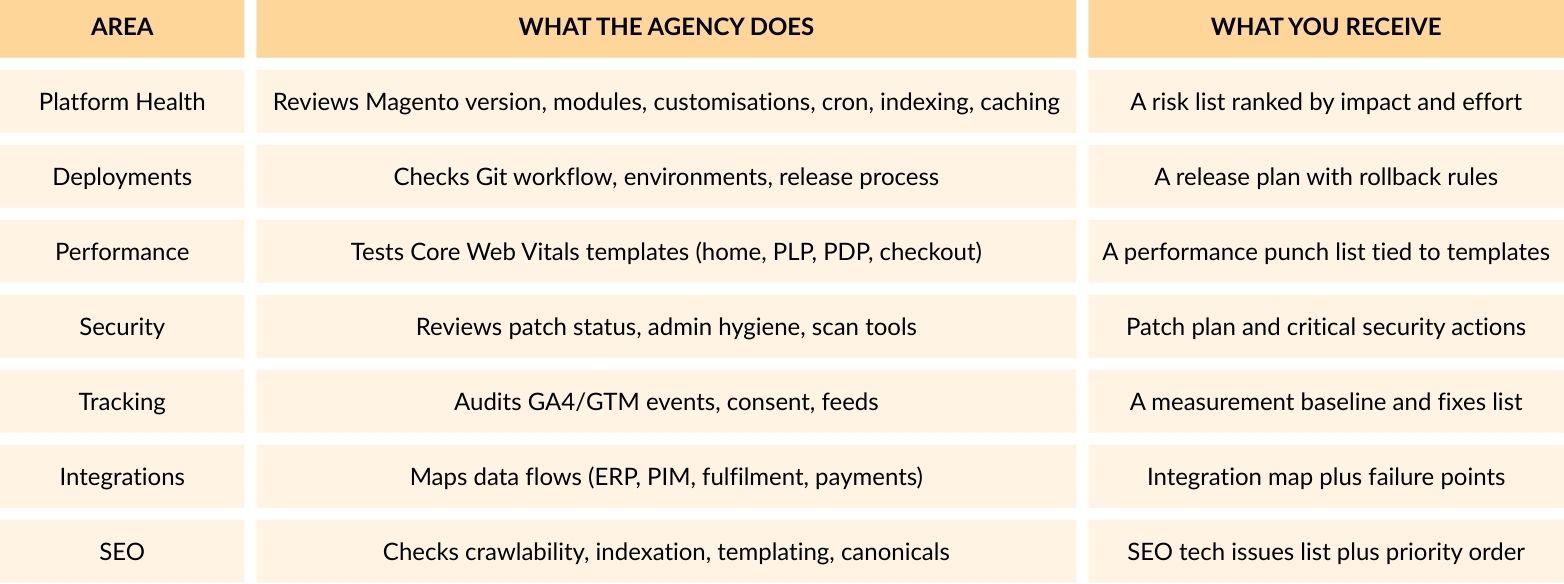
What Audits Should a New Magento Agency Run First?
A new magento agency should run audits that reduce business risk quickly: security and patching, deployment safety, performance on key templates, analytics accuracy, and integration stability. The output should be a ranked list tied to impact on revenue and effort to fix. Avoid audits that create paperwork but no delivery.
1) Security and Patching Reality Check
Adobe’s guidance pushes disciplined patching and testing in non-production environments before release.
What you want the agency to confirm early:
- Current patch status and upgrade path
- Admin user hygiene (no shared logins, correct permissions)
- Security scan cadence and alerting
2) Performance on Templates That Drive Money
Magento performance work fails when teams optimise the wrong pages. A smart audit checks:
- Home page, category listing pages, product detail pages, checkout
- Mobile performance first, since that’s where friction shows up fastest
3) Measurement Baseline and Tracking Integrity
This is the sneaky one competitors gloss over. If tracking is wrong during the handover, every decision afterwards is noisy.
Ask for:
- A documented baseline snapshot (key KPIs + data sources)
- A list of events that are missing, duplicated, or misattributed
- A plan for safe validation (test orders, staging checks)
4) Integration Map and Failure Points
A Magento store is an ecosystem. The agency should map:
- What system owns stock truth
- What system owns price truth
- How orders flow, including refunds and cancellations
- What happens during failure (retries, alerts, manual fallbacks)
You will usually uncover a “quiet failure” process that has been costing money for months.
5) Technical Debt Register That Protects Delivery Speed
A great agency creates a “debt register” that includes:
- What breaks upgrades
- What slows deployments
- What blocks SEO and performance work
- What is safe to leave alone for now
That register becomes your argument for sensible sequencing, especially if stakeholders push for shiny features on day 10.
Days 31–60: Stabilise and Ship the Right Quick Wins
What Changes in Days 31–60 With a New Magento Agency?
In days 31–60, a new magento agency should move into controlled delivery. Expect a stable release rhythm, faster ticket turnaround, and a handful of improvements that you can feel in trading. The work should still avoid risky rewrites, but it should prove momentum with measured wins and clean documentation.
This phase is where the agency earns trust. Not via long meetings, but via reliable delivery.
What You Should See Working by Now
- A consistent sprint or weekly delivery cycle
- A shared backlog with clear priorities and owners
- Predictable releases with QA gates and rollback plan
- Fewer “we need access” blockers
- A short list of decisions waiting on you, not a fog of open questions
What Are the Best Quick Wins a New Magento Agency Can Deliver?
The best quick wins a new magento agency delivers are low-risk changes with visible trading impact: fixing broken tracking, resolving checkout errors, improving template performance, stabilising integrations, and cleaning up feed issues. Quick wins should be measurable, reversible, and tied to a single owner, so they do not become half-finished “improvements” that linger.
A Quick-Win Shortlist Worth Pushing For
- Tracking sanity: Remove duplicated purchase events, fix missing revenue data
- Core Web Vitals basics: Reduce CLS on PDP, tackle LCP images, trim heavy scripts
- Checkout reliability: Fix common payment failures and edge cases
- Release reliability: Introduce a proper pre-release checklist and rollback steps
- Support visibility: Ticket triage rules and a weekly “what shipped” summary
Days 61–90: Roadmap, Delivery Rhythm, and Scale
What Should a New Magento Agency Deliver by Day 90?
A new magento agency should have delivery under control and a clear plan for the next quarter. Expect a prioritised roadmap tied to commercial goals, an operating rhythm your team can keep up with, and documented decisions that make future work faster. You should also have fewer unknowns around risk, integrations, and upgrades.
This is where you stop feeling like you are “handing over” and start feeling like you are building.
What Your 90-Day Outputs Should Include
1) A 90-Day Roadmap That Links Work to Outcomes
Not “improve performance”. Instead:
- “Improve PDP LCP and INP on mobile to reduce bounce and lift add-to-basket rate”
- “Stabilise stock sync to cut oversells and reduce customer service load”
- “Fix checkout error rate on PayPal path, validate via logs and test orders”
2) A Delivery Model That Suits Trading
If your business has weekly promo launches, you need:
- Agreed release windows
- A fast track lane for trading changes
- A safe lane for platform work
3) Documentation You Will Actually Use
- Environment notes and access list
- Integration map and key contacts
- A “how we release” playbook
How Do You Measure Success With a New Magento Agency in 90 Days?
Success with a new magento agency in 90 days is measured by stability, speed of delivery, and evidence of improved trading performance. Look for fewer incidents, safer releases, better site experience metrics, and clearer reporting. The right metrics mix technical health with commercial outcomes, so you avoid “busy work” that never hits revenue.
A Simple Scorecard You Can Use
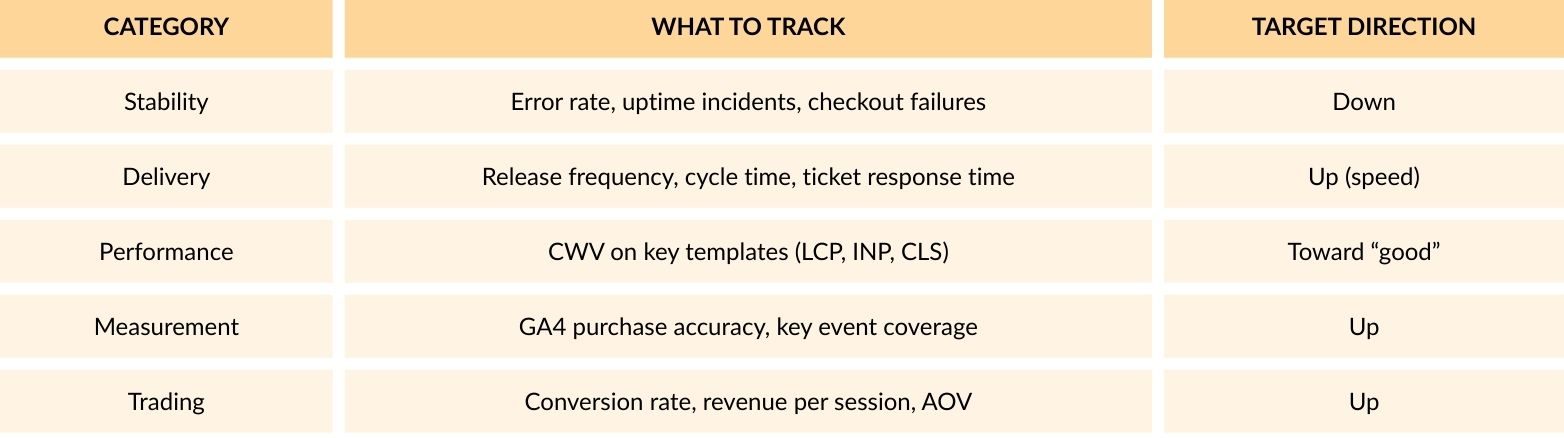
Tip: Keep a “baseline week” early in the handover and compare again at day 60 and day 90. It stops the relationship sliding into opinion-led debates.
Common Mistakes in the First 90 Days
These are the failure points I see most often when a new magento agency takes over.
1) Letting Decisions Bottleneck Delivery
If five people need to approve everything, nothing ships. Assign one owner for priorities. Give the agency a SLA decision. Stick to it.
2) Treating “Audit” as a Month-Long Activity
Audits should lead to ranked actions inside week one and week two. Discovery can run in parallel with delivery. If nothing ships by week four, the plan is off.
3) Not Freezing Risky Work Early
A short feature freeze can save you. Many handovers fail because a big change lands during knowledge transfer, then everyone blames everyone.
4) Ignoring Tracking Until Later
Bad data makes every meeting harder. Fix measurement early so your roadmap is built on truth.
5) Skipping Release Safety Basics
No matter how senior the devs are, the process matters. Patch guidance and staging validation exist for a reason.
Conclusion
A new magento agency should deliver three outcomes in the first 90 days:
- Control: Predictable releases, clear owners, fewer trading issues
- Clarity: Risks ranked by impact, a focused backlog, clean and trustworthy tracking
- Momentum: Measurable quick wins and a prioritised roadmap linked to revenue
By day 90, you should know exactly what’s been fixed, what’s next, who owns it, and how progress will be measured. If those basics are missing, it usually means the work is stuck in analysis, the backlog is driving the business (not the other way round), and results will stay inconsistent.