
Ecommerce marketing tools can make a huge difference to growth, though only when each one earns its place in the stack. The best setups drive more revenue, save team time, improve retention, and give cleaner reporting so you can act with confidence.
Ecommerce teams do not buy tools for fun. They buy them to cut wasted spend, lift conversion rate, improve customer lifetime value, and help smaller teams move faster. Instead of treating all ecommerce marketing tools as equal, this guide looks at the tools that genuinely pull their weight, why they work, where they fit, and what kind of return you should expect to track.
What Are Ecommerce Marketing Tools?
Ecommerce marketing tools are platforms that help online stores attract traffic, convert visitors, retain customers, and measure performance. The strongest ones improve revenue or reduce wasted time and spend in a clear, trackable way.

In practice, that means tools across five areas:
- Measurement
- Acquisition
- Conversion rate optimisation
- Retention
- Automation
The real mistake most brands make is buying too many tools in one area while ignoring another. A store may have five apps for email, popups, and reviews, yet still lack clean attribution, proper event tracking, or any clear view of incremental growth.
How Do You Choose Ecommerce Marketing Tools That Deliver ROI?
Choose ecommerce marketing tools by the commercial problem they solve, the revenue signal they improve, and how well they connect with the rest of your stack. A good tool earns its cost through sales impact, margin protection, or saved operational time.
A tool can look brilliant in a demo and still underperform once it lands in a live ecommerce setup. The issue usually comes down to one of these:
1. The tool solves a weak problem
If a store has low traffic, advanced personalisation software will not suddenly unlock strong revenue growth. In that situation, it makes more sense to fix traffic generation first before adding tools built for later-stage optimisation.
2. Reporting stays messy
If GA4, ad platforms, and the ecommerce platform all show different revenue figures, it becomes hard to trust performance data. That makes ROI difficult to judge and leads to slower, weaker decisions.
3. Teams double up on functionality
Many brands end up paying for several tools that cover very similar features. This adds cost, creates confusion, and makes the stack harder to manage properly.
4. The tool needs strong inputs
Some tools only perform well when the setup behind them is already in good shape. Email platforms need strong segmentation, SEO tools need quality execution, and CRO platforms need enough traffic to produce meaningful results.
5. The team never fully adopts it
A tool can look impressive during the buying stage and still underperform once it lands with the team. A cheaper platform that gets used well often delivers far more value than an expensive one that sits half-finished.
The 15 Best Ecommerce Marketing Tools That Actually Deliver ROI
Below is a practical list of ecommerce marketing tools that repeatedly prove useful for online brands.

1. Google Analytics 4
GA4 remains one of the core ecommerce marketing tools because it gives you the reporting layer needed to judge almost every other tool in the stack. Google’s ecommerce setup supports recommended shopping events like view_item, add_to_cart, and purchase, which feed product and revenue reporting when implemented correctly.
Best use case:
Channel analysis, product performance, funnel leaks
Why it delivers ROI:
Without usable measurement, teams overspend on channels that look good in platform dashboards yet fail to drive profitable growth. GA4 helps tie user behaviour to revenue, which gives every later decision more accuracy.
2. Google Tag Manager
Google Tag Manager rarely gets the spotlight in roundups, though it should. It gives marketing teams more control over tracking without pushing every change through development.
Best use case:
Event setup, pixel management, tracking changes
Why it delivers ROI:
It reduces friction. Faster tracking fixes mean quicker decisions, fewer reporting gaps, and less delay when campaigns go live.
3. Google Search Console
Google Search Console remains one of the most underrated ecommerce marketing tools because it shows real search queries, indexing problems, and click opportunities with zero media spend.
Best use case:
Content planning, category page improvement, indexing checks
Why it delivers ROI:
It helps brands find low-hanging organic wins. That could be a category sitting in positions 6 to 12, or product pages earning impressions without clicks.
4. Ahrefs
Ahrefs earns its place when organic search matters and content needs stronger direction.
Best use case:
Keyword research, link analysis, competitor content gaps
Why it delivers ROI:
It helps teams choose content with purchase intent rather than vanity traffic. That matters far more than writing another top-of-funnel article no one converts on.
5. Semrush
Semrush overlaps with Ahrefs in places, yet many teams prefer it for keyword grouping, visibility tracking, and broader competitive views.
Best use case:
Wider SEO planning, competitor tracking, content mapping
Why it delivers ROI:
It helps large catalogues prioritise. That matters for brands with hundreds or thousands of URLs where “do SEO” is too vague to be useful.
6. Google Ads
Google Ads still ranks among the strongest ecommerce marketing tools for capturing high-intent demand. When someone is ready to compare products, prices, or specific variants, paid search and shopping can close that gap quickly.
Best use case:
Bottom-funnel acquisition, Shopping, branded defence, category search
Why it delivers ROI:
Intent is strong. You are meeting a demand that already exists.
7. Meta Ads Manager
Meta remains strong for product discovery, creative testing, and retargeting. It shines when the brand has good creative, healthy margins, and a site that converts well on mobile.
Adobe reported that mobile accounted for 61.5% of UK online spend during the 2025 holiday period, which supports the case for mobile-first creative, landing pages, and checkout journeys.
Best use case:
Prospecting, retargeting, offer testing, social proof-led campaigns
Why it delivers ROI:
It creates demand earlier in the journey and can re-engage people who did not buy on the first visit.
8. Klaviyo
Klaviyo is one of the most effective ecommerce marketing tools for retention-led growth, especially for brands with healthy order volume and room to improve repeat purchase rate.
Best use case:
Email flows, SMS, segmentation, predictive targeting
Why it delivers ROI:
Automated flows can keep earning long after setup. Welcome, abandoned basket, browse abandonment, post-purchase, and win-back journeys often drive stronger returns than one-off campaigns.
HubSpot reports segmented emails drive 30% more opens and 50% more clickthroughs than unsegmented emails, which lines up with what most ecommerce teams see in practice. Better relevance usually means better revenue.
9. Omnisend
Omnisend works well for brands that want ecommerce-focused retention tools with a simpler setup path.
Best use case:
Smaller teams, email and SMS automation, campaign speed
Why it delivers ROI:
It gives many brands enough retention capability without the heavier learning curve or cost that can come with more advanced enterprise setups.
10. Hotjar
Hotjar helps explain why pages underperform. Analytics can tell you a conversion rate dropped. Hotjar can show where people hesitate, rage click, or abandon the page.
Best use case:
Landing pages, PDP friction, checkout observation
Why it delivers ROI:
It shortens the gap between poor performance and actionable UX fixes.
11. Microsoft Clarity
Microsoft Clarity is one of the best free ecommerce marketing tools for behavioural insight.
Best use case:
Session recordings, heatmaps, frustration signals
Why it delivers ROI:
It costs nothing and often surfaces high-impact UX issues fast.
12. VWO
VWO earns attention when the site has enough traffic to support structured testing.
Best use case:
A/B testing, checkout changes, PDP layout tests
Why it delivers ROI:
It helps teams validate ideas before rolling them across the whole site.
13. Nosto
Nosto is a strong option for merchandising and personalisation. It helps stores guide visitors towards relevant products, categories, and recommendations.
Best use case:
Onsite search, product recommendations, category merchandising
Why it delivers ROI:
It can improve product discovery and average order value, especially on larger catalogues.
14. Yotpo
Yotpo supports reviews, loyalty, and user-generated content, which can all strengthen conversion and retention.
Best use case:
Social proof, loyalty programmes, review collection
Why it delivers ROI:
Trust helps buyers move faster. Loyalty gives existing customers a reason to return again.
15. Triple Whale
Triple Whale suits brands that care about profitability and blended performance, especially across several paid channels.
Best use case:
Attribution, MER, profit-focused reporting
Why it delivers ROI:
It helps teams move beyond platform-reported numbers and look at the business more honestly.
Which Ecommerce Marketing Tools Are Free to Start With Right Now?
Not every ecommerce marketing tool needs a budget on day one. Some of the most useful platforms in the stack are either free or have a free entry point, which makes them ideal for early testing, cleaner reporting, and faster decision-making.
Free tools you can start with right now:
Google Analytics 4
Free to use and essential for understanding traffic, revenue, product performance, and funnel drop-off.
Google Tag Manager
Free and highly useful for managing tracking tags, ecommerce events, and pixels without relying on development for every update.
Google Search Console
Free and one of the best places to find real search queries, indexing issues, and SEO opportunities.
Microsoft Clarity
Free behavioural insight tool with heatmaps, session recordings, and frustration signals that can highlight UX problems quickly.
Google Ads
Not free to run, though free to set up. It still belongs on the shortlist because you can launch quickly once the budget is ready.
Meta Ads Manager
Also free to set up, with spend only starting when campaigns go live. Useful when you want to test creative, audiences, and retargeting.
Some paid tools also offer free trials or limited plans, but the strongest no-cost starting stack for most ecommerce brands looks like this:
- GA4
- GTM
- Search Console
- Clarity
That gives you measurement, tracking control, SEO visibility, and behavioural insight without immediate software cost. For many stores, that is enough to spot the first meaningful revenue gaps before adding paid tools like Klaviyo, Ahrefs, Hotjar, or VWO.
A practical starting point:
If the budget is tight, begin with GA4, GTM, Search Console, and Clarity. Those four tools give most ecommerce brands a strong enough base to measure performance, find issues, and make smarter marketing decisions before investing in more advanced platforms.
Which Ecommerce Marketing Tools Matter Most for Different Store Stages?

The best ecommerce marketing tools depend on stage, traffic level, and team size. Early-stage stores usually need clean tracking, one acquisition channel, and one retention platform. Larger brands need stronger measurement, testing, merchandising, and attribution depth.
A simple way to think about it:
Early-stage stores
Focus on:
- GA4
- GTM
- Search Console
- Google Ads or Meta Ads
- Klaviyo or Omnisend
- Clarity
Growth-stage stores
Add:
- Ahrefs or Semrush
- Hotjar
- VWO
- Yotpo
Mature ecommerce brands
Layer in:
- Nosto
- Triple Whale
- broader experimentation and merchandising tools
That order matters. There is little value in buying advanced personalisation software if basic tracking still breaks every other week.
How Should You Measure ROI Across Ecommerce Marketing Tools?
Measure ROI by linking each tool to one commercial outcome, one efficiency outcome, and one reporting outcome. That gives a clearer picture than chasing one headline metric.
Use a simple framework like this:
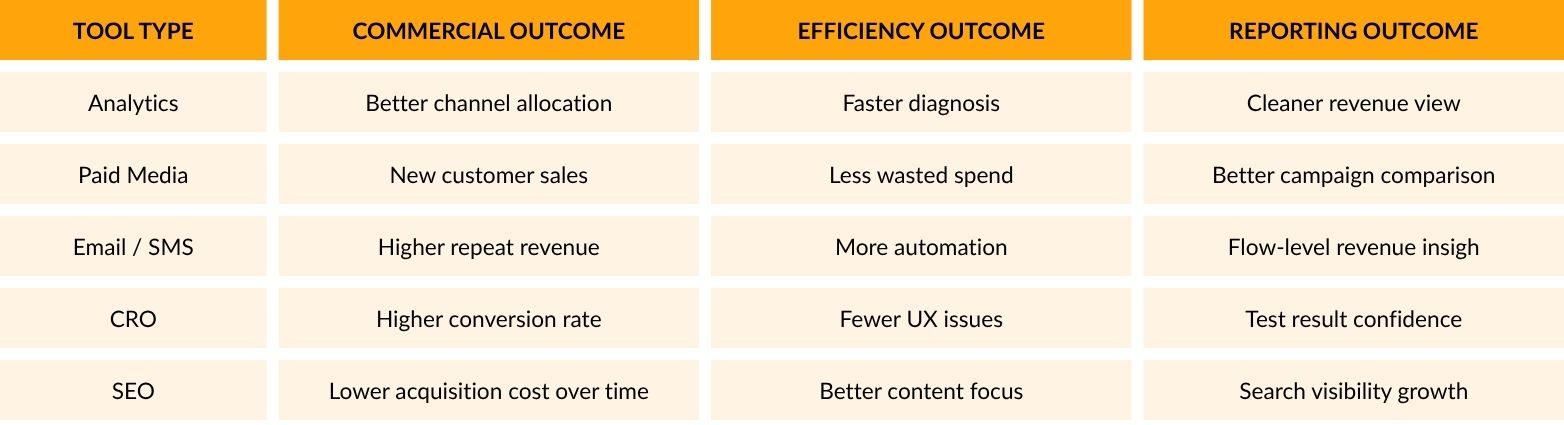
This is the part many teams skip. They ask, “Did the tool generate sales?” A stronger question is, “What changed after implementation, and can we prove it with confidence?”
Conclusion
The best ecommerce marketing tools are the ones that earn their place through revenue impact, operational savings, and better decision-making. For most brands, the strongest stack starts with clean measurement, one or two dependable acquisition channels, and a retention platform that keeps driving repeat revenue. After that, CRO, merchandising, and attribution tools can push growth further.
If a tool cannot clearly improve profit, save time, or sharpen reporting, it probably does not belong in the stack.
- By 5ms