
TikTok has gone from a place people discover products to a place they buy them. In 2024 the platform generated a record 23 billion dollars in revenue, and TikTok Shop is now a serious eCommerce channel in its own right: its global gross merchandise value reached around 33 billion dollars in 2024 and roughly doubled to about 66 billion dollars in 2025. For B2C brands, the question is no longer whether TikTok Shop matters, but how quickly they can get it right.
This guide is the practical version for brands that do not want to get left behind: what TikTok Shop is, how to set it up, how to connect your product catalogue, how live shopping actually drives sales, and what to do first. It also covers how TikTok Shop fits alongside your TikTok ads and the rest of your social commerce strategy, because the brands winning here treat the two as one system.
TikTok’s record revenue in 2024
TikTok Shop global GMV in 2025
How fast Shop GMV grew year on year
More likely to buy during a live than in feed
TikTok Shop is TikTok’s built-in eCommerce marketplace that lets people discover and buy products without leaving the app, through in-feed videos, a shop tab, and live shopping streams. For eCommerce brands it turns TikTok from a top-of-funnel discovery channel into a full checkout. To start, register in the TikTok Shop seller portal, connect your product catalogue (directly or via a platform like Shopify), list your bestsellers, and build a content and live shopping plan. It works best joined up with your TikTok ads and wider social commerce strategy.
The numbers tell the story on their own. TikTok Shop’s global gross merchandise value reached around 33 billion dollars in 2024 and grew to roughly 66 billion dollars in 2025, close to doubling in a single year. That is not a trend to keep an eye on, it is a channel that has already arrived. For context, TikTok as a whole earned a record 23 billion dollars in revenue in 2024, and the shop is the fastest-growing part of that business.
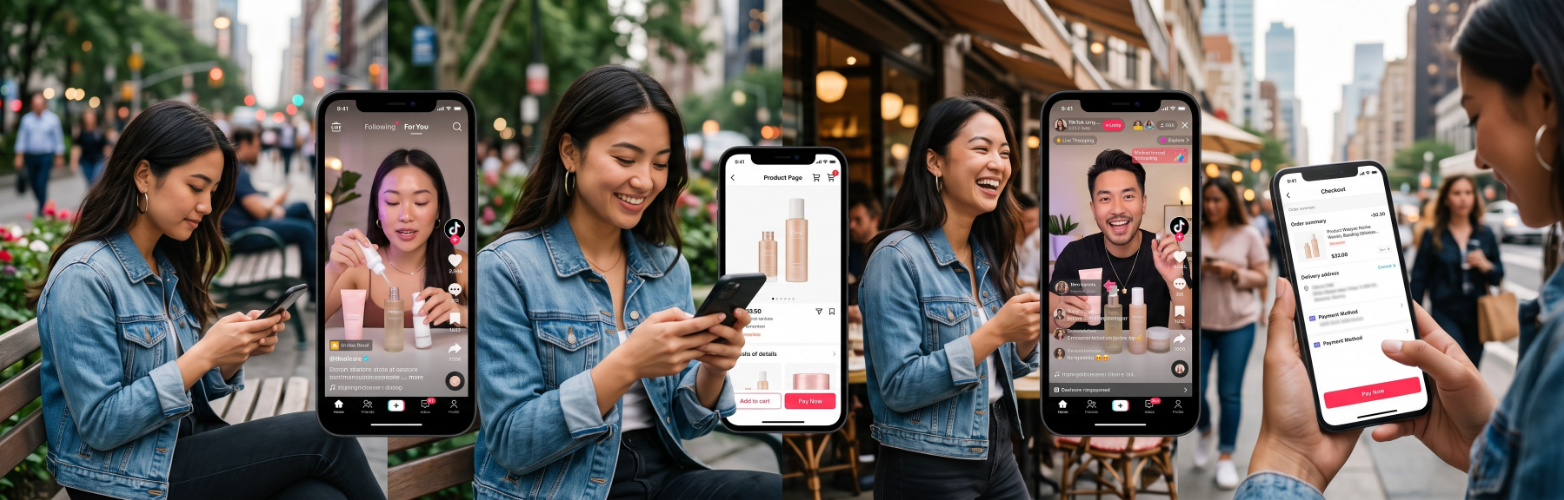
What makes TikTok Shop different from traditional eCommerce is that demand and checkout live in the same place. A shopper discovers a product in a video, taps, and buys without ever leaving the app. There is no landing page, no separate site visit, no drop-off between interest and purchase. That collapsed journey is why products can sell out in hours when a video takes off, and why brands that are not present are quietly losing sales to those that are.
The risk of waiting is not just missed revenue, it is a competitor building an audience, a content engine, and a base of reviews on the platform before you do. The brands that move first establish the creators, the formats, and the customer trust that are hard to catch up on later. Getting started does not require a huge budget, but it does require treating TikTok Shop as a real channel rather than an experiment.
TikTok Shop is the platform’s native eCommerce marketplace. Once your products are listed, shoppers can buy them in several ways without leaving TikTok:
- In-feed video. Shoppable videos with a product link, so a viewer can tap straight from content to a checkout.
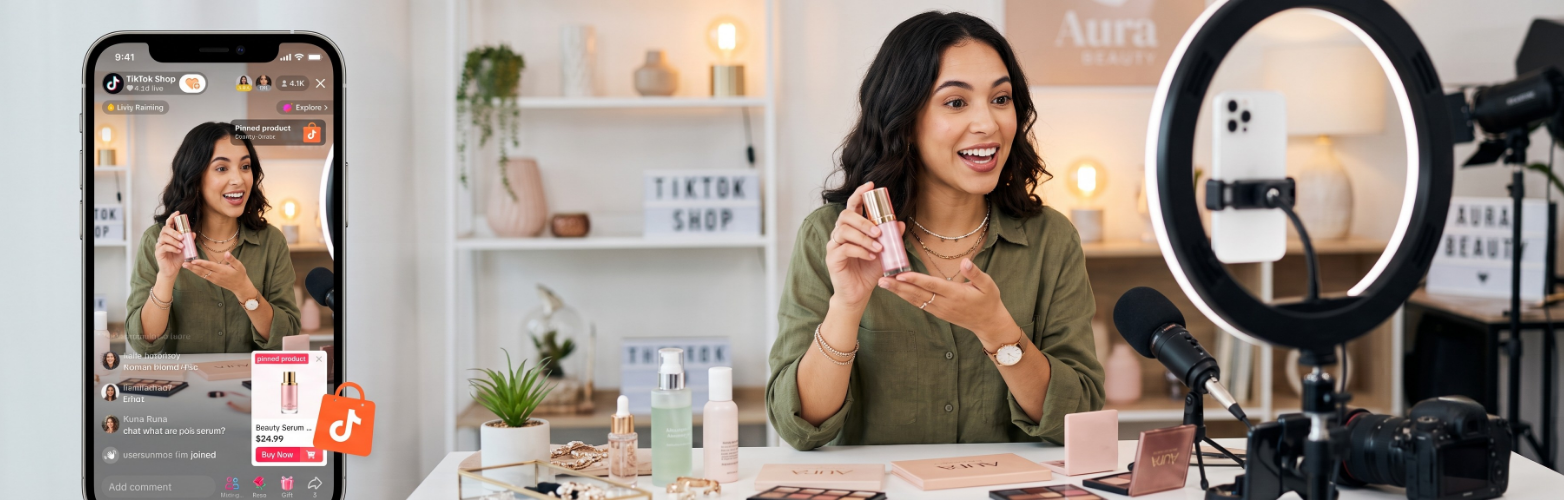
- LIVE shopping. Real-time streams where a host demonstrates products and viewers buy as they watch, pinned to the live.
- Product showcase and shop tab. A storefront on your profile where people can browse your full catalogue.
- Affiliate and creator content. Creators feature your products for a commission, extending your reach to their audiences.
Behind all of this sits the recommendation algorithm that made TikTok famous. It serves your shoppable content to people likely to buy, which means a single strong video can reach far beyond your follower count. TikTok Shop charges a commission on each sale, and the exact fees vary by region and category, so factor them into your margins from the start.
Getting a TikTok Shop live is more straightforward than most brands expect. Approval is often quick once your details are in.
Sign up in the official TikTok Shop seller portal for your region, providing your business details, identification, and bank account. Registration as a business is usually approved quickly.
Add your logo, a clear shop description, and consistent branding. Keep it mobile-first, because almost everyone will see it on a phone.
Start with your top five products, each with strong images, keyword-rich descriptions, accurate pricing, and a fulfilment method set. You do not need the whole catalogue on day one.
Set your shipping options, link your product catalogue, and publish. Then start posting shoppable content and planning your first live.
How you get products into TikTok Shop matters more than it first appears, because it affects how much manual work you carry forever. You have two broad routes: list products manually, or integrate your existing store so the catalogue and stock sync automatically.
For anything more than a handful of products, integration is the right answer. TikTok Shop connects with major eCommerce platforms, including a direct Shopify integration and connectors for other systems, so your products, prices, and inventory stay in sync without double entry. This prevents the most common and damaging mistake on the platform: selling stock you do not have because the channels are out of step.
When you connect the catalogue, treat it as a chance to optimise rather than just copy across. Product titles and descriptions should use the words people search on TikTok, images need to work at a glance on a small screen, and your bestsellers should be front and centre. If your store runs on a platform that needs custom integration work, our eCommerce development team handles catalogue and inventory sync as part of wider growth projects.
Live shopping is the format that sets TikTok Shop apart from a normal online store. In a LIVE stream, a host demonstrates products, answers questions in real time, and pins items for viewers to buy as they watch. The combination of demonstration, scarcity, and human interaction converts unusually well: industry data suggests shoppers are around 1.7 times more likely to buy during a live than from a standard in-feed video, and live sessions consistently outperform feed content on conversion.
A few principles make live shopping work:
- Go long and go regular. Longer, frequent streams give the algorithm time to bring in viewers and let momentum build. One-off short lives rarely perform.
- Demonstrate, do not just talk. Show the product in use, before and after, and on real people. Live is for proof, not a sales script.
- Create urgency. Limited-time offers and live-only bundles give viewers a reason to buy now rather than later.
- Answer questions live. Responding to comments in real time removes the doubts that stop people buying and builds trust fast.
- Partner with creators. A skilled live host with an engaged audience often outperforms an in-house stream, especially early on.
Live shopping rewards consistency. The first few streams are about learning your audience and format; the returns come from showing up regularly and refining what works.
It is easy to feel you have to do everything at once. You do not. The brands that succeed on TikTok Shop start narrow and build, rather than spreading themselves thin. If you are a B2C brand starting from scratch, this is the order that works:
- Pick the right hero products. Choose a few items that demonstrate well on video and sit at an impulse-friendly price point, rather than your entire range.
- Set up the shop and integrate the catalogue. Get the foundations right so stock and pricing stay accurate from day one.
- Post native, creator-style content. Make videos that fit the feed, not repurposed adverts, and post consistently to learn what resonates.
- Work with creators and affiliates. Tap into existing audiences and authentic voices rather than relying solely on your own following.
- Test live shopping. Run regular lives once you understand your audience, treating the early ones as paid learning.
- Measure and double down. Track which products, creators, and formats drive sales, and put more behind the winners.
The goal in the first few months is learning, not perfection. Treat early spend and effort as the cost of understanding a channel that is still cheaper to win on than the more mature platforms.
TikTok Shop is not a standalone tactic. It works hardest as part of your wider social commerce strategy, where organic content, creators, and the shop reinforce one another. The organic videos that perform best are also the ones worth putting budget behind, and the shop turns all of that attention into sales in the same place.
This is where TikTok ads come in. Paid promotion can amplify your best shoppable content and lives, putting them in front of more buyers than organic reach alone. Because TikTok tends to carry a lower headline return than search-driven channels, it is best understood as buying discovery and demand, which is exactly what the shop then converts. Our eCommerce paid media guide covers how TikTok ads fit alongside Meta and Google in a balanced budget.
Joined up, the picture is simple: organic and creator content builds reach, paid media amplifies the winners, the shop converts in-app, and the customers you gain feed your email and retention so each one is worth more over time. If you want help wiring TikTok Shop into that system, a free eCommerce growth audit is a good first step.
- TikTok Shop has become a major eCommerce channel, with global GMV roughly doubling to about 66 billion dollars in 2025.
- Its edge is that discovery and checkout happen in the same place, collapsing the journey from interest to purchase.
- Setup is quick: register in the seller portal, brand your storefront, list bestsellers, and connect fulfilment.
- Integrate your catalogue rather than listing manually, so products, pricing and stock stay in sync.
- Live shopping converts strongly, with shoppers around 1.7 times more likely to buy during a live than in feed.
- Treat TikTok Shop as part of one system with TikTok ads, social commerce, email and retention.
TikTok Shop is TikTok’s built-in marketplace, and it has grown into a serious eCommerce channel, with global GMV roughly doubling to about 66 billion dollars in 2025. To win, register in the seller portal, brand your storefront, and connect your product catalogue so stock and pricing stay in sync. List your bestsellers, post native creator-style content, and test live shopping, which converts strongly because shoppers are around 1.7 times more likely to buy during a live. Treat the shop as part of one system with your TikTok ads, social commerce, email and retention, and move now while the channel is still cheaper to win on than the mature platforms.
Common questions about TikTok Shop for eCommerce. Get in touch if yours is not here.
We help eCommerce brands set up TikTok Shop, integrate their catalogue, and join it up with paid media, social commerce and retention. Book a free consultation and we will map out your route in.