
@import url(‘https://fonts.googleapis.com/css2?family=Poppins:wght@400;500;600;700;800;900&display=swap’);
details.ms-faq summary{list-style:none;cursor:pointer;}
details.ms-faq summary::-webkit-details-marker{display:none;}
details.ms-faq .ms-arr{display:block;width:8px;height:8px;border-right:2px solid #FE6B1E;border-bottom:2px solid #FE6B1E;transform:rotate(45deg) translate(-2px,-2px);}
details.ms-faq .ms-ico{flex-shrink:0;width:32px;height:32px;min-width:32px;border-radius:50%;border:1px solid;display:flex;align-items:center;justify-content:center;}
details.ms-faq .ms-qtxt{font-family:’Poppins’,system-ui,sans-serif;font-size:1rem;font-weight:700;line-height:1.4;}
details.ms-faq{background:#161616!important;border-color:#2A2A2A!important;}
details.ms-faq[open] .ms-arr{border-right-color:#FFFFFF;border-bottom-color:#FFFFFF;transform:rotate(225deg) translate(-2px,-2px);}
details.ms-faq[open] .ms-ico{background:linear-gradient(135deg,#FFB37A 0%,#FE6B1E 35%,#C84500 100%)!important;border-color:#FE6B1E!important;}
details.ms-faq[open] .ms-qtxt{color:#FE6B1E!important;-webkit-text-fill-color:#FE6B1E!important;}
details.ms-faq[open]{background:#1A1005!important;border-color:rgba(254,107,30,0.40)!important;}
ol.ms-toc{counter-reset:toc;padding:0;margin:0;list-style:none;display:grid;grid-template-columns:1fr 1fr;gap:6px 28px;}
ol.ms-toc li{counter-increment:toc;position:relative;padding:4px 0 4px 44px;list-style:none;font-family:’Poppins’,system-ui,sans-serif;font-size:14px;font-weight:500;}
ol.ms-toc li::before{content:counter(toc,decimal-leading-zero);position:absolute;left:0;top:4px;color:#FE6B1E;font-weight:800;font-size:11px;background:rgba(254,107,30,0.10);padding:2px 7px;border-radius:5px;border:1px solid rgba(254,107,30,0.35);}
li.ms-tk{position:relative;padding:10px 0 10px 36px;border-bottom:1px solid #1E1E1E;list-style:none;font-family:’Poppins’,system-ui,sans-serif;font-size:15px;line-height:1.6;color:#FFFFFF;-webkit-text-fill-color:#FFFFFF;}
li.ms-tk::before{content:”\2713″;position:absolute;left:0;top:12px;width:22px;height:22px;background:linear-gradient(135deg,#FFB37A 0%,#FE6B1E 35%,#C84500 100%);color:#FFFFFF;border-radius:50%;display:flex;align-items:center;justify-content:center;font-size:12px;font-weight:800;}
li.ms-bul{position:relative;padding:5px 0 5px 22px;list-style:none;font-family:’Poppins’,system-ui,sans-serif;font-size:15px;line-height:1.65;color:#D8D8D8;-webkit-text-fill-color:#D8D8D8;}
li.ms-bul::before{content:””;position:absolute;left:7px;top:14px;width:7px;height:7px;border-radius:50%;background:#FE6B1E;}
@media(max-width:700px){ol.ms-toc{grid-template-columns:1fr!important;}.ms-sg{grid-template-columns:1fr 1fr!important;}.ms-fg{grid-template-columns:1fr!important;}.ms-2c{grid-template-columns:1fr!important;}}
#ms-blog-root p{text-align:justify;text-justify:inter-word;hyphens:auto;-webkit-hyphens:auto;}
details.ms-faq p,details.ms-faq .ms-qtxt{text-align:left;}
ol.ms-rr{padding:0;margin:0;list-style:none;}
ol.ms-rr li{position:relative;padding:16px 0 16px 28px;border-bottom:1px solid #1E1E1E;}
ol.ms-rr li::before{content:”\2192″;position:absolute;left:0;top:16px;color:#FE6B1E;-webkit-text-fill-color:#FE6B1E;font-weight:700;font-family:’Poppins’,system-ui,sans-serif;}
ol.ms-rr a{color:#FE6B1E;-webkit-text-fill-color:#FE6B1E;text-decoration:none;font-family:’Poppins’,system-ui,sans-serif;font-size:16px;font-weight:500;line-height:1.5;}
When sales are flat, the instinct is to spend more on ads. It feels like action, and it is what most agencies will happily sell you. But pouring traffic into a store that does not convert is like filling a leaking bucket: you pay for more water and most of it drains away. The faster, cheaper and more durable path to growth is almost always to fix the foundation first. When we do that for 5MS clients, the results speak for themselves: one saw revenue rise 60% and purchases jump 74% without simply buying more traffic.
This is the 5MS philosophy on eCommerce growth strategy, and the order it demands: foundation, then traffic, then scale, always in that sequence. This guide explains why that order matters, the conversion maths that makes it undeniable, what a strong foundation actually looks like, and when it is finally time to pour on the traffic.
Revenue uplift for a 5MS client
More purchases after foundation work
CVR uplift from foundation work
Orders from doubling CVR, same spend
A sound eCommerce growth strategy fixes the foundation before increasing ad spend, then adds traffic, then scales, in that order. The foundation is your site speed, UX, product pages, checkout and retention: the things that decide how many visitors actually buy. Improving conversion works on traffic you already pay for, so it is faster and cheaper than buying more. Doubling your conversion rate doubles revenue from the same spend, which is why fixing the foundation beats simply increasing ad spend almost every time.
More ad spend is the most expensive way to grow, and often the least effective. It buys you more visitors, but if your store converts poorly, most of those hard-won, paid-for visitors leave without buying. You are renting traffic to fill a leaking bucket, and the moment you stop paying, the growth stops with it.
The economics have got worse, too. Average return on ad spend across eCommerce has been drifting down, sitting around 2.87x in 2025, as auctions get more competitive and tracking weakens. Buying your way to growth costs more every year. Meanwhile, the average cart abandonment rate sits at around 70%, most of it caused by fixable friction. That gap between the traffic you already have and the sales you actually make is where the real growth is hiding.
Fixing the foundation attacks that gap directly. Improving your conversion rate, speed and retention works on the visitors you have already paid for, so every gain compounds across all your traffic and every future campaign. It is why one 5MS client grew revenue 60% and purchases 74% by making the store convert better, not by buying more clicks. Foundation work is the cheapest growth you will ever buy, and unlike ad spend, it keeps paying after you stop.
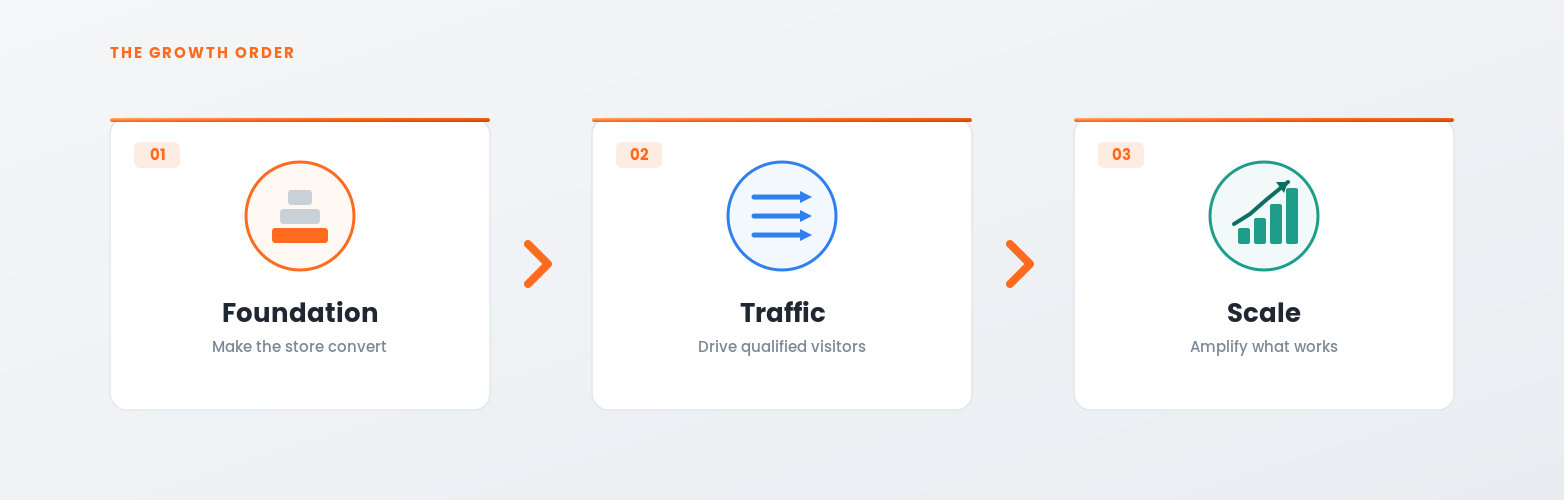
Growth has an order, and getting it wrong wastes money. The 5MS framework is simple and non-negotiable: foundation, then traffic, then scale.
Fix speed, UX, product pages, checkout and retention so a high share of visitors buy and come back. This multiplies the value of every visitor you already have and every one you will ever acquire.
Only once the store converts well do you turn on paid media, SEO and social to bring in more of the right people. Now every pound of traffic spend lands on a store built to make the most of it.
With a converting store and profitable channels proven, scale spend on the winners, expand to new channels and markets, and reinvest the higher margins the foundation created. Scaling a broken store just scales the losses.
The mistake most struggling stores make is starting at step two or three while step one is broken. It is the most common and most expensive error in eCommerce, and reversing the order is usually the single most valuable change we make.
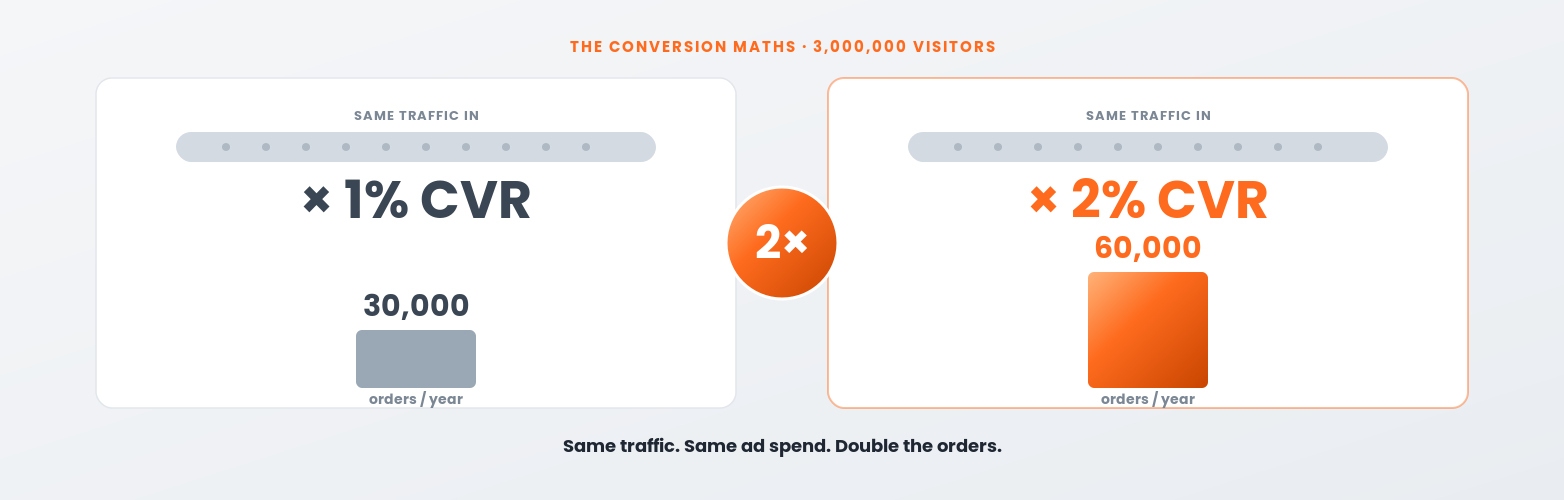
Here is the maths that makes the whole argument undeniable. Imagine a store that receives three million visitors a year. At a 1% conversion rate, that is 30,000 orders. Lift the conversion rate to 2%, and the same three million visitors produce 60,000 orders. That is 30,000 extra orders a year, a doubling of sales, from the exact same traffic and the exact same ad spend.
3,000,000 visitors × 2% CVR = 60,000 orders
Same traffic, same spend, 30,000 extra orders a year
To get the same result through traffic alone, you would have to double your ad budget, and eat the rising cost of every extra click. The conversion route costs a fraction of that and, once made, the improvement applies to all your traffic forever, paid and organic alike.
This is why conversion rate is the highest-leverage number in your business. A one percentage point gain does not add a little; on a store of any scale it can transform the P&L. It is also why we start every engagement by finding where conversion is leaking, through a structured review of speed, UX and checkout, before recommending a penny more on ads.
Foundation is not a vague idea; it is a specific set of things that decide whether visitors turn into buyers and buyers into repeat customers. Get these right and the store is ready to scale.
- Speed and Core Web Vitals: fast pages on mobile, because slow sites lose sales before UX even begins. See our performance guide.
- UX and navigation that let people find and choose products with confidence, covered in our eCommerce UX guide.
- Product pages that answer every question and remove every doubt before the add-to-cart.
- A checkout with guest purchase, no surprise costs and minimal fields, since this is where most sales are lost.
- Conversion rate optimisation as an ongoing habit, tested and measured, not a one-off. See our CRO guide.
- Retention and email flows that turn one-time buyers into repeat customers and raise lifetime value.
- Reliable tracking and analytics, so you can actually see what is working and what is leaking.
Retention feeds the foundation loop: higher lifetime value means you can afford to spend more to acquire customers, which lets you outbid competitors once you do turn on traffic. The foundation does not just convert better, it makes your future ad spend more powerful.
None of this means ads are bad. Paid media is a powerful growth engine, but only once the store is ready to convert the traffic profitably. The point is sequence, not exclusion. So how do you know the foundation is solid enough to start scaling?
- Your conversion rate is healthy for your sector, and you have fixed the obvious friction in speed, UX and checkout.
- You know your numbers, including conversion rate, average order value and customer lifetime value, so you can calculate what you can afford to spend to acquire a customer.
- Retention is working, so acquired customers come back and each one is worth more than a single order.
- A test campaign is profitable, proving the store converts paid traffic at a return you are happy with before you scale the budget.
When those boxes are ticked, scaling is a joy rather than a gamble, because you are amplifying a machine that already works. Turn on paid media, expand into new channels, and reinvest the extra margin the foundation created. Not sure which stage you are at? A free eCommerce growth audit will show you exactly where your foundation stands and what to fix first.
- More ad spend is the most expensive way to grow; fixing the foundation is faster, cheaper and lasts.
- Follow the order every time: foundation, then traffic, then scale. Scaling a broken store scales the losses.
- On three million visitors, lifting CVR from 1% to 2% means 30,000 extra orders a year from the same spend.
- The foundation is speed, UX, product pages, checkout, CRO and retention, plus reliable tracking.
- Retention compounds the foundation: higher lifetime value lets you outbid competitors when you do scale.
- Fixing the foundation grew one 5MS client’s revenue 60% and purchases 74% without simply buying more traffic.
The most effective eCommerce growth strategy fixes the foundation before increasing ad spend, then adds traffic, then scales, in that order. The foundation, your speed, UX, product pages, checkout, CRO and retention, decides how many visitors buy, and improving it works on traffic you already pay for. The maths is stark: on three million visitors, lifting conversion from 1% to 2% adds 30,000 orders a year with no extra spend. That is why fixing the foundation beats buying more traffic almost every time, and why doing it grew one 5MS client’s revenue 60% and purchases 74%.
Common questions about eCommerce growth strategy. Get in touch if yours is not here.
We find where your store is leaking revenue, fix the foundation, and only then scale the traffic, the order that grew one client’s revenue 60%. Book a free consultation and we will show you where to start.
{
“@context”: “https://schema.org”,
“@graph”: [
{
“@type”: “BlogPosting”,
“headline”: “eCommerce Growth Strategy: Fix the Foundation First”,
“description”: “Why fixing your eCommerce foundation beats increasing ad spend: the foundation, traffic, scale framework, the conversion maths, and what a strong foundation looks like.”,
“author”: {
“@type”: “Organization”,
“name”: “5MS”,
“url”: “https://5ms.co.uk/”
},
“publisher”: {
“@type”: “Organization”,
“name”: “5MS”,
“url”: “https://5ms.co.uk/”
},
“datePublished”: “2026-06-24”,
“dateModified”: “2026-06-24”,
“keywords”: “ecommerce growth strategy, ecommerce foundation, fix ecommerce before scaling, ecommerce revenue growth, scale ecommerce”,
“mainEntityOfPage”: {
“@type”: “WebPage”,
“@id”: “https://5ms.co.uk/ecommerce-growth-strategy/”
}
},
{
“@type”: “FAQPage”,
“mainEntity”: [
{
“@type”: “Question”,
“name”: “What is an eCommerce growth strategy?”,
“acceptedAnswer”: {
“@type”: “Answer”,
“text”: “An eCommerce growth strategy is a plan for growing online revenue sustainably. A sound one fixes the foundation, your site speed, UX, checkout and retention, before increasing ad spend, then adds traffic, then scales. The order matters because improving conversion works on traffic you already have, making it far cheaper and more durable than simply buying more.”
}
},
{
“@type”: “Question”,
“name”: “Should I fix my site before increasing ad spend?”,
“acceptedAnswer”: {
“@type”: “Answer”,
“text”: “Almost always, yes. Driving more paid traffic to a store that converts poorly wastes most of that spend, because the extra visitors leave without buying. Fixing conversion first means every future click works harder, applies to all your traffic at once, and keeps paying after you stop spending, whereas ad-driven growth stops when the budget does.”
}
},
{
“@type”: “Question”,
“name”: “What does foundation mean in eCommerce?”,
“acceptedAnswer”: {
“@type”: “Answer”,
“text”: “The foundation is everything that decides whether visitors buy and come back: site speed and Core Web Vitals, UX and navigation, product pages, checkout, conversion rate optimisation, retention and email, and reliable tracking. These are the parts of the store that multiply the value of every visitor, which is why they come before traffic and scale.”
}
},
{
“@type”: “Question”,
“name”: “How much difference does conversion rate make?”,
“acceptedAnswer”: {
“@type”: “Answer”,
“text”: “An enormous difference, because it multiplies across all your traffic. On three million visitors a year, lifting conversion from 1% to 2% is the difference between 30,000 and 60,000 orders, a doubling of sales from the same spend. To achieve the same through traffic you would have to double your ad budget and absorb rising click costs.”
}
},
{
“@type”: “Question”,
“name”: “Why is more ad spend not always the answer?”,
“acceptedAnswer”: {
“@type”: “Answer”,
“text”: “Because it only adds visitors; it does not fix how many of them buy. If your store converts poorly, more spend just means more paid visitors leaving without purchasing, and ad costs have been rising while average returns fall. Ad-driven growth also stops the moment you stop paying, whereas foundation improvements keep working across all traffic indefinitely.”
}
},
{
“@type”: “Question”,
“name”: “In what order should I grow my eCommerce store?”,
“acceptedAnswer”: {
“@type”: “Answer”,
“text”: “Foundation, then traffic, then scale, in that order. First make the store convert with speed, UX, checkout and retention work. Then drive qualified traffic to a store built to make the most of it. Finally, scale spend on the channels proven profitable. Starting at traffic or scale while the foundation is broken is the most common and expensive mistake in eCommerce.”
}
},
{
“@type”: “Question”,
“name”: “When should I scale my eCommerce store?”,
“acceptedAnswer”: {
“@type”: “Answer”,
“text”: “Scale once your conversion rate is healthy, you know your numbers, retention is working, and a test campaign is profitable. At that point you are amplifying a machine that already works rather than gambling. Scaling before those conditions are met simply multiplies the losses from a store that does not convert.”
}
},
{
“@type”: “Question”,
“name”: “How do I know if my foundation is strong enough to scale?”,
“acceptedAnswer”: {
“@type”: “Answer”,
“text”: “Check the signals: a healthy conversion rate for your sector, no obvious friction in speed, UX or checkout, working retention, and a test campaign that returns a profit you are happy with. If you are unsure, a structured growth audit will show exactly where your foundation stands and what to fix before you scale.”
}
}
]
},
{
“@type”: “BreadcrumbList”,
“itemListElement”: [
{
“@type”: “ListItem”,
“position”: 1,
“name”: “Home”,
“item”: “https://5ms.co.uk/”
},
{
“@type”: “ListItem”,
“position”: 2,
“name”: “Blog”,
“item”: “https://5ms.co.uk/blog/”
},
{
“@type”: “ListItem”,
“position”: 3,
“name”: “eCommerce Growth Strategy: Fix the Foundation First”,
“item”: “https://5ms.co.uk/ecommerce-growth-strategy/”
}
]
}
]
}