

Choosing an eCommerce agency is one of the highest-stakes decisions a store owner makes. The right partner compounds your growth for years; the wrong one drains budget, stalls your roadmap and leaves you starting over. Yet most brands pick on gut feel, a slick pitch or the lowest quote, and regret it. This guide gives you a proper decision framework instead: how to weigh generalists against specialists, what to look for at your business size, and a scorecard to evaluate candidates objectively rather than emotionally.
It is written for the person who has to make the call and live with it. Work through it and you will walk into agency conversations knowing exactly what to ask, what to score, and what would be a deal-breaker, so you choose with evidence, not hope.
Criteria to score every agency on
The scorecard
Business stages, different priorities
Startup to enterprise
Transparency you should demand
Time and results
Decision you will live with for years
Choose with evidence
To choose the right eCommerce agency, judge candidates against a consistent scorecard rather than the pitch: relevant expertise and platform fit, a track record with proof, transparency on time and cost, accountability for results, communication and responsiveness, cultural fit, and commercial structure. Decide whether you need a generalist or a specialist, and weight the criteria to your business size, startups prioritise value and speed, scaling brands prioritise growth expertise, enterprises prioritise depth and reliability. Score two or three shortlisted agencies, ask the hard questions, watch for red flags like opacity and lock-in, and choose on evidence.
Your eCommerce agency has more influence over your revenue than almost any other supplier you choose. They shape how fast your store loads, how well it converts, how secure it is, and how quickly you can act on opportunities. Get the choice right and that influence compounds in your favour for years. Get it wrong and the same influence works quietly against you, while the switching costs keep you stuck longer than you should be.
The reason so many brands choose badly is that they evaluate on the wrong things. A polished pitch, an impressive client logo, a low quote or a good first meeting all feel like signals, but none of them tells you whether the agency will deliver results, communicate well, or still be a good fit in two years. The pitch is the best the agency will ever look; what matters is what the working relationship is like once the contract is signed.
The fix is to replace gut feel with a framework. Decide what you actually need, define the criteria that predict a good partnership, score each candidate against them consistently, and make the hard questions and red flags part of the process rather than an afterthought. That is what the rest of this guide gives you. It will not make the decision for you, but it will make sure you are deciding on evidence.
The first real fork is whether you need a generalist marketing agency or an eCommerce specialist. They are not the same thing, and picking the wrong type is a common, expensive mistake. A generalist covers many disciplines across many industries; a specialist lives and breathes online stores, their platforms, and the mechanics of converting and retaining shoppers.
For most stores, a specialist wins, because eCommerce is unforgiving and the details matter. You want a partner who already knows your platform, has seen your problems before, and does not need to learn the fundamentals of online retail at your expense. A generalist can make sense if commerce is a small part of a broader brand programme, but if the store is the business, choose the agency that specialises in stores.
These are the seven things that predict whether an agency relationship will work. They form the backbone of the scorecard later. Assess every candidate against all seven rather than being dazzled by strength in just one.
Do they genuinely know your platform (Magento, WooCommerce, Shopify) and your type of business? Deep, relevant expertise is the single biggest predictor of results and the fewest costly mistakes.
Case studies, results and references from businesses like yours. Look for real numbers and outcomes, not just pretty screenshots, and ask to speak to a current client.
Will you see where your budget and hours actually go? Opacity removes accountability. Insist on clear reporting and a breakdown of what you are paying for.
Do they tie their work to your commercial outcomes, or just to deliverables? A good agency talks about revenue, conversion and growth, not only tasks completed.
How quickly and clearly do they respond, and who is your point of contact? Communication during the sales process is the best preview of what it will be like as a client.
You will work closely for a long time. Do their values, pace and communication style fit yours? A capable agency you cannot work with is not the right agency.
Fair, flexible terms, and no lock-in. You should own your code, hosting and data, and be able to leave if it is not working. Beware anyone who makes exit difficult.
The seven criteria always apply, but their weighting shifts with your stage. A startup and an enterprise need different things from an agency, and matching the agency’s strengths to your stage is half the battle.
| Stage | Prioritise | Watch out for |
|---|---|---|
| Startup / small | Value, speed to launch, flexibility, a partner who does not overcharge for scope you do not need | Agencies geared to enterprise budgets, or freelancers with no continuity |
| Scaling / mid-sized | Growth expertise, CRO and retention, proactivity, and the ability to scale with you | Order-takers who only do what is asked, with no strategy or roadmap |
| Enterprise / high-volume | Technical depth, reliability, security, senior team access and proven scale | Small teams stretched too thin, or juniors doing the real work |
The other lens is trajectory: choose an agency that fits not just where you are, but where you will be in two to three years. An agency that suits a startup may not scale with you, and an enterprise agency will overserve and overcharge a small store. A partner that can grow with you saves a painful re-selection later.
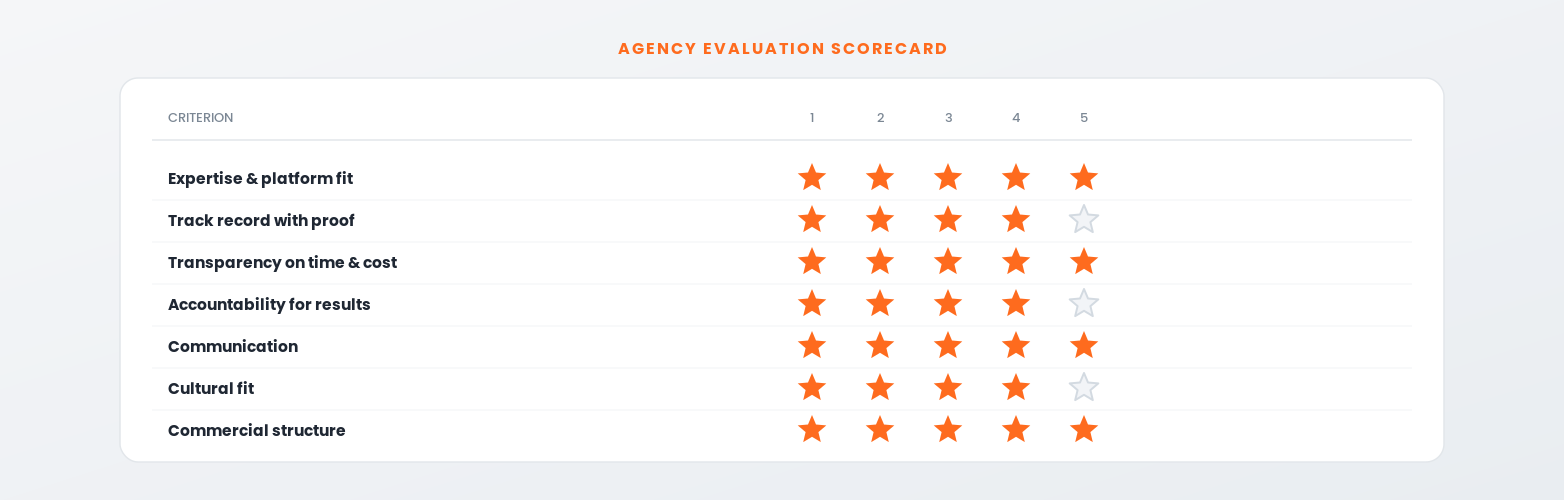
Here is how to turn the seven criteria into an objective decision. Score each shortlisted agency from 1 to 5 on every criterion, weight the ones that matter most to your stage, and total the scores. It sounds mechanical, but that is the point: it stops a charismatic pitch from overriding a poor fit, and it makes comparing two or three candidates genuinely fair.
| Criterion | Score 1-5 | What a 5 looks like |
|---|---|---|
| Expertise and platform fit | ___ | Deep, current experience on your exact platform and model |
| Track record with proof | ___ | Relevant case studies with real numbers and a reference |
| Transparency on time and cost | ___ | Clear reporting and a full breakdown, shown upfront |
| Accountability for results | ___ | Talks in revenue and outcomes, sets measurable goals |
| Communication and responsiveness | ___ | Fast, clear replies and a named point of contact |
| Cultural fit | ___ | Shared values and a working style that fits yours |
| Commercial structure and ownership | ___ | Fair, flexible terms, no lock-in, you own your assets |
Score each agency independently straight after the meeting, while it is fresh, then compare totals. If two are close, the tie-breaker is almost always communication and cultural fit, because those decide what the next two years actually feel like. Want the ready-made version? Download the agency evaluation scorecard below.
The right questions expose what a pitch hides. Ask each candidate: who exactly will work on my account, and can I meet them? How do you report on time and results? Can I speak to a client like me? What happens if I want to leave? How do you measure success, and what would you do first on my store? The quality and honesty of the answers tell you more than the polished slides.
Equally, watch for the red flags that predict a bad relationship. Guaranteed results or rankings, opacity about time and cost, contracts that lock you in or withhold your own code and data, one salesperson who then hands you to juniors, no relevant references, and communication that is already slow during the courtship. Any one of these should give you pause; several together are a clear no. We cover the warning signs in depth in our guide to the signs it is time to leave your agency, and the same red flags apply when choosing one.
A useful mental test: imagine the relationship going wrong. How easily could you leave, how much would you lose, and how much would you be in the dark along the way? If the honest answers are worrying before you have even signed, trust that signal.
Beyond who you choose is how you engage them. Two structural questions matter. First, one full-service partner or several specialists? A single full-service agency gives you one accountable team across design, development, support and marketing, with no finger-pointing between vendors; a set of specialists can offer more depth in each discipline but leaves you to coordinate them. For most stores, the accountability of one joined-up partner wins, which is the model we describe in our guide to a full service eCommerce retainer.
Second, retainer or project? Project work suits a defined, one-off piece such as a build or migration; a retainer suits ongoing growth, because results compound as the agency learns your store month after month. The smartest path is often both in sequence: a project to establish the baseline, then a retainer to grow it. Whichever you choose, insist on transparency of time so you always know what you are paying for.
Match the structure to the work, not the other way round. A great agency will recommend the structure that fits your needs rather than the one that maximises their invoice, and a willingness to do that is itself a good sign you have found the right one.
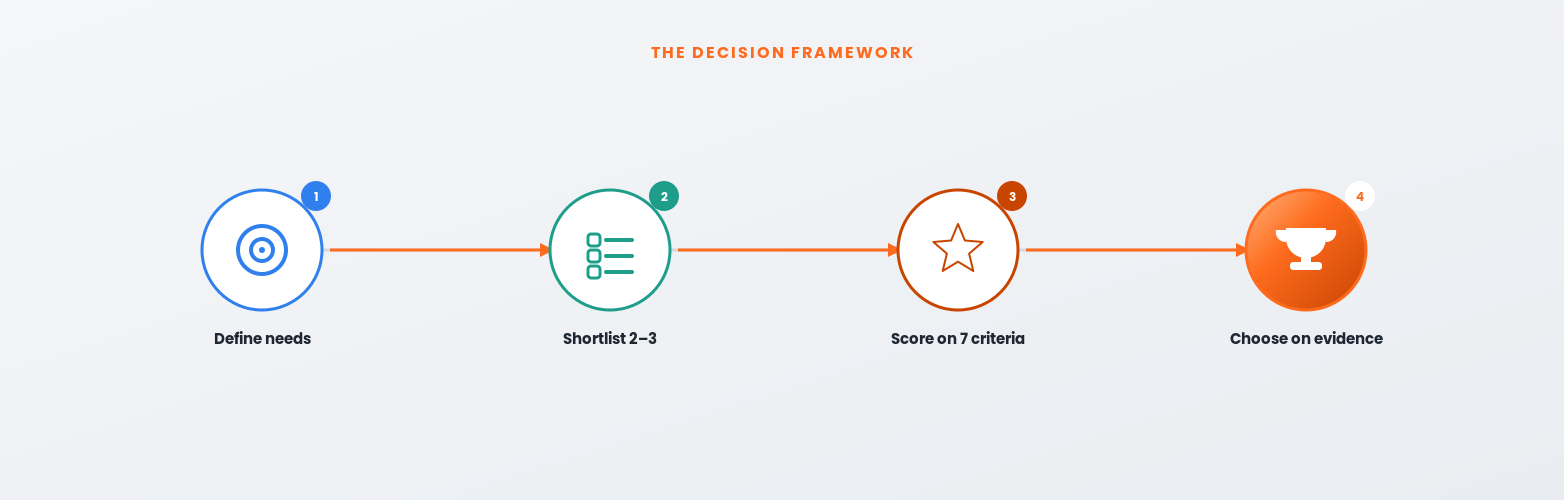
Put it all together and the process is simple. Define what you need and your realistic trajectory. Decide generalist or specialist, and full service or specialists. Shortlist two or three agencies that fit your stage. Score each against the seven criteria, ask the hard questions, and check references. Then choose on the evidence, with communication and cultural fit as the tie-breaker. It takes a little more effort than going with the best pitch, and it is the difference between a partner you keep for years and one you are quietly Googling how to replace within months.
If 5MS is on your shortlist, we would expect to be scored on exactly these criteria. We are an eCommerce specialist that works across Magento and WooCommerce, we run transparent retainers where you always see the time and the results, and we tie our work to your revenue. Whatever you decide, use the framework, because the store you are choosing an agency for deserves a decision made on evidence. See what a good partnership looks like across our eCommerce services.
To choose the right eCommerce agency, use a framework rather than gut feel. Decide whether you need a generalist or a specialist (for most stores, a specialist wins), and whether you want one full-service partner or several specialists. Score two or three shortlisted agencies from 1 to 5 on seven criteria, expertise and platform fit, track record with proof, transparency on time and cost, accountability for results, communication, cultural fit, and commercial structure, weighting them to your business size. Ask the hard questions, check references, watch for red flags like guaranteed results, opacity and lock-in, and choose on the evidence, with communication and cultural fit as the tie-breaker.
Common questions about choosing an eCommerce agency. Get in touch if yours is not here.
Use a framework, not gut feel. Decide whether you need a specialist or a generalist, shortlist two or three agencies that fit your stage, and score each from 1 to 5 on seven criteria: expertise and platform fit, track record, transparency, accountability, communication, cultural fit and commercial structure. Ask the hard questions, check references, watch for red flags, and choose on the evidence.
For most stores, an eCommerce specialist is the better choice, because they already know your platform and the mechanics of converting and retaining shoppers, so they reach results faster with fewer costly mistakes. A generalist can suit brands where commerce is a small part of a wider marketing programme, but if the store is the business, choose the agency that specialises in stores.
Relevant expertise and platform fit, a track record with real proof, transparency on time and cost, accountability for results rather than just deliverables, strong communication and responsiveness, cultural fit, and fair commercial terms with no lock-in. These seven criteria predict whether the relationship will work, so assess every candidate against all of them.
Ask who will actually work on your account and whether you can meet them, how they report on time and results, whether you can speak to a similar client, what happens if you want to leave, how they measure success, and what they would do first on your store. The honesty and clarity of the answers reveal far more than the pitch deck.
Guaranteed results or rankings, opacity about time and cost, contracts that lock you in or withhold your own code and data, a salesperson who then hands you to juniors, no relevant references, and slow communication during the sales process. Any one warrants caution; several together are a clear no. If leaving would be hard and lossy before you have even signed, trust that signal.
It varies widely with scope, from a light support retainer to a substantial embedded-team arrangement or a large one-off build. The right question is not the fee alone but the return it generates and whether the time is transparent. Judge cost against outcomes: a cheaper agency that achieves nothing is expensive, and a larger retainer that compounds revenue is a bargain.
For most stores, one full-service partner is easier and more accountable, with a single team across design, development, support and marketing and no finger-pointing between vendors. Several specialists can offer more depth in each discipline but leave you to coordinate them. Choose specialists only if you have the internal capacity to manage several relationships well.
Match their strengths to your stage. Startups should prioritise value, speed and flexibility; scaling brands should prioritise growth expertise, CRO and proactivity; enterprises should prioritise technical depth, reliability and senior-team access. Also choose for your trajectory, so the agency can grow with you and you avoid a painful re-selection in a year or two.
→10 signs it is time to leave your Magento agency
→WooCommerce vs Magento: which platform should you choose
Source: AgencyAnalytics, Project vs Retainer Agency Pricing Models.
By the 5MS team, UK eCommerce agency and Adobe Solution Partner. Last updated: July 2026.