
eCommerce replatforming is the single most expensive and risky project most online retailers ever take on, and it is also the one most likely to be started for the wrong reasons. A slow checkout, a frustrating admin, or a persuasive sales deck can all make a rebuild feel urgent when the real problem sits somewhere cheaper to fix. This guide sets out exactly when eCommerce replatforming is the right commercial call in 2026, when you are better off staying and investing in what you already have, and how to run the move without torching your rankings or your budget.
It is written by an eCommerce agency that has migrated and rebuilt Magento, Adobe Commerce and Shopify stores for UK retailers since 2015, so the bias here is towards the commercially right answer, not the most billable one.
Satisfied with their platform
Swell, 2026
Of migrations overrun budget
Industry research
Traffic lost in a bad migration
Elogic, 2026
Saw revenue rise after a good move
Swell, 2026
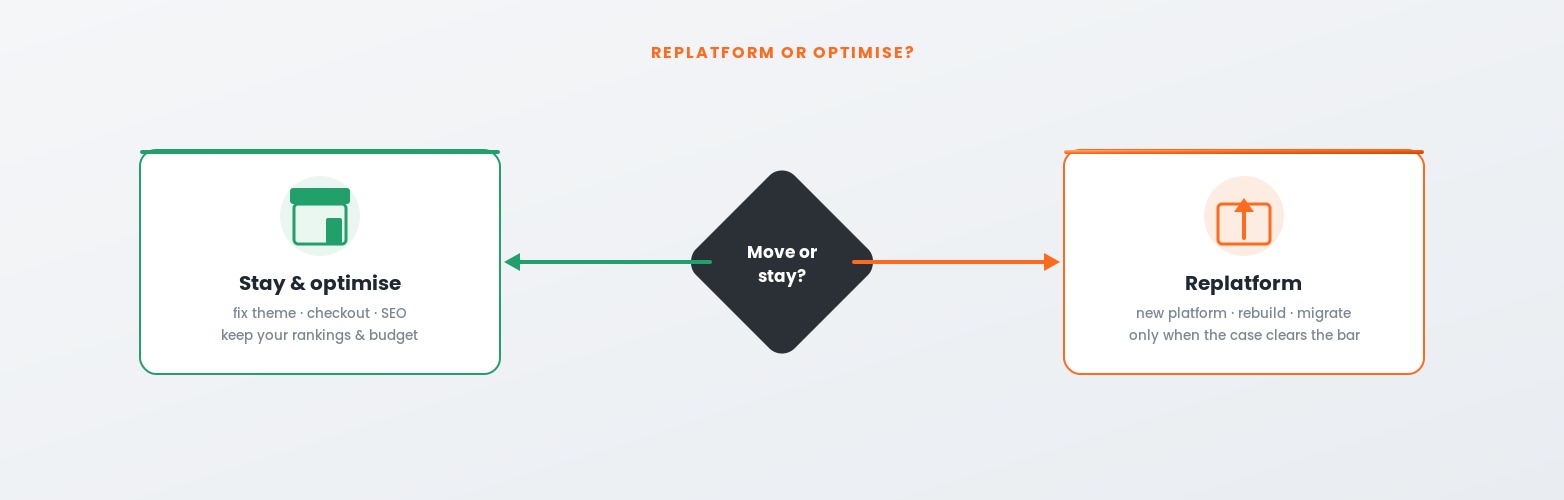
Choose eCommerce replatforming when your current system actively blocks growth: it cannot support the features, integrations or performance you need, and fixing it costs more than moving. If the pain is a slow theme, poor SEO or a bad checkout, fix those first. eCommerce replatforming is a strategic move, not a cure for neglect, and a lot of what looks like platform failure is really a skills gap in disguise.
📄 In This Guide
What Does eCommerce Replatforming Actually Mean?
eCommerce replatforming is the process of moving your online store from one platform to another, for example from Magento to Shopify Plus, or from a legacy custom build to a modern headless stack. It is not a redesign and it is not an upgrade. It is a full change of the software that runs your catalogue, checkout, pricing, orders and integrations, which is why it touches almost every part of the business.
Replatforming versus redesign versus migration
These three terms get used interchangeably and cost very different amounts. A redesign changes how the store looks and behaves on the same platform. A migration is the technical act of moving data, products, customers and orders from one system to another. eCommerce replatforming is the strategic decision that wraps around a migration: choosing a new platform, rebuilding on it, and moving everything across. You can redesign without replatforming, but you cannot replatform without migrating.
Why 2026 is a busy year for platform moves
Two forces are pushing merchants to move right now. Adobe Commerce has shifted its pricing firmly upmarket, tying licence cost to gross merchandise value and pricing out many mid-market brands that were happy on Magento for years. At the same time, only 14% of businesses report being satisfied with their current platform and 77% feel urgency to migrate within the next year, according to Swell’s 2026 replatforming research. Demand for moves is high, which makes it more important than ever to be sure yours is justified.
Signs You Need eCommerce Replatforming: You Have Outgrown Your Platform
eCommerce replatforming is worth it when the platform itself, not your team or your neglect, is the ceiling on growth. These are the signals that the software itself has become the constraint.
The platform blocks features you need to sell
If you cannot launch subscriptions, B2B account pricing, bundles, or a new market without a costly custom build every time, the platform is fighting you. When basic commercial requirements need engineering heroics, the total cost of staying quietly climbs past the cost of moving. Around 90% of recent migrators reported sales and revenue improvements after switching, largely because the new platform unblocked things they simply could not do before.
Total cost of ownership has quietly exploded
Legacy platforms rarely announce their true cost. It leaks out through hosting, security patching, developer retainers, extension licences and the opportunity cost of slow releases. Adobe Commerce’s total cost of ownership runs materially higher than Shopify’s on average across implementation, platform fees and operations, per IWD Agency’s 2026 comparison. One caution before you read that as a reason to leave: a lot of runaway Magento cost is self-inflicted, coming from bloated extensions, over-engineered custom work and a team that does not know the platform well. The right partner often brings that bill down without a rebuild. Only when the cost is structural, and not fixable by better hands, is it a business case to move.
Performance and security are becoming liabilities
Slow, unpatched platforms cost sales and invite risk. Page speed correlates directly with conversion, and the Baymard Institute puts average documented checkout abandonment at roughly 70%, with friction and slow loading among the leading causes. If you are firefighting security patches and cannot hit modern Core Web Vitals without a rebuild, the platform has become a liability rather than an asset.
Before you blame the platform, ask whether the problem is the platform or how it has been built and maintained. A slow Magento store is almost always a badly built or badly managed Magento store, not proof that Magento is wrong for you. In the right hands, Magento remains one of the most capable platforms on the market.
When Should You Stay on Your Current Platform?
This is the section most eCommerce replatforming guides skip, because most are written by people who only make money when you move. Staying is frequently the smarter commercial decision, and here is when.
When the real problem is fixable in place
A large share of the pain that triggers replatforming enquiries is not platform-deep. A slow theme, a bloated checkout, poor eCommerce SEO, or a neglected extension stack can all be fixed on your existing platform for a fraction of a rebuild. If a focused optimisation project can lift conversion and speed without a migration, do that first. You keep your rankings, your integrations and your budget.
When the platform is fine but the team is not
This is the most common and most misdiagnosed reason people think they need to move. Magento and Adobe Commerce are powerful, and that power punishes a team that does not understand them: sites go slow, releases stall, and costs climb, all of which look like platform failure but are really a skills gap. Put the right developers and support in place and the same platform that felt like a dead weight starts performing. Before you cost a rebuild, price up a better team. A capable partner running a well-configured Magento build will out-perform a rushed migration to a platform your business is not set up to exploit. This is exactly the work our Magento support and Magento agency teams do every day.
When your team cannot yet operate the new architecture
Wanting composable or headless is not the same as being ready to run it. A business with high complexity but low engineering maturity and weak change management is a warning sign: it may need modern architecture but cannot yet operate it without more cost and downtime than the old system caused. Build the capability first, then move. Moving into an architecture you cannot maintain simply relocates the problem.
When the numbers do not clear the bar
eCommerce replatforming has to pay for itself. If a move costs six figures and a two to four month recovery window, the expected uplift in conversion, average order value and operating efficiency has to comfortably beat that over a sensible horizon. When the business case is thin, or driven by a shiny demo rather than hard numbers, staying and reinvesting the money in marketing or optimisation usually returns more.
Move when the platform is the ceiling on growth and fixing it costs more than replacing it. Stay when the pain is fixable in place, your team is not ready, or the numbers do not clear the bar.
Think your platform is fine but the team behind it is not?
How Much Does eCommerce Replatforming Cost in 2026?
Cost scales with catalogue size, integrations and how much custom logic your business runs. The headline platform licence is often the smallest line in the budget.
Typical project cost by store complexity
For a Magento to Shopify Plus move, Elogic’s 2026 Cost Index puts a simple sub-1,000-SKU store at roughly $25,000 to $50,000, a mid-market store with ERP-light B2B at $50,000 to $120,000, and a complex B2B or headless build at $120,000 to $300,000 or more. Enterprise projects with many integrations and high SKU volume can run higher still. In sterling terms, budget accordingly and add contingency, because the next point matters.
Why most migrations overrun
Roughly 64% of data migrations overrun their budget and 54% overrun their timeline. The usual culprits are underestimated data cleansing, integrations that were more custom than anyone documented, and scope that creeps once the rebuild starts. Build a contingency of 20% to 25% into any eCommerce replatforming budget and treat any quote without a discovery phase as a guess.
The ongoing cost that decides the decision
Project cost is one-off; total cost of ownership is forever. For mid-enterprise brands, Adobe Commerce’s multi-year TCO typically lands well above Shopify Plus once implementation, platform fees and operations are counted. Over five years, the platform with the higher project cost can easily be the cheaper one to own, and vice versa. Always compare five-year TCO, not day-one price.
Want to know if a rebuild is actually worth it for your store?
Which Platform Should You Replatform To?
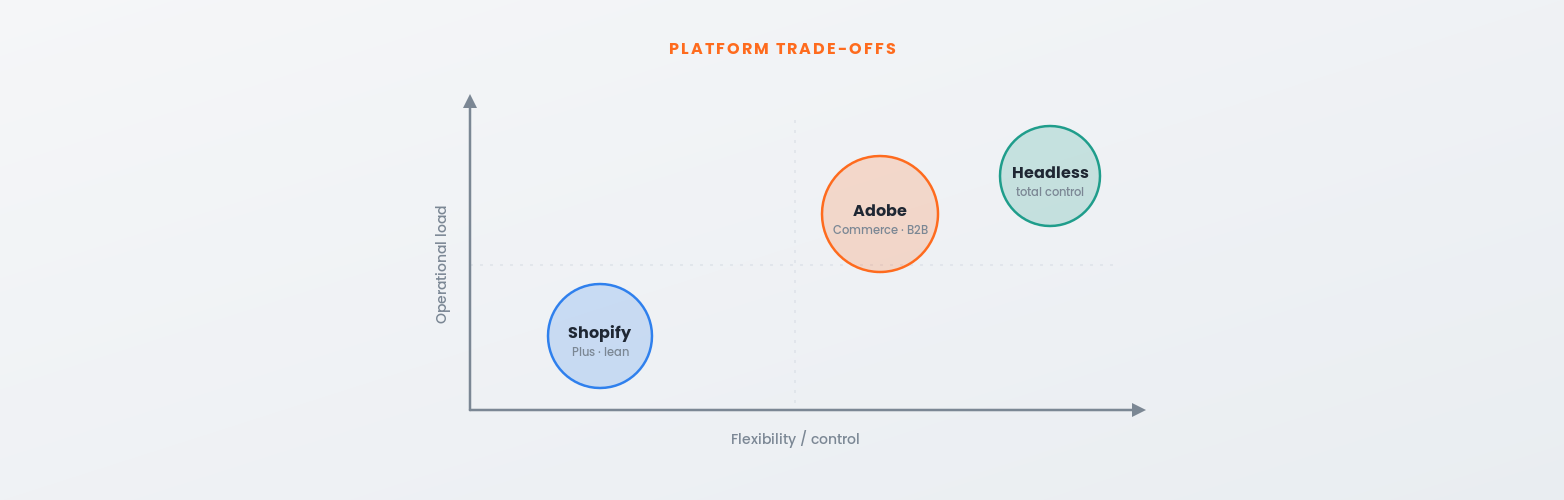
There is no universally best platform, only the best fit for your model, your team and your roadmap. For most UK mid-market retailers weighing eCommerce replatforming, the real choice in 2026 is Shopify Plus, Adobe Commerce, or a headless build on a commerce backend.
Shopify Plus: speed to market and low operational load
Shopify Plus starts at around $2,300 per month and takes hosting, security and platform maintenance off your plate entirely. It wins for brands that want to ship fast, run lean, and avoid a large in-house engineering team. It is one of the most widely used platforms in mid-market retail, making it a default choice for direct-to-consumer brands. Explore what a move looks like on our Shopify development service.
Adobe Commerce: deep B2B and total control
Adobe Commerce (Magento) still powers a large share of the top US retailers and remains the stronger choice for complex B2B: multi-tier catalogues, customer-specific pricing, quote-to-order, approval chains and account hierarchies. It gives you total control, and the higher TCO and heavier operational load people complain about are mostly a function of how it is run, not the platform itself. A team that knows Magento keeps it fast, secure and cost-controlled; a team that does not will make any platform expensive. For the large number of stores where Magento already fits the model, the answer is almost never a rebuild. It is better hands on the platform you have, which is what our Magento support and Magento agency teams do.
Comparison: which fits your store
| Factor | Shopify Plus | Adobe Commerce | Headless |
|---|---|---|---|
| Entry cost | From ~$2,300/mo | GMV-based, upmarket | Highest build cost |
| 5-year TCO | Lower | Higher | Varies widely |
| Operational load | Low (fully hosted) | High | High |
| Complex B2B | Improving | Strongest | Strong |
| Frontend flexibility | Good | Good | Total |
| Team required | Lean | Engineering-heavy | Engineering-heavy |
| Speed to launch | Fast | Moderate | Slowest |
What Are the Biggest eCommerce Replatforming Risks?
Every eCommerce replatforming failure story traces back to a handful of avoidable risks. Knowing them upfront is how you price and plan around them.
Losing organic traffic and rankings
This is the most common and most expensive failure. Poor redirect execution produces documented 20% to 40% organic traffic drops, and a badly executed migration can lose 30% to 60% of organic traffic in the first three months. Because that traffic is often your cheapest acquisition channel, a rankings collapse can wipe out the entire business case on its own.
Budget and timeline blowout
With 64% of migrations overrunning budget and 54% overrunning timeline, cost control is a project in itself. The fix is a proper discovery phase, a fixed data model before build starts, and disciplined scope management. Beware fixed-price quotes with no discovery: they either pad heavily or unravel mid-project.
Data loss and broken integrations
Orders, customer records, loyalty balances and tax logic all have to move intact. Integrations to your ERP, PIM, marketing and fulfilment systems are where hidden custom work lives. Map and test every integration in a staging environment before launch, and never migrate dirty data: clean it first.
An incomplete 301 redirect map. If even a portion of your indexed URLs are not redirected to their new equivalents on launch day, you lose rankings that can take months to recover, if they recover at all.
How Do You Protect SEO During eCommerce Replatforming?
SEO protection is not a post-launch task. It is planned before the build and executed on launch day. Follow this sequence and you keep the rankings you have spent years earning.
If SEO is the part that worries you most, that is the right instinct. It is where the money is lost. Our migration team plans the redirect map before a line of the new build is written.
Migrating and worried about losing rankings? Do not launch without a redirect plan.
How Long Does eCommerce Replatforming Take?
Timeline scales with complexity, integrations and data volume. Anyone promising a fixed timeline before discovery is guessing.
Typical timelines by store size
A smaller store moving to a SaaS platform such as Shopify can complete in roughly 8 to 12 weeks. Larger or more complex migrations involving custom development, multi-region requirements or heavy B2B logic commonly take six months or more, and enterprise builds can run 8 to 14 months. The build itself is often shorter than the discovery, data cleansing and testing around it.
Where the time actually goes
Merchants consistently underestimate three phases: discovery and requirements, data cleansing and mapping, and pre-launch testing. Rushing any of the three is exactly how the 54% timeline-overrun statistic happens. Protect these phases and the rest of the project tends to hold.
Monolith, Headless or Composable: Which in 2026?
eCommerce replatforming is not only a platform choice, it is an architecture choice. The three broad options each suit a different kind of business.
The three models explained
A monolith bundles frontend, backend and admin into one system, which is simpler to run but harder to customise. Headless separates the frontend from the commerce backend for total design freedom. Composable goes further, assembling best-of-breed services (catalogue, checkout, search, marketing) into a modular stack. A large share of enterprises now use headless architecture, and most commerce decision-makers plan to adopt composable elements, per BigCommerce’s research.
Match the architecture to your maturity
The trend toward composable is real, but so is the operational cost. If you have meaningful frontend requirements but backend complexity does not yet justify full decomposition, a headless build on a capable commerce backend gives flexibility without the burden of running distributed services. Composable rewards teams with strong engineering maturity and punishes those without it. Choose the simplest architecture that meets your requirements, not the most fashionable one.
How Do You Build the eCommerce Replatforming Business Case?
An eCommerce replatforming decision that cannot be defended in numbers should not be made. Build the case on evidence, not on a demo.
Quantify the cost of staying
Add up everything your current platform costs you: licences, hosting, patching, developer retainers, extension fees, and the revenue you lose to slow speed, poor conversion or features you cannot ship. That annual figure is your baseline. eCommerce replatforming only makes sense when the move beats it convincingly.
Model the uplift with realistic numbers
Project the realistic gains from a new platform: higher conversion from a faster, better checkout, lower operating cost, faster time to market, and revenue from features you can finally launch. Discount those numbers, then set them against project cost plus the recovery-window risk. If the case only works with optimistic assumptions, it does not work. When it clears the bar comfortably, move with confidence, and if you want a second opinion first, book a free eCommerce growth audit.
Move With Evidence, Stay Without Guilt
Choose eCommerce replatforming when the platform is the real ceiling on growth, fixing it in place would cost more than replacing it, and the five-year numbers clear the bar with room to spare. Stay when the pain is a fixable theme, checkout or SEO problem, your team cannot yet operate a more complex architecture, or the business case only works on optimism. For most UK mid-market retailers in 2026: if you are on Shopify and growing, optimise rather than move; if you are on Magento or Adobe Commerce and it fits your model, the smart money is usually better support and the right team, not a rebuild, because most apparent platform failure is a skills gap in disguise. Whatever you choose, protect your SEO from day one with a full 301 redirect map, and build the case on numbers, not a sales deck.
Frequently Asked Questions
Common questions about eCommerce replatforming. Get in touch if yours is not here.
What is eCommerce replatforming?
eCommerce replatforming is moving your online store from one platform to another, such as Magento to Shopify Plus, and rebuilding on the new system. It changes the software that runs your catalogue, checkout, pricing and orders. It is a strategic decision that includes a data migration, not just a redesign or an upgrade.
How much does eCommerce replatforming cost in 2026?
A Magento to Shopify Plus move runs roughly $25,000 to $50,000 for a simple store, $50,000 to $120,000 for a mid-market store, and $120,000 to $300,000-plus for complex B2B or headless builds, per Elogic’s 2026 Cost Index. Enterprise projects run higher. Always add 20% to 25% contingency, as around 64% of migrations overrun budget.
How long does eCommerce replatforming take?
A smaller store moving to a SaaS platform like Shopify can complete in 8 to 12 weeks. Complex migrations with custom development or multi-region needs take six months or more, and enterprise builds can run 8 to 14 months. Discovery, data cleansing and testing usually take longer than the build itself.
Will I lose SEO rankings when I replatform?
You can, if it is done badly. Poor redirect execution causes 20% to 40% organic traffic drops, and a bad migration can lose 30% to 60% in the first three months. A complete 301 redirect map, preserved on-page signals and Search Console monitoring protect your rankings. Well-planned moves can even gain traffic over time.
When should I stay on my current platform instead of moving?
Stay when the problem is fixable in place, such as a slow theme, poor checkout or neglected SEO, when your team cannot yet operate a more complex architecture, or when the business case only works on optimistic assumptions. eCommerce replatforming is a strategic move for platform-deep problems, not a cure for a neglected store.
Shopify Plus or Adobe Commerce: which should I choose?
Choose Shopify Plus for speed to market, low operational load and a lean team; it starts around $2,300 per month. Choose Adobe Commerce for complex B2B needs like multi-tier catalogues, customer-specific pricing and quote-to-order. Adobe’s multi-year TCO is typically higher, so compare total cost of ownership, not day-one price.
What is the difference between headless and composable commerce?
Headless separates your storefront from the commerce backend for total frontend freedom while keeping one core system. Composable goes further, assembling best-of-breed services like catalogue, checkout and search into a modular stack. Both are increasingly popular, but both demand strong engineering maturity to run well.
Why do so many eCommerce replatforming projects fail?
Most failures come from an incomplete 301 redirect map, underestimated data cleansing and integrations, and scope creep. Around 64% of migrations overrun budget and 54% overrun timeline. A proper discovery phase, a fixed data model before build, disciplined scope management and thorough staging tests prevent almost all of these failures.
How do I build a business case for replatforming?
Quantify the full annual cost of staying, including licences, hosting, patching, developer time and lost revenue from poor performance. Then model realistic gains in conversion, operating cost and time to market, discount them, and set them against project cost plus recovery risk. If the case only works on optimistic numbers, it does not work.
Can I replatform without any downtime?
Near-zero downtime is achievable with careful planning: a full staging build, a tested data sync, DNS cutover during a low-traffic window and a rehearsed rollback plan. Some brief maintenance is normal for the final data sync. The bigger risk is not downtime but a broken redirect map, so prioritise that above all else.
Should I redesign at the same time as replatforming?
It is tempting but risky. Changing both the platform and the design at once means that if rankings or conversion drop, you cannot tell which change caused it. Where SEO is a priority, keep on-page signals and structure close to the original at launch, then improve the design in a controlled phase afterwards.
Related Reading
→What Shopify development with 5MS looks like
→Protecting and growing eCommerce SEO
→Optimising Magento instead of replacing it
Sources: Swell replatforming statistics, Elogic 2026 Cost Index and Google site move guidance. Figures are third-party 2026 estimates, verify against the source before quoting.
By the 5MS team, UK eCommerce agency migrating and rebuilding Magento, Adobe Commerce and Shopify stores since 2015. Last updated: July 2026.