
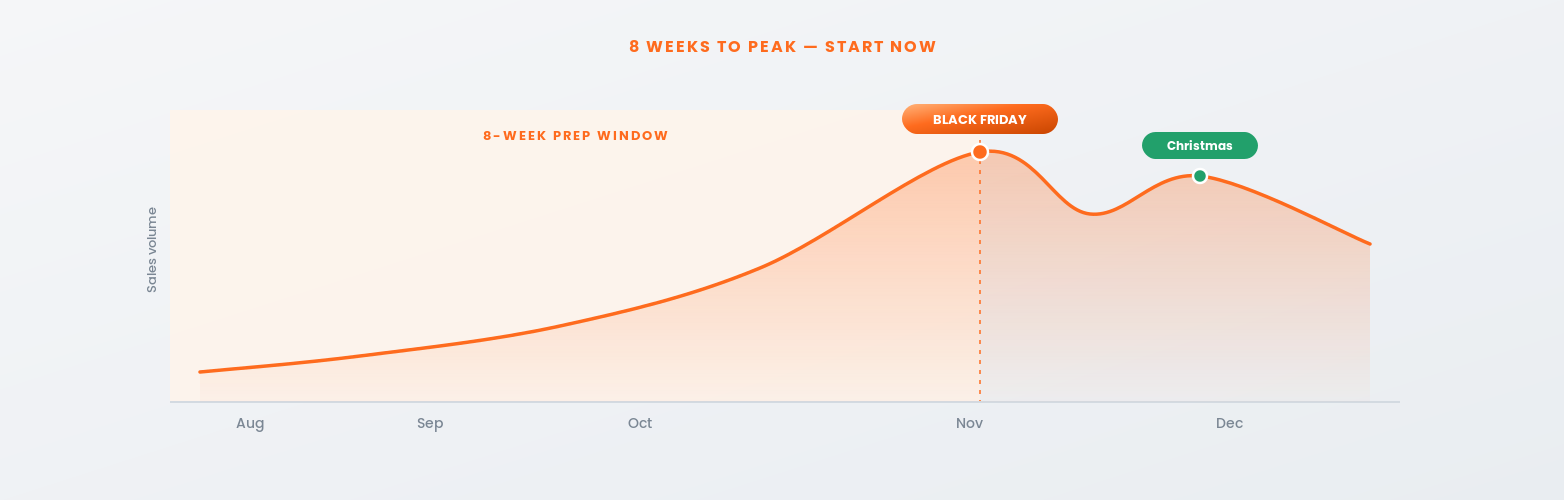
eCommerce peak season is won or lost in the eight weeks before the first big sale, not on Black Friday itself. Roughly a third of annual online sales land in the final quarter, and if your store buckles under load, your feeds are wrong or your email flows are not ready, you pay for it at the exact moment traffic peaks. This playbook gives you a week-by-week plan to get infrastructure, product feeds and automation flows ready in time, starting from where you are right now.
August is the prep window. Start the eight-week countdown now and you go into peak calm and tested, rather than firefighting live. Here is exactly what to do, and when.
Weeks to prep, starting now
Start in August
Of annual online sales fall in Q4
UK retail data, 2025
Of the year’s revenue in November alone
Black Friday month
Workstreams to get right
Infra, feeds, flows, QA
To prepare for eCommerce peak season, work backwards from your first big sale on an eight-week plan: audit and set targets (week 8), harden infrastructure and hosting (week 7), fix site speed (week 6), get product data and feeds right (week 5), lock offers and merchandising (week 4), build email and automation flows (week 3), run full QA (week 2), then freeze code and monitor (week 1). Nail infrastructure, feeds, flows and testing before traffic climbs and peak becomes your best trading period instead of your riskiest.
What eCommerce Peak Season Means in 2026
eCommerce peak season is the golden quarter, roughly October to December, when Black Friday, Cyber Monday and Christmas concentrate a huge share of the year’s sales into a few frantic weeks. In the UK, Q4 accounts for around 29% of annual online volume, and November alone can drive about 11% of a store’s yearly revenue. Online’s share of retail also spikes: it typically sits near 27% but pushes past 32% around Black Friday.
That concentration is exactly why preparation matters so much. Any weakness in your store, slow pages, a fragile checkout, wrong stock in your feeds, gets amplified when traffic is at its highest and every visitor is expensive. The stores that win peak are not the ones that discount hardest; they are the ones that were ready before the rush.
Infrastructure changes, feed fixes and flow builds all need time to test safely. Starting eight weeks out means you finish and test before traffic climbs, and you keep a clean code freeze over the highest-risk trading days.
Your 8-Week eCommerce Peak Season Timeline
Count backwards from your first major sale. This is the sequence we use to get stores ready without a last-minute scramble, each week builds on the one before, so do them in order.
Review last year’s data, set revenue and traffic targets, and agree scope. Everything else is measured against this.
Load-test at expected peak traffic, plan scaling and caching, and confirm your hosting can take the spike.
Optimise images, scripts and templates. Every extra second of load time quietly costs conversions when it matters most.
Clean titles, prices, stock and Google and Meta feeds. Wrong feed data at peak means wasted ad spend and lost sales.
Finalise deals, build landing pages, and set up navigation and on-site merchandising for the promotions.
Prepare BFCM campaign sequences, refresh abandonment and welcome flows, and clean your segments.
Test the whole journey on staging: checkout, payments, mobile, promotions and returns. Fix everything now, not live.
Stop deploying changes, set up live dashboards and alerts, and put someone on call. Stability beats last-minute tweaks.
Infrastructure and Speed: Survive the Spike
Peak traffic is when infrastructure gets tested for real, and a store that slows or falls over on Black Friday loses sales it can never win back. Two things matter: capacity to handle the spike, and speed so the traffic you do get converts.
If speed is your weak point, fix it well before the freeze. Our guide to eCommerce site speed covers what moves the needle, and our Magento support team runs peak readiness for stores every year.
Product Feeds and Merchandising
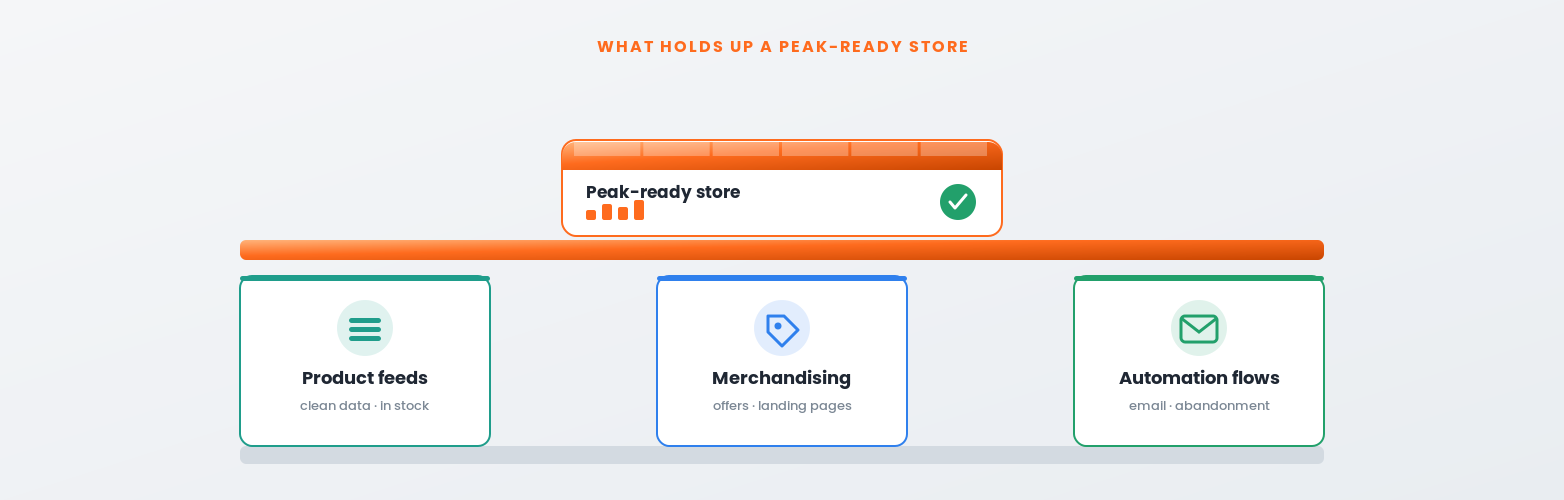
Your product feed is the fuel for Google Shopping and Meta ads, and peak season is the worst time to discover it is wrong. Bad feed data, missing prices, wrong stock, poor titles, means disapproved products, wasted ad spend and shoppers landing on out-of-stock pages.
Getting shoppers to the right product quickly is a conversion job as much as a merchandising one, which is why feeds and on-site experience should be planned together with your wider conversion rate optimisation work.
Email and Automation Flows (BFCM Prep)
Email and automation are where peak margin is protected. Paid traffic is expensive during BFCM, so the owned channels that re-engage visitors, recover abandoned carts and bring back last year’s buyers do a disproportionate amount of the work. Build and test these flows in week 3, not on the day.
Done well, flows turn one-off Black Friday bargain-hunters into repeat customers, which is where the real value of peak season lives.
Your Peak Readiness Checklist
Print this, work down it, and do not go into peak with anything unticked. Four workstreams, colour-coded so you can see at a glance where you stand, the essentials in each.
eCommerce Peak Season Prep, in Short
eCommerce peak season, the October to December golden quarter, drives roughly 29% of annual online sales, so preparation beats last-minute discounting. Work an eight-week countdown to your first big sale: audit and set targets (week 8), harden infrastructure (week 7), fix site speed (week 6), clean product data and feeds (week 5), lock offers and merchandising (week 4), build email and automation flows (week 3), run full QA (week 2), and freeze code and monitor (week 1). Get infrastructure, feeds, flows and testing right before traffic climbs, and starting in August gives you time to finish and test safely rather than firefighting live.
Frequently Asked Questions
Common questions about eCommerce peak season prep. Get in touch if yours is not here.
When should I start preparing for eCommerce peak season?
Start about eight weeks before your first big sale, which for most UK stores means beginning in August or early September. Infrastructure, speed, feed and flow work all need time to build and test safely, so an early start means you finish and test before traffic climbs rather than firefighting live.
What is a code freeze and why does it matter at peak?
A code freeze means you stop deploying changes to your live store over the highest-traffic, highest-revenue days. It matters because a well-meant last-minute change is one of the most common causes of a site going down at exactly the wrong moment. Freeze, monitor and only touch the site for genuine emergencies.
How do I stop my site crashing on Black Friday?
Load-test against realistic peak traffic well in advance, add caching and a CDN, and have a scaling plan so resources flex up for the spike. Fix the bottlenecks the load test exposes, then freeze changes and monitor with live dashboards and alerts so you catch any issue instantly.
Why do product feeds matter so much during peak?
Your feed powers Google Shopping and Meta ads, so errors are expensive when spend is high. Wrong prices or stock mean disapproved products, wasted budget and shoppers landing on sold-out pages. Audit and fix feeds in week 5, and keep stock synced accurately throughout peak.
Which email flows should be ready for BFCM?
Have your BFCM campaign calendar (teaser, early access, launch, last-chance, extension) plus refreshed abandoned-cart, browse, welcome and post-purchase automations. Clean and segment your list, and check deliverability so peak emails reach the inbox. Owned channels protect margin when paid traffic is at its most expensive.
Is it too late to prepare if I start in October?
No, but you will need to prioritise. If time is short, focus first on stability and speed, then feeds, then flows, and keep changes minimal and well-tested. A shorter runway means a tighter scope and a stricter code freeze, but a focused two to three weeks still beats going in unprepared.
How long does peak season really last?
The core runs from Black Friday and Cyber Monday through to Christmas and into the January sales, but the golden quarter as a whole spans October to December. Treat it as a season, not a single day: plan promotions, stock and support across the whole window, including post-Christmas returns.
Can an agency run peak readiness for me?
Yes. A specialist team can run the full eight-week programme, load-testing, speed, feeds, flows and a monitored code freeze, so your peak is planned and stable rather than stressful. At 5MS we do exactly this for stores every year through our Magento support and eCommerce services.
Related Reading
SpeedHow to make an eCommerce site faster
SupportMagento support and peak readiness
Source: ONS UK retail sales data. Seasonal shares are UK retail estimates, verify against current data before quoting.
By the 5MS team, UK eCommerce agency and Adobe Solution Partner. Last updated: August 2026.