

Changing agency feels like a hassle, so most directors put it off far too long, quietly losing revenue while they wait for things to improve. They rarely do. A good Magento agency is a growth partner: transparent, proactive and accountable for results. A bad one is a slow leak on your business that is easy to normalise until you see the red flags written down. This guide lists the ten clearest signs it is time to leave your Magento agency, what each one looks like day to day, and why it matters to your bottom line.
If you recognise three or more of these, the problem is not going to fix itself. The cost of staying is almost always higher than the cost of switching, and this guide ends with how to move on safely, without losing your store, your data or your rankings.
Red flags every director should know
Covered below
Transparency you should expect
On time and results
Accountable team, not many vendors
One point of contact
CVR uplift from ongoing 5MS work
5MS client data
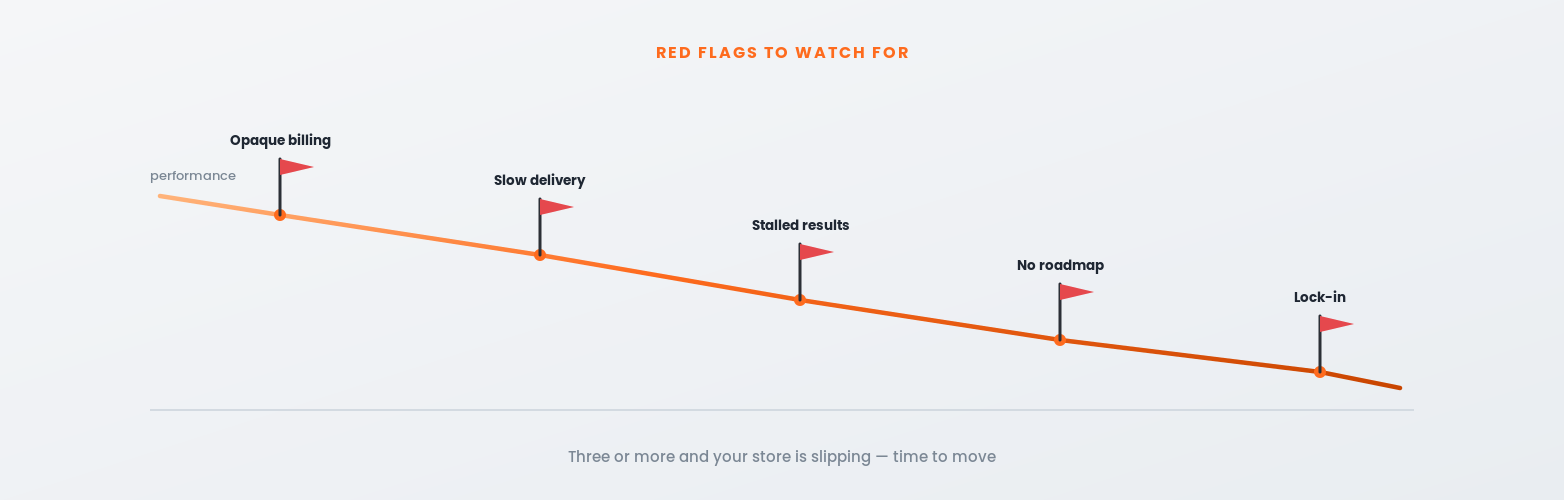
It is time to leave your Magento agency when the warning signs stack up: you never know what you are paying for, everything takes too long, they only react instead of improving your store, performance and security are slipping, and results have stalled with no measurable impact on revenue. Add poor communication, staff churn, shallow Magento knowledge, no roadmap, and lock-in over your code and data, and the relationship is costing you more than it earns. Recognise three or more and it is time to move, which you can do without losing your store, data or rankings.
Your Magento agency has more influence over your revenue than almost any other supplier. They decide how fast your store loads, how smoothly it checks out, how secure it is, and how quickly you can respond to opportunities. When the relationship works, that influence compounds in your favour. When it does not, the same influence quietly works against you, and because the decline is gradual, it is easy to accept a level of service you would never sign up for today.
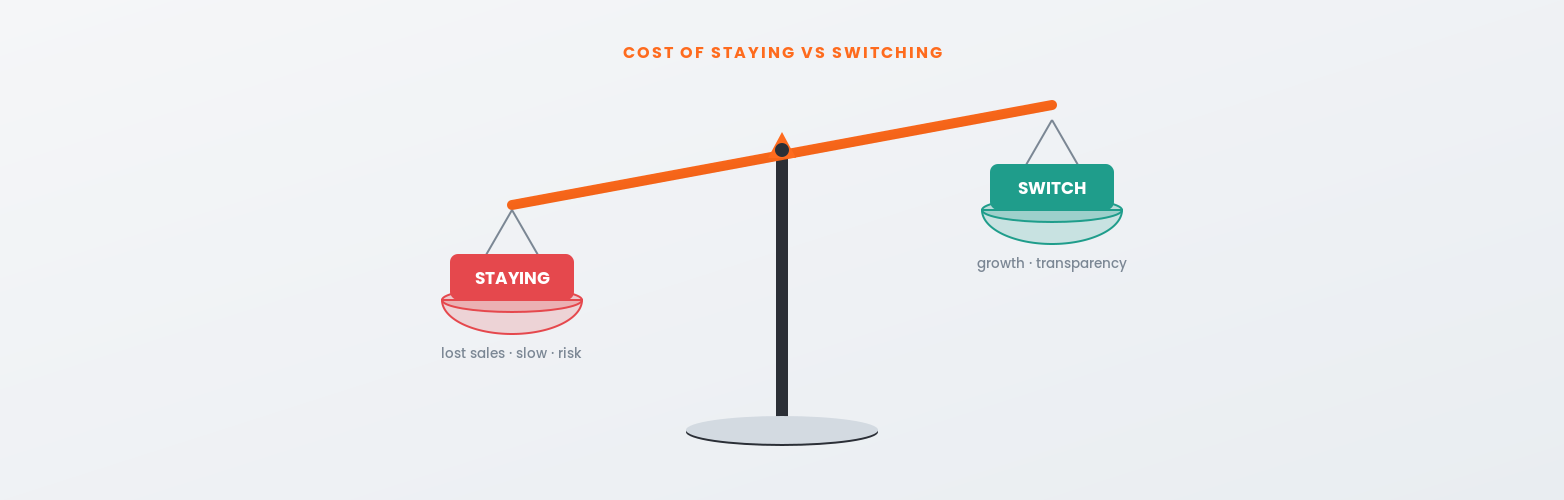
The reason directors tolerate a poor agency is switching costs, both real and imagined. Migrating a relationship feels risky, so a store limps along on an agency that has stopped delivering. But the true cost is what you lose every month you stay: slow pages that leak sales, security you cannot vouch for, and a roadmap that has quietly stalled. That ongoing loss almost always dwarfs the one-off effort of moving.
The healthiest way to judge the relationship is against a simple standard: transparency, proactivity and accountability for results. A good agency shows you where the time goes, brings you improvements before you ask, and ties its work to your revenue, much like the transparent model we describe in our guide to a full service eCommerce retainer. Measure your current agency against that, and the red flags below will be easy to spot.
What it looks like: a single retainer figure each month with no breakdown of hours, tasks or outcomes. When you ask where the time went, the answer is vague.
Why it matters: opacity removes accountability. If you cannot see the work, you cannot judge the value, and you have no way to tell whether you are being well served or quietly overcharged.
What it looks like: simple changes sit in a queue for weeks, urgent fixes are not urgent to them, and there are no clear response times you can rely on.
Why it matters: eCommerce moves fast. A slow agency means missed campaigns, prolonged bugs and lost sales, and it signals you are not a priority for them.
What it looks like: they fix what breaks and nothing more. There are no proactive suggestions, no optimisation, no ideas you did not ask for first.
Why it matters: a reactive support contract dressed up as a partnership will keep your store alive but never grow it. Standing still online means slowly falling behind competitors who are improving.
What it looks like: the store feels slower, patches and updates lag behind, and nobody can give you a straight answer on backups, security or Core Web Vitals.
Why it matters: slow pages lose sales before checkout even begins, and the average cart abandonment rate already sits at around 70%. Neglected security is a breach waiting to happen, and on Magento that risk is real.
What it looks like: your conversion rate, revenue and performance metrics have been flat for months, and the agency cannot point to anything they have done to move them.
Why it matters: you pay an agency for outcomes, not activity. If the work is not tied to measurable improvement in the numbers that matter, you are funding motion, not progress.
What it looks like: you chase them for updates, emails go unanswered, meetings get cancelled, and you learn about problems after they have already cost you.
Why it matters: communication is the clearest signal of how much an agency values you. If you are always the one chasing, you have already slipped down their list, and the work will follow.
What it looks like: a new account manager every few months, developers who have to relearn your store each time, and no single person who really knows your setup.
Why it matters: the value of a long relationship is institutional knowledge. Constant churn throws that away, so you pay repeatedly for people to get up to speed instead of moving you forward.
What it looks like: they treat Magento like any other platform, struggle with upgrades and extensions, and reach for workarounds where a specialist would know the right fix.
Why it matters: Magento and Adobe Commerce are complex and unforgiving. A generalist accumulates technical debt and risk on your store, while a true specialist keeps it fast, stable and upgradeable.
What it looks like: no forward plan, no priorities, no strategy beyond the next ticket. When you ask what is next for the store, nobody has an answer.
Why it matters: without a roadmap, your store drifts. A good agency owns a plan tied to your commercial goals, so every month moves you toward something rather than just keeping the lights on.
What it looks like: you do not have full access to your own code, hosting, domain or analytics, and getting it feels like pulling teeth. Leaving is made deliberately difficult.
Why it matters: lock-in is a red flag in itself, and often a sign an agency knows you would leave if you easily could. Your store, code and data are your assets; any agency that treats them as leverage is not on your side.
Recognising the red flags is the hard part; acting on them is more straightforward than it feels. The fear of switching is usually worse than the reality, especially when you plan the move rather than react to a crisis. Start by getting an honest second opinion on your store: a specialist can quickly tell you whether the issues are fixable in place or whether a change of agency is genuinely warranted.
When you do move, protect your assets first. Make sure you have full ownership of your code repository, hosting, domain and analytics before you give notice, and agree a clean handover so nothing is lost. A good incoming agency will manage this transition for you, auditing the store, documenting what they inherit, and safeguarding your rankings and data as they take over, the same care a well-run platform migration demands. Done properly, switching is low-risk and the improvement is quick to feel.
At 5MS we take on stores from other agencies regularly, and the pattern is familiar: transparent time, proactive improvements and a clear roadmap turn a stalled store back into a growing one. If the red flags above sound like your current setup, our Magento support team can review your store and tell you honestly where you stand, and our wider eCommerce services cover the growth work a good partner should be doing.
It is time to leave your Magento agency when the red flags stack up: you never know what you are paying for, everything takes too long, they only react instead of improving your store, performance and security are slipping, results have stalled, communication has broken down, staff churn kills continuity, their Magento knowledge is shallow, there is no roadmap, and they lock you in over your own code and data. Judge the relationship on transparency, proactivity and accountability, and if three or more of these ring true, plan a move: secure your assets first and let a good incoming agency handle the handover so you keep your store, data and rankings.
Common questions about leaving a Magento agency. Get in touch if yours is not here.
Look for the red flags: opaque billing, slow response times, purely reactive work, slipping performance and security, stalled results, poor communication, staff churn, shallow Magento knowledge, no roadmap, and lock-in over your code and data. If three or more sound familiar, the relationship is costing you more than it earns and it is time to plan a move.
Less than most directors fear, provided you plan it. Secure full ownership of your code repository, hosting, domain and analytics before giving notice, and agree a clean handover. A good incoming agency audits the store, documents what it inherits and safeguards your rankings and data during the transition, which keeps the risk low.
The most serious are lack of transparency on time and cost, no accountability for results, and lock-in that stops you leaving. These undermine the whole relationship. Slow response, reactive-only work and neglected performance and security follow close behind, because they directly cost you sales while you wait for things to improve.
Not if the move is handled properly. Rankings are at risk only when a transition is rushed or a site is rebuilt carelessly. A careful handover preserves your URLs, content and technical SEO, and a competent incoming agency treats protecting your search visibility as a priority, not an afterthought.
It is worth one honest conversation. Raise the specific issues and give clear expectations with a deadline. If the agency responds with transparency and improvement, the relationship may be salvageable. If you are met with excuses, defensiveness or no change, that answer tells you it is time to move on.
Make sure you own and can access your Magento admin, code repository, hosting and server, domain registrar, DNS, analytics, and any third-party accounts such as payment and email tools. These are your assets. Confirming access before you give notice prevents an agency from using them as leverage during the exit.
A well-run handover typically takes a few weeks: an audit and access transfer, a documentation and knowledge-capture phase, then the new agency taking over day-to-day work. Notice periods in your current contract may extend that, so check the terms early. The active improvement usually begins as soon as the new team has full access.
A good agency gives you transparent time tracking, quick and reliable response times, proactive improvements, strong Magento expertise, a clear roadmap tied to your revenue goals, and honest reporting on results. It treats your code and data as your assets. In short, it turns the ten red flags into ten reasons to stay.
→Magento support and maintenance services from 5MS
→eCommerce development and growth services from 5MS
Source: Baymard Institute, Cart Abandonment Rate Statistics.
By the 5MS team, UK eCommerce agency and Adobe Solution Partner. Last updated: July 2026.