
Every tool now claims to be powered by AI, and it is hard to tell the genuine revenue drivers from the marketing gloss. The truth is more useful than the hype: a handful of AI applications reliably lift sales for eCommerce brands today, while others are still demos looking for a use case. This guide cuts through it. We cover what AI in eCommerce actually delivers right now, from product recommendations and search to chatbots and personalisation, what is still overhyped, and what to implement first on a Magento store, drawn from what we see working for real clients.
It is deliberately practical, not theoretical. The aim is to help you spend your budget on the AI that pays for itself, and ignore the rest until it earns its place.
Revenue lift from personalisation
McKinsey
Of revenue from recommendations, engaged sessions
Barilliance
More revenue from personalisation, fast growers
McKinsey
Coverage from AI support assistants
Always on
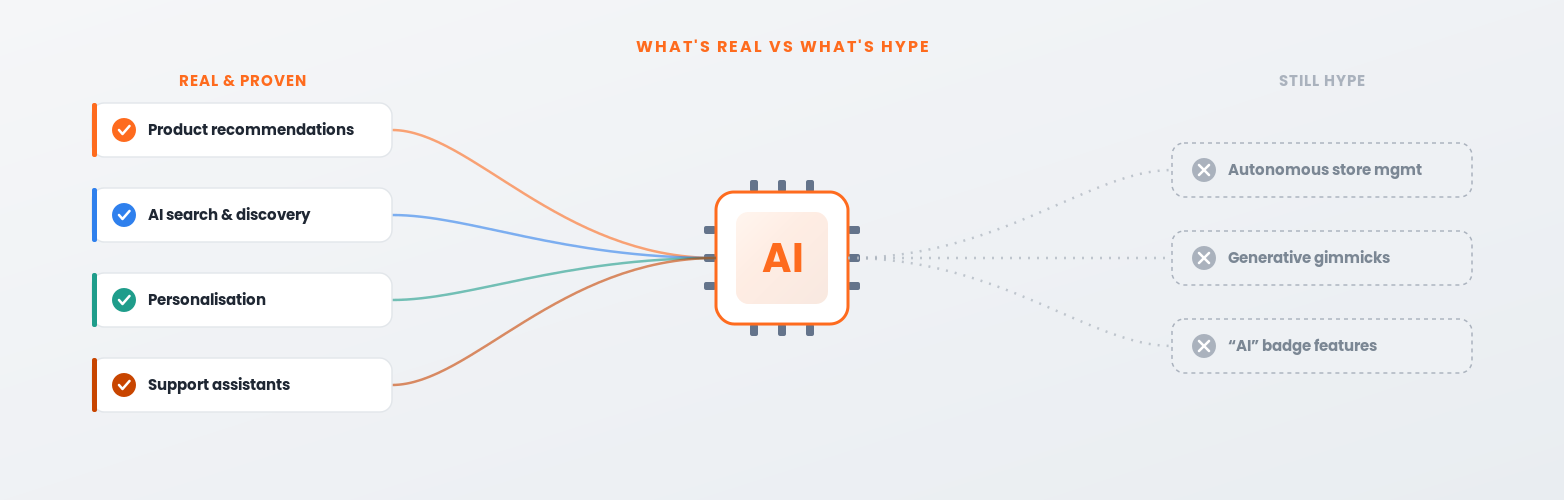
The AI in eCommerce that reliably drives revenue today is product recommendations, AI-powered search and discovery, personalisation at scale, and, done well, customer support assistants. These lift conversion and average order value by showing shoppers the right products and answers faster. What is still largely hype is fully autonomous store management and generative gimmicks with no measurable return. On Magento, implement in this order: fix your data and search, add recommendations, layer on personalisation, then trial a support assistant. Start with what pays for itself.
The useful way to think about AI in eCommerce is not “is it the future” but “does it move a number I care about today”. Judged that way, the picture gets clear quickly. Some applications are proven revenue drivers with real data behind them; others are impressive demos that do not yet justify the cost or risk. Here is the honest split.
The pattern is simple: the AI that works quietly improves an existing job, helping shoppers find and choose products, rather than promising to run your store for you. Keep that test in mind and the rest of this guide will tell you exactly where to spend first.

This is the most proven AI application in eCommerce, and the easiest place to see a return. AI recommendation engines analyse browsing and purchase behaviour to show each shopper the products they are most likely to want, on the homepage, product pages, cart and in email. They power the “customers also bought”, “recommended for you” and “complete the look” blocks that lift average order value and rescue otherwise dead-end pages.
The numbers back it up. Personalised recommendations can drive up to around 31% of eCommerce revenue in sessions where shoppers engage with them, according to widely cited Barilliance research, and personalisation overall drives a 10 to 15% revenue lift on average, per McKinsey. Recommendations are where that value most often starts.
The catch is that recommendations are only as good as your data. A clean product catalogue with accurate attributes and enough behavioural data to learn from is what separates genuinely helpful suggestions from random noise. Get the data right first, and this is usually the highest-return AI you can add.
Shoppers who use search convert at far higher rates than those who browse, because they are telling you exactly what they want. The problem is that traditional keyword search is brittle: a small typo, a synonym or a natural-language query, and it returns nothing. AI search fixes this. It understands intent and meaning rather than matching exact strings, so “warm waterproof coat for hiking” returns the right products even if none of those words appear in the title.
Good AI search also handles synonyms, typos, and increasingly image and conversational queries, and it learns from what shoppers click and buy. For stores with large catalogues, this is one of the fastest wins available, because it rescues high-intent visitors who would otherwise hit a dead end and leave. A failed search is a lost sale from someone who was ready to buy.
This is also where AI meets the shift in how people discover products. As shoppers increasingly search on social platforms and through AI assistants, on-site AI search keeps your own store competitive with those experiences. It pairs naturally with strong product data and the discovery habits we cover in our social commerce guide.
Chatbots are where the gap between real and hype is widest. The old rule-based bots that trapped customers in menus deservedly earned a bad name. Modern generative AI assistants are genuinely better: they can answer product questions, track orders, handle returns and guide shoppers to the right item in natural language, around the clock. Done well, they deflect routine queries from your support team and help hesitant buyers over the line.
The key word is “assist”. The mistake is treating an assistant as a way to remove humans entirely, which frustrates customers the moment a query gets complex or emotional. The version that works handles the common, repetitive questions instantly and hands off cleanly to a person for everything else. It also needs guardrails: an assistant that invents answers about your policies or stock does more harm than good.
Our advice is to trial a support assistant on a defined scope, order status, FAQs, sizing, measure deflection and satisfaction, and expand only where it clearly helps. Treated as a helpful layer rather than a replacement, it is a real win; treated as a cost-cutting shortcut, it usually backfires.
Personalisation is the thread that ties the other applications together, and it is where AI earns its biggest, most durable returns. It means tailoring the experience, the products shown, the content, the offers, the email timing, to each shopper based on their behaviour, at a scale no human team could manage manually. McKinsey finds that faster-growing companies drive around 40% more of their revenue from personalisation than slower-growing peers, which tells you it is a driver of growth, not a nice-to-have.
In practice this spans the whole journey: personalised recommendations on-site, dynamic content and merchandising by segment, and behaviour-triggered email and SMS. The email side is often the fastest to monetise, because tools like Klaviyo already hold the data and the triggers, as we cover in our Klaviyo for Magento guide. Personalisation is also the engine of a strong conversion rate.
The recurring theme, again, is data. Personalisation runs on unified, accurate customer and product data, so the practical route is to get your data and tracking in order first, then let AI act on it. Do that, and personalisation quietly compounds across every channel you run.
Magento and Adobe Commerce are well suited to AI, with a large ecosystem of recommendation, search and personalisation extensions, plus Adobe Sensei on Commerce. The mistake is bolting on tools before the foundations are ready. This is the order we recommend to clients, because each step makes the next one work better.
Clean product data, accurate attributes and reliable analytics come first. Every AI tool learns from this; feed it messy data and you get messy results. This is unglamorous but non-negotiable groundwork.
Fix on-site search so high-intent shoppers find products, then add a recommendation engine across product pages, cart and email. These two deliver the quickest, clearest return on most stores.
Extend personalisation across site and email, measuring the lift. Only then trial a support assistant on a defined scope. Add each tool where the data shows it pays, not because it is fashionable.
We help clients pick and implement the AI tools that actually move revenue on Magento, and skip the ones that do not. If you want a practical review of where AI would pay off on your store, our eCommerce team can map it to your data and goals.
The AI in eCommerce that reliably drives revenue today is product recommendations, AI-powered search and discovery, personalisation at scale, and well-scoped customer support assistants. Recommendations can drive up to around 31% of revenue in engaged sessions and personalisation lifts revenue 10 to 15% on average, per McKinsey. What is still mostly hype is autonomous store management and generative gimmicks with no measurable return. On Magento, implement in order: fix your data and tracking, upgrade search, add recommendations, layer on personalisation, then trial a support assistant. Start with the AI that pays for itself, and everything depends on clean, unified data.
Common questions about AI in eCommerce. Get in touch if yours is not here.
AI in eCommerce is the use of machine learning and generative AI to improve how an online store sells: recommending products, powering search, personalising the experience, and assisting customer support. The applications that work today quietly enhance an existing job, helping shoppers find and choose products, rather than trying to run the store autonomously.
Product recommendations, AI search and discovery, personalisation across site and email, and well-scoped support assistants are the proven revenue drivers. They lift conversion and average order value with real data behind them. Fully autonomous store management and generative gimmicks with no measurable return are still mostly hype and not worth prioritising.
Yes, and it is the most proven AI application in eCommerce. Personalised recommendations can drive up to around 31% of revenue in sessions where shoppers engage with them, and they reliably lift average order value by surfacing relevant products. The results depend on clean product data and enough behavioural data for the engine to learn from.
They can be, if treated as an assistant rather than a replacement for people. A well-scoped AI assistant handles common questions like order status, FAQs and sizing instantly and around the clock, then hands off to a human for complex or sensitive queries. It needs guardrails so it does not invent answers. Trial it on a defined scope, measure deflection and satisfaction, and expand only where it helps.
AI personalisation tailors the experience to each shopper, the products shown, content, offers and email timing, based on their behaviour, at a scale no human team could manage. McKinsey finds faster-growing companies drive around 40% more of their revenue from personalisation than slower-growing peers. It runs on unified, accurate customer and product data, so getting your data in order comes first.
Yes. Magento and Adobe Commerce have a large ecosystem of AI recommendation, search and personalisation extensions, plus Adobe Sensei on Adobe Commerce. The important thing is to build on clean data and add tools in the right order, rather than bolting AI onto a store with messy data and weak tracking.
Fix your data and tracking first, then upgrade on-site search and add product recommendations, which usually deliver the quickest return. After that, extend personalisation across site and email, and only then trial a support assistant on a defined scope. Add each tool where the data shows it pays, not because it is fashionable.
Parts of it are. “AI” is now stamped on ordinary features, and some tools promise autonomous store management that does not deliver. But the core applications, recommendations, search, personalisation and scoped assistants, are genuinely proven revenue drivers. The skill is separating the two and spending on what pays for itself, which is exactly what this guide is for.
→eCommerce conversion rate optimisation: turn more visitors into buyers
→The complete guide to eCommerce analytics that drives growth
Source: McKinsey, The value of getting personalization right or wrong is multiplying.
By the 5MS team, UK eCommerce agency and Adobe Solution Partner. Last updated: July 2026.