
Shopping and social media have merged. People no longer just discover products on TikTok and Instagram and then head to a website to buy, they buy in the app, in the moment, often mid live stream. Social commerce was worth around 1.6 trillion dollars globally in 2025 and is on track to make up more than a fifth of all eCommerce by 2026. This pillar guide covers how brands win: the platform playbooks for TikTok Shop and Instagram Shopping, how live commerce and social proof drive sales, what B2B can learn from B2C, and how it all connects to your paid media and email.
Global social commerce sales, 2025
Mordor Intelligence
Of all eCommerce by 2026
Up from ~17% in 2025
US social commerce in 2026
First time past $100bn
More likely to buy during a live
Vs standard in-feed video
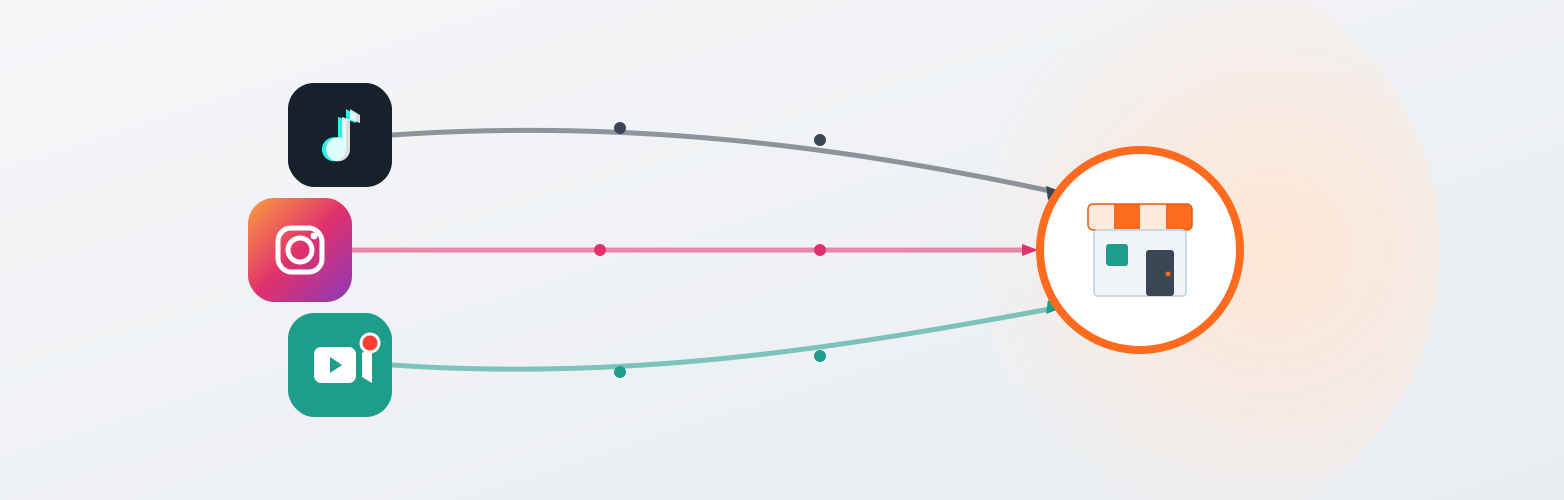
Social commerce is selling products directly through social platforms like TikTok, Instagram and Facebook, so shoppers discover and buy without leaving the app. It goes beyond social media marketing, which drives traffic to a website, by turning the platform itself into the store and checkout. Brands win by combining shoppable content, native tools like TikTok Shop and Instagram Shopping, live commerce and strong social proof, all joined up with their paid media and email.
Social commerce is selling products directly through social media platforms, so the whole journey from discovery to checkout happens inside the app. A shopper sees a product in a TikTok video or an Instagram post, taps, and buys without ever visiting a separate website. The social platform is both the shop window and the till.
This is the key difference from social media marketing. Marketing on social uses posts and ads to drive people to your own website, where they buy. Social commerce removes that step: the transaction completes on the platform itself. Every extra step between wanting a product and owning it loses sales, and social commerce collapses that distance to almost nothing.
It takes several forms: shoppable posts and videos, in-app storefronts, live shopping streams, and creator or affiliate selling. The common thread is that content, community and commerce sit in one place, so your content is not just building awareness, it is directly generating sales.
The scale is hard to ignore. The global social commerce market was worth roughly 1.6 trillion dollars in 2025 and is forecast to keep growing at pace. In the US, social commerce is set to pass 100 billion dollars for the first time in 2026, and globally it is expected to account for more than a fifth of all eCommerce transactions that year, up from around 17% in 2025.
Behind the numbers is a behaviour shift. Younger shoppers in particular treat social platforms as search engines and shopping malls in one, discovering brands through creators and buying on impulse. TikTok Shop alone grew its global merchandise value to around 66 billion dollars in 2025. The path from inspiration to purchase has never been shorter.
For brands, the opportunity is twofold. Social commerce opens a new, fast-growing sales channel, and it is often still cheaper to win on than the mature search and social ad auctions. The brands that build a presence now, before their category gets crowded, establish the content, creators and reviews that are hard for latecomers to catch.

TikTok is the engine room of social commerce. Its algorithm surfaces shoppable content to people likely to buy, so a single strong video can reach far beyond your followers, and TikTok Shop lets them buy in-app. It excels at discovery and impulse, and can take a product from unknown to sold out in days. The winning playbook:
Native, creator-led content. Video that fits the feed and does not look like an advert outperforms polished brand films. Partner with creators whose audiences trust them.
Post consistently and let winners run. Volume feeds the algorithm; when a video takes off, put budget behind it and keep the product in stock.
Use TikTok Shop and live selling. Connect your catalogue so buying is one tap, and run regular lives, where shoppers convert notably better than in feed.
Lean on the affiliate programme. Let creators feature your products for a commission, extending reach with built-in trust.
TikTok suits visually demonstrable, impulse-friendly products best. For a step-by-step guide to setup, catalogue integration and live selling, see our dedicated TikTok Shop for eCommerce guide.
Instagram is the visual storefront of social commerce. Where TikTok drives raw discovery, Instagram is where many brands build a considered, aspirational presence and convert followers who already know them. Its shopping tools turn the whole app into a catalogue. The tools and tactics that work:
Instagram rewards a consistent, high-quality visual identity. It suits brands where aesthetics and lifestyle matter, and it works especially well alongside TikTok: TikTok sparks discovery, Instagram deepens the relationship and closes the sale.
| Strength | TikTok Shop | Instagram Shopping |
|---|---|---|
| Best for | Discovery and impulse | Considered, aspirational buying |
| Reaches | Far beyond your followers | Followers, plus Reels reach |
| Content that wins | Native, creator-led video | Polished visuals and Reels |
Live commerce is the fastest-growing corner of social selling. In a live stream, a host demonstrates products, answers questions in real time, and pins items for viewers to buy as they watch. It recreates the energy of a shopping channel with the interactivity of social media, and it converts unusually well: shoppers are around 1.7 times more likely to buy during a live than from a standard in-feed video. What makes it work:
Regular, longer streams that give the platform time to bring in viewers and let momentum build, rather than one-off short broadcasts.
Genuine demonstration that shows the product in use and answers real questions, since live is about proof, not a scripted pitch.
Live-only urgency through limited-time offers and bundles that reward people for buying during the stream.
Skilled hosts or creators who can hold an audience and respond to comments naturally, which often beats an in-house presenter.
Live commerce rewards consistency more than production values. The first streams are for learning your audience and format; the returns come from showing up regularly and refining what works.
Social commerce runs on trust, and trust on social platforms comes from other people, not from the brand. Social proof, the evidence that real customers use and love your products, is the single most persuasive force in the channel. It is why a creator’s honest review outsells a glossy brand ad.
The practical takeaway is to make social proof a system, not an afterthought. Actively gather customer content, build creator relationships, and put reviews and community front and centre. In social commerce, your customers are your best marketers.
Social commerce is a natural home for B2C brands selling visual, impulse-friendly products. B2B brands often assume none of it applies to them, which is a mistake. The buying cycle is longer, but the principles transfer directly.
The lesson for B2B is not to force in-app checkout, but to borrow B2C’s playbook for discovery, proof and relationship-building. The trust that social commerce creates still shortens the sale.
Social commerce works best as part of a system, not a silo. The brands that win wire it into their paid media and email so each part amplifies the others.
Promote your best organic shoppable content and lives with ads to reach far more buyers than organic alone. Our paid media guide covers the mix.
Impulse first purchases rarely return on their own. Nurturing them with email marketing turns a one-off sale into a repeat customer.
Content drives discovery, ads amplify winners, the platform converts in-app, and retention grows the lifetime value that funds it all. Our eCommerce growth team joins it up.
Social commerce, selling directly through social platforms, was worth around 1.6 trillion dollars globally in 2025 and is heading past a fifth of all eCommerce by 2026. Brands win by running platform-specific playbooks: native creator-led content and TikTok Shop for discovery and impulse, Instagram Shopping for a considered visual storefront, live commerce for real-time conversion, and social proof to build trust. B2C brands are the natural fit, but B2B can borrow the same discovery and proof tactics. Above all, connect social commerce to your paid media and email so content drives discovery, ads amplify the winners, the platform converts in-app, and retention grows lifetime value.
Common questions about social commerce. Get in touch if yours is not here.
Social commerce is selling products directly through social media platforms like TikTok, Instagram and Facebook, so shoppers discover and buy without leaving the app. The platform is both the shop window and the checkout. It includes shoppable posts and videos, in-app storefronts, live shopping and creator selling, bringing content, community and commerce into one place.
The global social commerce market was worth roughly 1.6 trillion dollars in 2025 and is forecast to keep growing quickly. In the US it is set to pass 100 billion dollars for the first time in 2026, and globally it is expected to account for more than a fifth of all eCommerce transactions in 2026, up from around 17% in 2025.
Social media marketing uses posts and ads to drive people to your website, where they buy. Social commerce completes the purchase on the social platform itself, with no separate website visit. The two work together: marketing builds the audience and demand, and social commerce converts it in-app by removing steps between wanting a product and owning it.
It depends on your product and audience. TikTok is strongest for discovery and impulse buying through its algorithm and TikTok Shop, while Instagram excels as a visual storefront that converts followers who already know you. Most successful brands use both, with TikTok sparking discovery and Instagram deepening the relationship.
Live commerce is selling through a live video stream, where a host demonstrates products, answers questions in real time, and pins items for viewers to buy as they watch. It blends the energy of a shopping channel with social interactivity, and converts strongly, with shoppers around 1.7 times more likely to buy during a live than from a standard in-feed video.
Not usually as direct in-app checkout, but the principles absolutely apply. B2B decision-makers are on these platforms and research suppliers there, so a credible social presence shapes who gets shortlisted. B2B brands should borrow the B2C playbook for discovery, social proof, thought leadership and authentic content to build the trust that shortens a longer buying cycle.
Start on the platform where your audience already is, connect your product catalogue to its native shopping tools, and post native, creator-style content consistently. Pick a few hero products rather than your whole range. Then test live selling, build creator relationships, and measure which products and formats drive sales so you can double down on what works.
Paid media amplifies your best organic content and lives to reach more buyers, while the social shop converts that demand in-app. Because social buys discovery, it pairs naturally with the platform that closes the sale. Email then captures the long-term value, turning impulse-driven first purchases into repeat customers, which is what makes the acquisition cost pay off.
→The complete eCommerce guide to paid media
→eCommerce email marketing: flows that drive repeat revenue
Source: Mordor Intelligence, Social Commerce Market.
By the 5MS team, UK eCommerce agency and Adobe Solution Partner. Last updated: July 2026.