
Meta is still the dominant paid channel for B2C eCommerce, and also the easiest place to quietly burn money. Facebook and Instagram put your products in front of enormous, well-targeted audiences, but the platform is happy to spend your budget whether or not it makes you a profit. The difference between a channel that scales your store and one that drains it comes down to structure, audiences, creative and measurement. This guide covers how to run Meta ads for eCommerce properly: the campaign structure that works, the audiences to target, the creative that converts, realistic ROAS benchmarks, and how to connect Meta to your email and on-site conversion so the spend compounds.
It is written for store owners and marketers who want a practical playbook, not platform jargon. Get these fundamentals right and Meta becomes a reliable growth engine rather than a monthly gamble.
Average eCommerce Meta ROAS, 2025
Triple Whale
Typical retargeting ROAS
Triple Whale
Cross-industry video ad ROAS
Billo
Core campaign types to run
Prospecting, retargeting, DPA
To make Meta ads for eCommerce profitable, run three core campaign types, prospecting to reach new audiences, retargeting to re-engage visitors, and dynamic product ads (DPA) to show people the exact items they viewed. Feed them broad, signal-led audiences and scroll-stopping creative, mostly native-style video and user-generated content. Track true return on ad spend against benchmarks (the 2025 eCommerce average is around 2.19x, with retargeting near 3.61x), and connect Meta to your email and on-site conversion so acquired customers turn into repeat revenue. Structure, creative and measurement are what separate a channel that scales from one that wastes budget.
Despite years of predictions to the contrary, Meta remains the workhorse of B2C eCommerce advertising. The reach is unmatched, the buying intent signals are rich, and its machine learning is genuinely good at finding people likely to buy, if you give it the right inputs. For most stores, Facebook and Instagram are still where the largest, most scalable pool of profitable demand lives.
The trouble is that Meta will spend to the objective you set, not the profit you want. Budget leaks in predictable ways: a messy account structure that competes with itself, broad spend with no retargeting to catch warm visitors, weak creative that the algorithm cannot make work, and vanity metrics like reach or clicks standing in for real return. Rising costs and weaker post-privacy tracking punish these mistakes harder than they used to.
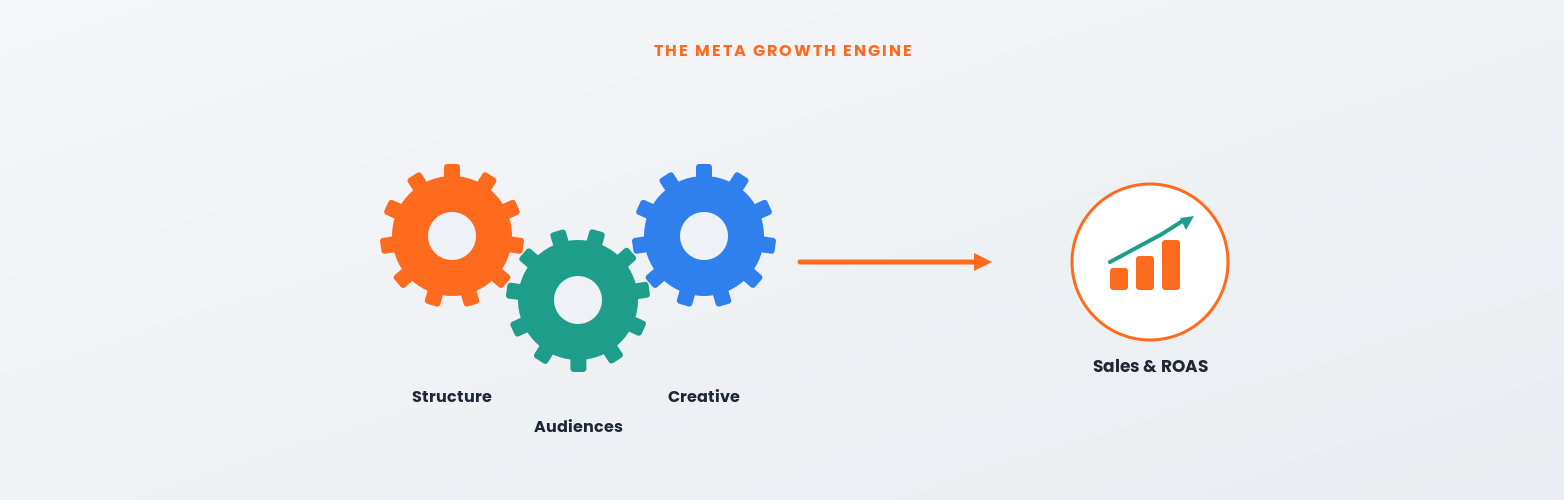
The fix is not a secret hack; it is discipline across four areas: a clean campaign structure, sensible audiences, strong creative, and honest measurement tied to profit. Meta is one lever in a wider system, and it works best alongside the rest of your paid media and on-site conversion. Get the four fundamentals right and the waste largely disappears.
A clean structure lets Meta’s algorithm learn and stops your campaigns bidding against each other. For most eCommerce stores, three campaign types do the heavy lifting. Keep it simple, consolidated and well-funded rather than fragmented into dozens of tiny ad sets.
Reaches new people who do not yet know you, usually with broad or interest-led audiences and your strongest top-of-funnel creative. This is where you fill the funnel, so it carries the most budget and is judged on cost per new customer, not just immediate ROAS.
Re-engages people who visited, viewed products or added to cart but did not buy. It is the most efficient spend on Meta, with retargeting ROAS typically around 3.61x, because you are converting warm demand rather than creating it. Keep it running, but do not over-invest in it at the expense of feeding the top of the funnel.
DPA pulls from your product catalogue to automatically show each person the exact items they viewed or related products, ideal for large ranges. Advantage+ Shopping campaigns let Meta’s AI handle much of the targeting and placement. Both need a healthy, accurate product feed to work, which is a technical job worth doing properly.
Consolidate rather than fragment. Modern Meta rewards fewer, better-funded campaigns that give the algorithm enough conversions to learn from. Splitting budget across many tiny ad sets starves each of the data it needs, which is one of the most common causes of wasted spend.
Audience targeting on Meta has shifted. Since privacy changes reduced granular tracking, the platform increasingly rewards broad targeting powered by your data signals and strong creative, rather than tightly stacked interests. The practical approach:
Feed Meta clean conversion data. Install the Pixel and the Conversions API so the algorithm can optimise on real purchases. This signal quality now matters more than manual targeting.
Go broad for prospecting. Let the algorithm find buyers across a wide audience rather than boxing it into narrow interests. Broad plus strong creative now often beats tightly layered targeting.
Build from first-party data. Use customer lists to create lookalikes of your best buyers, and retarget site and engagement audiences. Your own data is the most valuable targeting asset you have.
Exclude to avoid overlap. Exclude recent purchasers and existing retargeting pools from prospecting so you are not paying to reach the same people twice or advertising to those who just bought.
In short, targeting is now more about the quality of your data signals and creative than clever interest stacking. Give Meta clean purchase data and room to optimise, and it will usually out-target a manually narrowed audience.
On modern Meta, creative is the single biggest lever you control. With targeting largely automated, the ad itself does the heavy lifting of finding and persuading the right buyer. The formats that consistently perform for eCommerce:
Design for sound-off, vertical, mobile viewing, hook attention in the first two seconds, and make the value obvious fast. Since creative is now the main driver of performance, treating it as an ongoing production process rather than a one-off is what keeps Meta profitable as you scale.
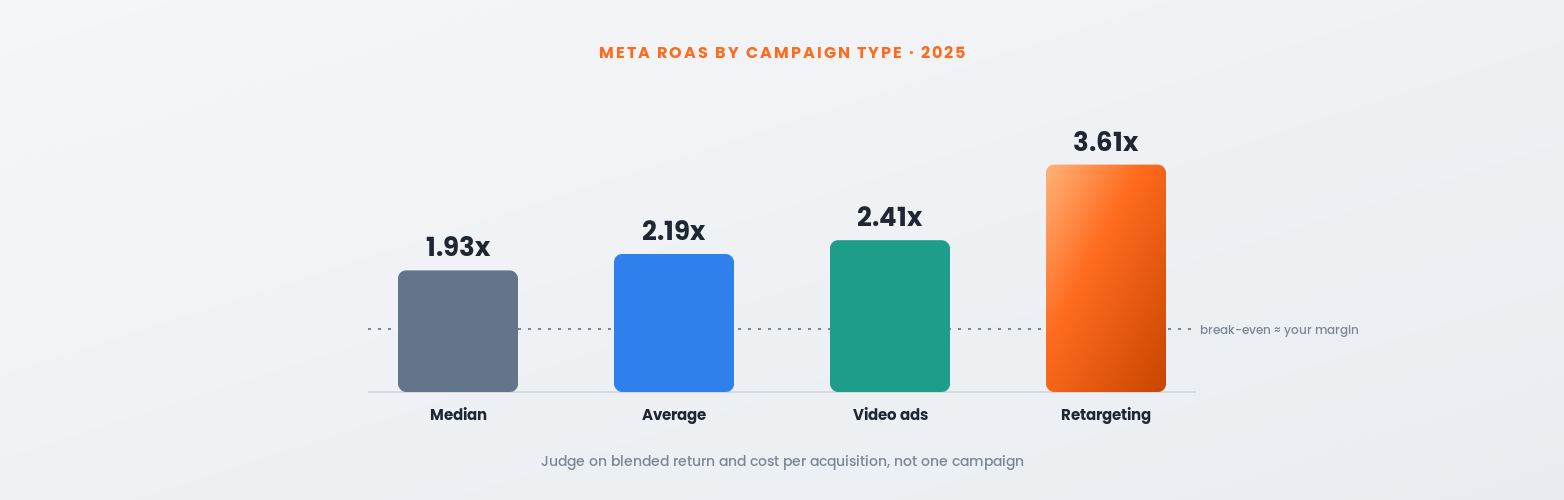
Return on ad spend is the number that matters, but benchmarks are a guide, not a target: your break-even ROAS depends on your margins, so know your own numbers first. That said, here is roughly what the market looked like across eCommerce in 2025, drawn from Triple Whale’s Meta benchmarks.
| Meta ROAS benchmark (2025) | Typical figure |
|---|---|
| Average across industries | around 2.19x |
| Retargeting campaigns | around 3.61x |
| Video ads (cross-industry) | around 2.41x |
| Median across industries | around 1.93x |
These figures vary widely by category, so your own sector tells you far more than the blended average. Use them to sense-check performance, not to set goals. Prospecting will naturally run a lower ROAS than retargeting because it is buying new customers, so judge the account on blended return and cost per acquisition, not one campaign in isolation.
What “good” really means is a blended return that clears your break-even with room for profit, a healthy flow of new customers, and a cost per acquisition you can afford given your customer lifetime value. To judge that honestly you need reliable measurement, which is where clean eCommerce analytics and attribution earn their keep.
Meta rarely works as well in isolation as it does as part of a system. Two connections make the biggest difference to whether your ad spend actually turns a profit. The first is conversion: paid traffic is wasted on a store that does not convert, so on-site experience and conversion rate optimisation directly determine your ROAS. Improving conversion lifts the return on every pound you spend on Meta, which is why fixing the store often beats raising the budget.
The second is retention. Meta is brilliant at acquiring customers, but many first purchases are one-offs unless you capture the customer and nurture them. Feeding new buyers into email and SMS flows, through a tool like Klaviyo, turns a single ad-driven sale into repeat revenue, as we cover in our Klaviyo for Magento guide. A higher lifetime value then lets you afford a higher cost per acquisition, so you can outbid competitors on Meta.
Put together, the flywheel is clear: Meta drives discovery and acquisition, CRO converts the traffic, and email grows the lifetime value that funds more acquisition. It also pairs naturally with organic and social commerce, where the same creative and audiences do double duty. Run Meta as one connected part of that system and the budget stops leaking and starts compounding.
To drive sales and stop wasting budget on Meta ads for eCommerce, run three core campaign types, prospecting, retargeting and dynamic product ads, consolidated so the algorithm can learn. Target broad audiences powered by clean conversion signals and first-party data rather than narrow interests, and make creative, mostly native video and user-generated content, your main lever, testing continuously. Judge performance on blended return and cost per acquisition against benchmarks (the 2025 eCommerce average is around 2.19x, retargeting near 3.61x), and connect Meta to your CRO and email so better conversion lifts ROAS and retention grows the lifetime value that funds more acquisition.
Common questions about Meta ads for eCommerce. Get in touch if yours is not here.
In 2025 the average eCommerce Meta ROAS was around 2.19x, with a median near 1.93x and retargeting around 3.61x. But “good” depends entirely on your margins: a store with high margins can profit at 2x, while a thin-margin store may need 4x or more. Work out your break-even ROAS from your own numbers, then judge campaigns against that rather than a generic benchmark.
Use three core campaign types: prospecting to reach new audiences, retargeting to re-engage visitors and cart abandoners, and dynamic product ads to show people the exact items they viewed. Keep the structure consolidated rather than fragmented into many tiny ad sets, so Meta’s algorithm gets enough conversion data to optimise properly.
Dynamic product ads pull from your product catalogue to automatically show each shopper the specific items they viewed, added to cart or are likely to want, along with related products. They are especially powerful for retargeting and for stores with large ranges. DPA needs a healthy, accurate product feed to work well, which is a technical setup worth getting right.
For prospecting, broad targeting powered by clean conversion data and strong creative now usually beats tightly stacked interests, because privacy changes have pushed Meta toward algorithmic optimisation. Use your first-party customer data for lookalikes and retargeting. The quality of your data signals and creative matters more than manual interest targeting.
Native-style short video and user-generated content are the top performers, with cross-industry video ROAS around 2.41x. Clear product and offer creative converts warm audiences, and carousels or collection ads suit visual ranges. Design for sound-off, vertical, mobile viewing, hook attention in the first two seconds, and keep a steady pipeline of fresh creative because winners fatigue quickly.
The usual causes are a fragmented account structure that starves campaigns of data, no retargeting to convert warm visitors, weak creative the algorithm cannot make work, poor conversion tracking, and a store that does not convert the traffic. Fix the structure, strengthen creative, install the Pixel and Conversions API, and improve on-site conversion, and profitability usually follows.
You do not have to choose. Both run through Meta Ads Manager, and the platform can place your ads across Facebook, Instagram and their networks automatically to find the cheapest conversions. Let Meta optimise placements rather than restricting to one, and focus your energy on creative that works in-feed and in Stories and Reels across both.
Enough to give the algorithm sufficient conversions to learn, then scale with performance. Rather than a fixed figure, work back from your target cost per acquisition and customer lifetime value: if you profitably acquire customers at your CPA, you can keep scaling. Start with a budget that generates a steady flow of conversions, prove profitability, then increase it gradually.
→Klaviyo for Magento: setup and flows that drive revenue
→Social commerce in 2026: how eCommerce brands win
Source: Triple Whale, Facebook Ad Benchmarks by Industry.
By the 5MS team, UK eCommerce agency and Adobe Solution Partner. Last updated: July 2026.