
WooCommerce and Magento are two of the most capable open-source eCommerce platforms available, and both are excellent, for different businesses. The honest answer to WooCommerce vs Magento is not that one is better, but that each fits a different stage and set of requirements. WooCommerce is the natural choice for WordPress-based, content-led stores with a manageable catalogue; Magento comes into its own at scale, in B2B, and where requirements get complex. Choose the wrong one and you either outgrow your platform or pay for power you never use.
This guide gives you a clear, practical way to decide: when WooCommerce is the right call, when Magento is, a side-by-side decision matrix, and what to know if you are switching between them. As an agency that builds on both, our aim is to point you to the platform that actually fits, not the one we would rather sell.

Of online stores run WooCommerce
Store Leads
Of top 1,000 US retailers run Magento
Enterprise strength
Open-source platforms 5MS builds on
Both, done well
Right fit, and it depends on your stage
Not a universal winner
In the WooCommerce vs Magento decision, choose WooCommerce if you are WordPress-based, content-led, and running a small to mid-sized catalogue where speed to launch and lower cost matter most. Choose Magento (Adobe Commerce) if you are scaling, sell B2B or across multiple stores and regions, have a large catalogue, or need complex pricing, integrations and workflows. WooCommerce is cheaper and simpler to start; Magento is more powerful and better for scale, but needs more resource to run. Match the platform to your stage and requirements, not to hype.
There is no universal winner in WooCommerce vs Magento, which is exactly why the comparison is so often unhelpful. Both are mature, open-source and capable of running a serious store. The right choice depends on your business: your scale, your catalogue, your team, your budget and how complex your requirements really are. The market reflects this split. WooCommerce is the most widely used platform, powering roughly a third of all online stores, while Magento powers far fewer sites overall but around 20% of the top 1,000 US retailers, a sign of where its strength lies.
The practical way to decide is to be honest about where you are and where you are heading in the next two to three years. A platform that fits today but you will outgrow in a year is a false economy; equally, buying enterprise power you cannot use or resource is money wasted. Choose for your realistic trajectory, not your ambition or your nostalgia.
Four questions cut through most of the noise: how large and complex is your catalogue, do you sell B2B or across multiple stores and regions, how content-led is your marketing, and what technical resource do you have to run and maintain the store. Hold those in mind as we look at when each platform is the right call.
WooCommerce is a plugin that turns WordPress into an online store, so it inherits WordPress’s flexibility, huge ecosystem and content strengths. It is the right choice when those things matter more than enterprise-scale power. It suits you if:
You are already on WordPress or content-led. If content, blogging and SEO are central to your marketing, WooCommerce lets commerce and content live in one system rather than bolted together.
You have a small to mid-sized catalogue. For hundreds or low thousands of products with straightforward structure, WooCommerce handles it comfortably without the overhead of a heavier platform.
Budget and speed to launch matter. The core plugin is free and hosting is cheaper, so you can launch faster and for less, ideal for newer or leaner stores watching cash.
You want a simpler day to day. A familiar WordPress admin and a vast plugin library make it approachable for smaller teams without dedicated developers.
The trade-off is that WooCommerce can strain as you scale, with large catalogues, heavy traffic or complex requirements, where performance and plugin sprawl become a management burden. Well-built and maintained, though, it powers plenty of serious stores. Our WooCommerce agency guide covers what good looks like.
Magento, now Adobe Commerce, is a dedicated eCommerce platform built for scale and complexity. It is more powerful and more demanding than WooCommerce, and that power pays off when your requirements genuinely need it. It is the better call when:
You are scaling or high-volume. Magento handles large catalogues, high traffic and heavy order volumes natively, which is why it powers a big share of enterprise retailers.
You sell B2B or across multiple stores. Native B2B features, multiple storefronts, currencies and languages from one back end make Magento far stronger for complex, multi-market or wholesale operations.
Your requirements are complex. Advanced pricing rules, custom workflows, deep ERP and third-party integrations, and highly tailored functionality are where Magento’s architecture shines.
You have the resource to run it. Magento rewards a proper development and support partner. With one in place, it scales beautifully; without one, its power becomes a burden.
The trade-off is cost and complexity: Magento needs more hosting, more expertise and ongoing maintenance to stay fast and secure. That is exactly what our Magento support service exists to handle, so the platform’s power works for you rather than against you.
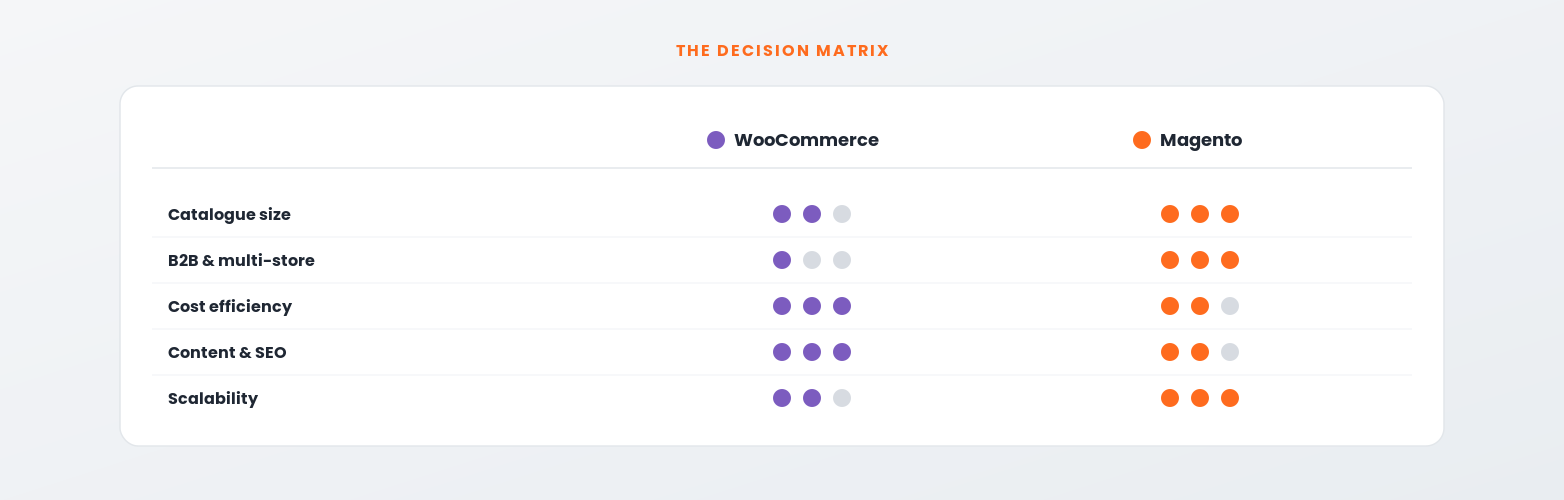
Use this side-by-side to sense-check your instinct against your actual requirements. Read down the factors that matter most to your business, and the pattern usually becomes obvious.
| Factor | WooCommerce | Magento |
|---|---|---|
| Best for | Small to mid-sized, content-led stores | Scaling, enterprise and B2B stores |
| Catalogue size | Hundreds to low thousands | Large and complex catalogues |
| Content and SEO | Excellent, built on WordPress | Capable, less content-native |
| B2B and multi-store | Via plugins, limited | Native and powerful |
| Cost to run | Lower | Higher |
| Technical resource | Modest | Dedicated partner needed |
| Scalability ceiling | Good, with effort at scale | Very high |
If most of your rows point to the same column, your answer is clear. If they are split, weight the factors that will matter most over the next two to three years, usually scale, B2B and complexity on the Magento side, cost, content and simplicity on the WooCommerce side.
A common trigger for this comparison is outgrowing WooCommerce. When a store’s catalogue, traffic or B2B needs start to strain the platform, switching from WooCommerce to Magento is often the right move, and it is a well-trodden path. The key is to treat it as a proper project: migrate products, customers, orders and content carefully, preserve your URLs and SEO, and rebuild rather than simply copy, so you land on a faster, cleaner store rather than porting old problems across.
Done badly, a migration can cost rankings and revenue; done well, it protects both and unlocks growth. Our guide to eCommerce platform migration covers how to do it safely, and it applies whether you are moving up to Magento or consolidating onto WooCommerce.
Because we build and support both platforms, our advice is not tied to selling one. We will tell you honestly whether WooCommerce is fine for where you are, whether Magento is worth the step up, and how to get there without disruption. If you want a straight answer for your store, our eCommerce team is happy to talk it through.
In WooCommerce vs Magento, neither is universally better; the right choice depends on your business. Choose WooCommerce if you are WordPress-based and content-led with a small to mid-sized catalogue, a lower budget and a leaner team, since it is cheaper and simpler to launch and run. Choose Magento, now Adobe Commerce, if you are scaling, sell B2B or across multiple stores and regions, have a large catalogue or complex requirements, and can resource a support partner, because it is more powerful and built for scale. WooCommerce powers roughly a third of all online stores; Magento powers around 20% of the top 1,000 US retailers. Match the platform to your stage and trajectory, and migrate carefully if you outgrow WooCommerce.
Common questions about WooCommerce vs Magento. Get in touch if yours is not here.
Neither is better in absolute terms; they suit different businesses. Magento is more powerful and better for scale, B2B and complex requirements, while WooCommerce is cheaper, simpler and stronger for content-led stores with smaller catalogues. The right choice depends on your scale, catalogue, budget and technical resource, so match the platform to your business rather than chasing the more powerful option.
WooCommerce is generally cheaper. The core plugin is free, hosting is less demanding, and it needs less specialist development to run. Magento (Adobe Commerce) typically costs more in hosting, development and ongoing maintenance, and Adobe Commerce carries a licence fee. That extra cost buys enterprise-grade power, so it is worth it only if your requirements genuinely need it.
It can, up to a point, and with the right build and hosting. WooCommerce runs plenty of successful, sizeable stores. But as catalogues, traffic and complexity grow, it takes increasing effort to keep it fast and manageable, and plugin sprawl becomes a burden. At genuine enterprise scale or with heavy B2B needs, Magento is usually the more natural fit.
Yes, B2B is one of Magento’s biggest strengths. Adobe Commerce includes native B2B features such as company accounts, customer-specific pricing and catalogues, quote requests and multiple storefronts, which WooCommerce can only approximate through plugins. If B2B or wholesale is central to your business, Magento is usually the stronger platform.
Switch when you have genuinely outgrown WooCommerce, when its performance, B2B limits or plugin sprawl are holding back growth. It is a common, well-trodden move. Treat it as a proper migration project: transfer products, customers, orders and content carefully, preserve URLs and SEO, and rebuild rather than copy, so you gain a cleaner, faster store rather than porting old problems.
WooCommerce has the edge for content-led SEO because it runs on WordPress, the leading content platform, so blogging, landing pages and content marketing sit natively alongside your store. Magento is perfectly capable of strong SEO, but it is less content-native. If content marketing is central to your strategy, WooCommerce makes it easier; if not, the difference is minor.
In practice, yes. Magento rewards a dedicated development and support partner to keep it fast, secure and up to date, and to build the complex functionality it enables. WooCommerce is more approachable for a smaller team without in-house developers. Factor ongoing support into your decision: Magento’s power only pays off when it is properly maintained.
Yes. We build and support both WooCommerce and Magento, so our advice is not tied to selling one platform. We will tell you honestly whether WooCommerce fits where you are, whether Magento is worth the step up, and how to migrate safely if you are switching. Get in touch and we will give you a straight recommendation for your store.
→eCommerce platform migration without losing rankings
→Magento support and maintenance services from 5MS
Source: Envisage Digital, Magento Market Share and Growth Statistics.
By the 5MS team, UK eCommerce agency and Adobe Solution Partner. Last updated: July 2026.