
B2B email marketing is not just B2C with a duller tone. The whole game is different: buying cycles run for months, decisions are rational rather than impulsive, and several stakeholders have to agree before anything is signed. Blast the same promotional emails you would send a consumer and you will get ignored. Win instead by nurturing, guiding each contact through a long, considered decision with the right information at the right time, until they are ready to buy. This guide covers how to build B2B nurture flows that actually convert: why B2B is different, the core flows to set up, which platform fits, and how to make it all pay off.
It is written for B2B and B2B eCommerce marketers who know email should be working harder. Get the flows right and email becomes your most efficient pipeline engine, delivering better leads at a lower cost than almost any other channel.
More sales-ready leads from nurturing
Forrester
Lower cost per lead when you nurture
Forrester
Response vs one-off email blasts
Nurture emails
Core nurture flows to build first
Welcome to win-back
B2B email marketing converts by nurturing, not blasting, because B2B buying cycles are long, rational and involve several decision-makers. Build four core nurture flows: a welcome series that sets expectations and educates, a content download nurture that follows up datasheets and guides, a quote request follow-up that keeps deals moving, and a re-engagement flow for leads that have gone quiet. Segment by buying stage and role, keep the tone helpful rather than salesy, and align email with your sales team. Done well, nurturing generates 50% more sales-ready leads at 33% lower cost, per Forrester.
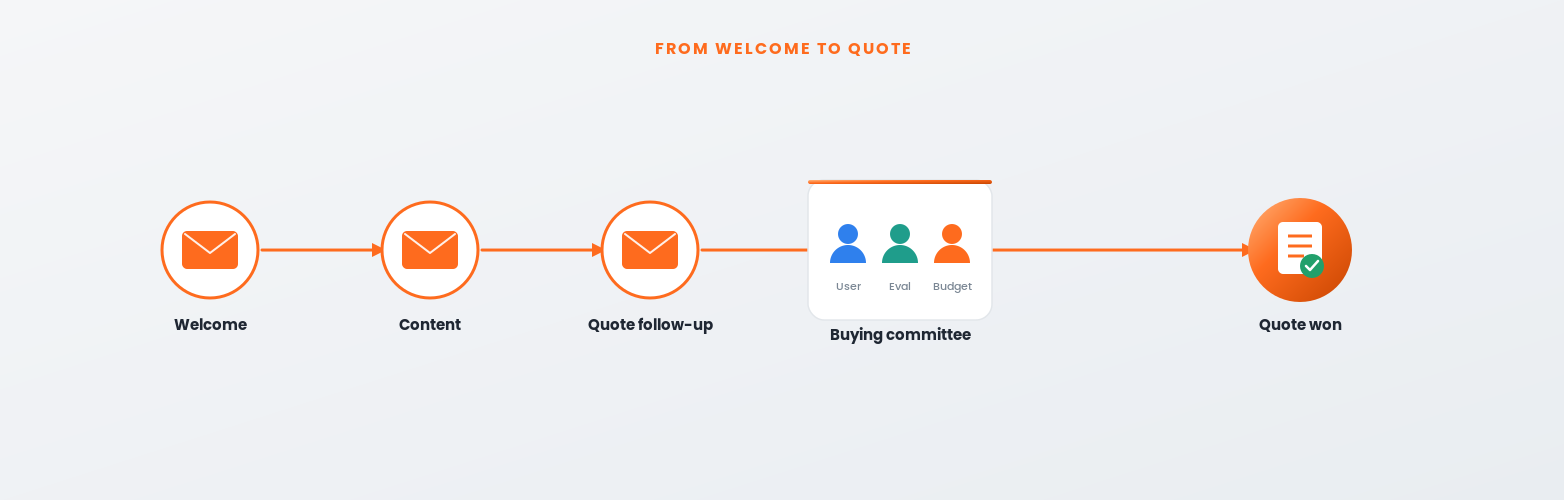
In B2C, email often drives an impulse: see it, want it, buy it, sometimes within minutes. B2B does not work that way, and treating it like B2C is why so much B2B email underperforms. Three differences shape everything. First, the buying cycle is long, often weeks or months of research, comparison and internal discussion, so a single promotional email rarely lands at the exact moment someone is ready. Second, decisions are rational: buyers need evidence, specifications, case studies and reassurance, not urgency and discounts. Third, several people are involved, a user, a technical evaluator, a budget holder, each with different questions and concerns.
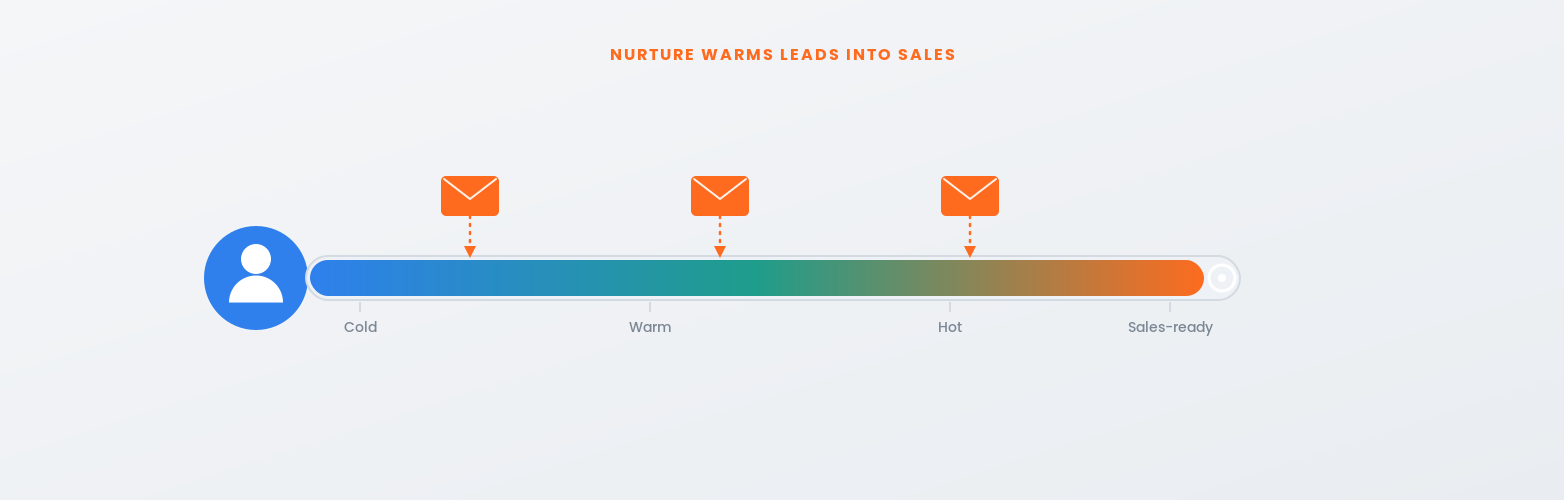
The answer to all three is nurturing. Rather than pushing for the sale, you stay usefully present across the whole cycle, delivering the right information to the right stakeholder at the right stage, so that when the buying committee is ready, you are the obvious, trusted choice. This is why lead nurturing is so effective in B2B: companies that do it well generate 50% more sales-ready leads at 33% lower cost, according to Forrester, and nurture emails earn several times the response of one-off blasts.
Everything that follows flows from this shift in mindset, from selling to helping. The tone is educational, the cadence is patient, and success is measured over the length of the sales cycle, not the day you hit send. Build for that, and email becomes the engine that quietly warms your pipeline while your sales team focuses on the leads that are ready.
These four automated flows map to how B2B buyers actually move, and they are the ones to build first. Each is triggered by a specific action or moment, so it reaches people with the right message at the right time.
Build these as multi-email sequences spaced to match your cycle, not a rush of daily sends. In B2B, patient and relevant beats frequent and pushy, and the flows should hand a lead to sales the moment its behaviour shows it is ready to talk.
The platform you choose should match how complex your B2B sales process is and what you already run. Here is how the three most common choices compare for B2B nurture.
| Platform | Best for | B2B strength |
|---|---|---|
| Dotdigital | Mid-market B2B and B2B eCommerce, especially on Magento | Strong automation, UK support, deep Magento and CRM integration; a capable all-rounder |
| HubSpot | Complex B2B with a real sales pipeline | Full CRM plus marketing automation, lead scoring and sales alignment in one; powerful but pricier |
| Klaviyo | Transactional B2B eCommerce and B2C | Deep store-data and eCommerce flows; less suited to long, committee-led sales cycles |
In short: choose HubSpot if your B2B process is complex and sales-led and you want CRM and marketing in one; choose Dotdigital if you want strong automation with tight Magento and CRM integration, common for UK B2B eCommerce; and choose Klaviyo if your B2B is really transactional eCommerce, where its store-data strengths shine, as we cover in our Klaviyo for Magento guide. The best platform is the one that fits your process and integrates with the systems you already use.
Flows and a platform are the mechanics; these principles are what make them actually convert leads into sales.
Segment by buying stage and role. A technical evaluator and a budget holder need different messages. Segment by where they are in the cycle and who they are, so every email is relevant.
Lead with value, not the pitch. Educate and help. Useful content earns attention and trust across a long cycle far better than repeated calls to buy.
Score leads and align with sales. Use behaviour, opens, clicks, downloads, page visits, to score readiness, and hand hot leads to sales at the right moment. Marketing and sales must work from the same definition of a qualified lead.
Measure over the cycle. Judge B2B email on pipeline and closed revenue over months, not opens on the day. Track influence on deals, not vanity metrics.
At 5MS we build and run B2B email programmes that do exactly this, mapping flows to the real sales cycle, integrating with the CRM, and reporting on pipeline rather than vanity metrics. It sits within our email marketing service and wider eCommerce growth work, and depends on the same clean analytics that make any email programme measurable. If B2B and B2C sit side by side in your business, the discovery and trust tactics in our social commerce guide complement email nicely.
B2B email marketing converts through nurturing, not blasting, because B2B buying is long, rational and committee-led. Build four core automated flows: a welcome and orientation series, a content download nurture, a quote request follow-up, and a re-engagement flow, spaced to match your sales cycle. Choose the platform to fit your process, HubSpot for complex sales-led B2B, Dotdigital for Magento-integrated B2B eCommerce, and Klaviyo for transactional B2B eCommerce. Then segment by buying stage and role, lead with value rather than the pitch, score leads and align with sales, and measure on pipeline and revenue over the cycle. Done well, nurturing generates 50% more sales-ready leads at 33% lower cost, per Forrester.
Common questions about B2B email marketing. Get in touch if yours is not here.
B2B buying cycles are long, decisions are rational and evidence-led, and several stakeholders are involved, whereas B2C is often a quick, emotional, single-person purchase. So B2B email nurtures over time with educational content aimed at different roles, rather than pushing impulse purchases with urgency and discounts. Success is measured on pipeline over months, not opens on the day you send.
A lead nurture flow is an automated email sequence that guides a prospect through a long buying cycle, delivering the right content at the right stage until they are ready to buy. Rather than one promotional blast, it stays helpfully present over weeks or months, builds trust and moves the buying committee toward a decision. The core B2B flows are welcome, content download, quote follow-up and re-engagement.
Start with four: a welcome and orientation series for new subscribers, a content download nurture triggered by datasheet or guide downloads, a quote request follow-up to keep high-intent deals moving, and a re-engagement flow for leads that go quiet. These map to how B2B buyers actually move, and cover the moments where the right email makes the biggest difference.
Choose HubSpot for complex, sales-led B2B where you want CRM and marketing automation with lead scoring in one place. Choose Dotdigital for mid-market B2B and B2B eCommerce, especially on Magento, where you want strong automation and tight integration. Choose Klaviyo when your B2B is really transactional eCommerce and its deep store-data flows are the priority. Match the tool to your sales process.
Yes, it is one of the highest-ROI channels in B2B when done as nurturing rather than blasting. Forrester finds companies with mature lead nurturing generate 50% more sales-ready leads at 33% lower cost, and nurture emails earn several times the response of one-off blasts. The key is patience, relevance and aligning email with sales, not sending more.
Less often than B2C, and spaced to match your sales cycle. A patient cadence of genuinely useful emails over weeks beats a rush of frequent sends that feel pushy and get muted. Let behaviour guide timing: someone actively engaging can be contacted more often, while quiet leads should get spaced, value-led touches rather than pressure.
Measure on pipeline and revenue over the sales cycle, not opens on the day. Track how email influences leads moving from marketing-qualified to sales-qualified to closed, and the cost per sales-ready lead. Opens and clicks are useful signals for engagement and lead scoring, but the real measure is the deals your nurture programme helps create and progress.
Absolutely. B2B nurture works best when marketing and sales agree on what a qualified lead looks like, and when hot leads are handed to sales at the right moment rather than left in an automated flow. Lead scoring based on behaviour is the bridge: it tells you when to stop nurturing and start selling, so no warm opportunity slips through the cracks.
→Klaviyo for Magento: setup and flows that drive revenue
→Social commerce in 2026: what B2B can learn from B2C
Source: HubSpot, Lead Nurturing Statistics (Forrester data).
By the 5MS team, UK eCommerce agency and Adobe Solution Partner. Last updated: July 2026.