
In June 2026 Shopify moved from tolerating vape merchants to removing them, telling stores to strip out every vape and e-cigarette product or face suspension. It was triggered by US regulators, and whether the policy applies to UK stores is genuinely unsettled: Shopify has not confirmed it is global, one US regulator says it is, and some coverage still describes it as US-only. If you sell vapes online in the UK on Shopify, the safe reading is simple, treat your store as at risk and build a plan B now.
Combined with the UK’s fast-changing vaping laws, the disposables ban, the Tobacco and Vapes Act 2026 and the new vape duty from October 2026, the resilient move is a platform you actually own. At 5MS we are a UK eCommerce agency partnered with the major commerce platforms, and we handle store migrations for a living. Here is a clear-eyed look at what changed, what it means, and what a resilient setup looks like.
Shopify removal deadline, 2026
Notices from 24 June
Vape duty per 10ml
From 1 Oct 2026
Eviction risk on a store you own
No category ban by policy
Weeks for a typical migration
Plan it, don’t panic it
In June 2026 Shopify told merchants to remove all vape and e-cigarette (ENDS) products, with a deadline of 7–8 July 2026. It was triggered by US state regulators; whether it applies to UK stores is disputed, as Shopify has not confirmed a global rollout, so the safe stance for a UK vape shop is to treat your store as at risk. Because mainstream payment processors already exclude vape, and UK vaping law is tightening (disposables ban, Tobacco and Vapes Act 2026, and a vape duty from October 2026), the resilient answer is a platform you own. Self-hosted options like Adobe Commerce (Magento) or WooCommerce cannot evict you for selling a legal, regulated product.
Around 24 June 2026, Shopify began sending merchants a notice stating that, due to changes in legal restrictions on the sale of Electronic Nicotine Delivery Systems (ENDS), it no longer supports the sale of these products. Merchants were given until 7–8 July 2026 to remove all vape listings or face product suspension and, ultimately, store termination.
The ban is broad. It covers the entire category: e-cigarettes, e-liquids, pods, disposables, coils, vaping hardware and accessories, regardless of nicotine content and regardless of whether the product is legally sold in your market. This was not a tightening of rules. It was an exit notice for a whole industry on the platform.
The trigger was regulatory pressure in the US, where a coalition of state attorneys general pushed platforms for stronger safeguards on age verification, shipping restrictions and adult signature on delivery. Rather than police it merchant by merchant, Shopify removed the category. That is the pattern to notice: a general-purpose host can decide an entire product line is more trouble than it is worth, and act on it in days.
This is the question every UK retailer is asking, and the honest answer is that the scope is genuinely unsettled. The ban was triggered by US regulators, and some coverage describes it as US-only, with UK stores not currently affected. But a spokesperson for a US attorney general has said the policy applies globally, and when asked directly whether the ban extends beyond the US, Shopify reportedly declined to answer. The notices themselves refer to removing ENDS products regardless of where they are legally sold.
In plain terms: nobody outside Shopify can say with certainty whether a UK vape store is safe today. Given the stakes, the sensible planning assumption is that UK retailers are affected or could be at short notice, rather than betting your business on continued tolerance.
Even if your UK store has not been flagged, building a migration plan now is far cheaper and calmer than an emergency move after a suspension. A plan you never have to use costs little; a scramble after your store is switched off costs sales and rankings.
There is also a commercial reality that predates this ban: the mainstream payment processors do not want vape either. Stripe, PayPal, Square and Shopify Payments all exclude vape and e-cigarette retail in their acceptable-use policies. Many UK Shopify vape shops were already relying on workarounds. The ban simply removes any remaining doubt that a general-purpose hosted platform is a fragile foundation for this industry.
The platform question does not exist in a vacuum. UK vape and tobacco regulation is moving quickly, and every change adds compliance weight to your store. If you are re-platforming anyway, build for the rules that are coming, not just the ones in force today. You can check the current position on the GOV.UK single-use vapes ban guidance and the news that the Tobacco and Vapes Bill became law.
| Change | From | What it means for retailers |
|---|---|---|
| Single-use (disposable) vape ban | 1 June 2025 | Illegal to sell or supply disposable vapes, including non-nicotine, online and in store across the UK. Reusable products remain legal. |
| Tobacco and Vapes Act becomes law | 29 April 2026 | Royal Assent. Brings advertising restrictions, a future retail licensing scheme and stronger Trading Standards powers. |
| Age-of-sale 18 for all nicotine and non-nicotine vapes | 29 October 2026 | Extends the minimum age of 18 to zero-nicotine vapes and other consumer nicotine products (e.g. pouches); free samples banned. Nicotine vapes were already 18+. |
| Vaping Products Duty (vape tax) | 1 October 2026 | Flat duty of £2.20 per 10ml on all e-liquid (nicotine and zero-nicotine), plus VAT. Duty stamps required, with a grace period for pre-duty stock into 2027. Pricing, SKUs and reporting all affected. |
| Generational tobacco ban (born on/after 1 Jan 2009) | 1 January 2027 | Anyone born on or after 1 January 2009 can never legally be sold tobacco. Age checks get progressively more complex over time. |
The through-line is that selling vapes legally in the UK now demands robust age verification, accurate duty-aware pricing, careful marketing and clean record-keeping. That is far easier on a platform you control than on one where a policy email can switch your store off.
Vaping and tobacco regulation is changing rapidly and dates can shift. Always confirm the current rules on GOV.UK or with a qualified adviser before acting on anything here.
It is tempting to read the Shopify story as a vape story. It is really a platform-risk story, and it applies to any regulated or higher-risk category.
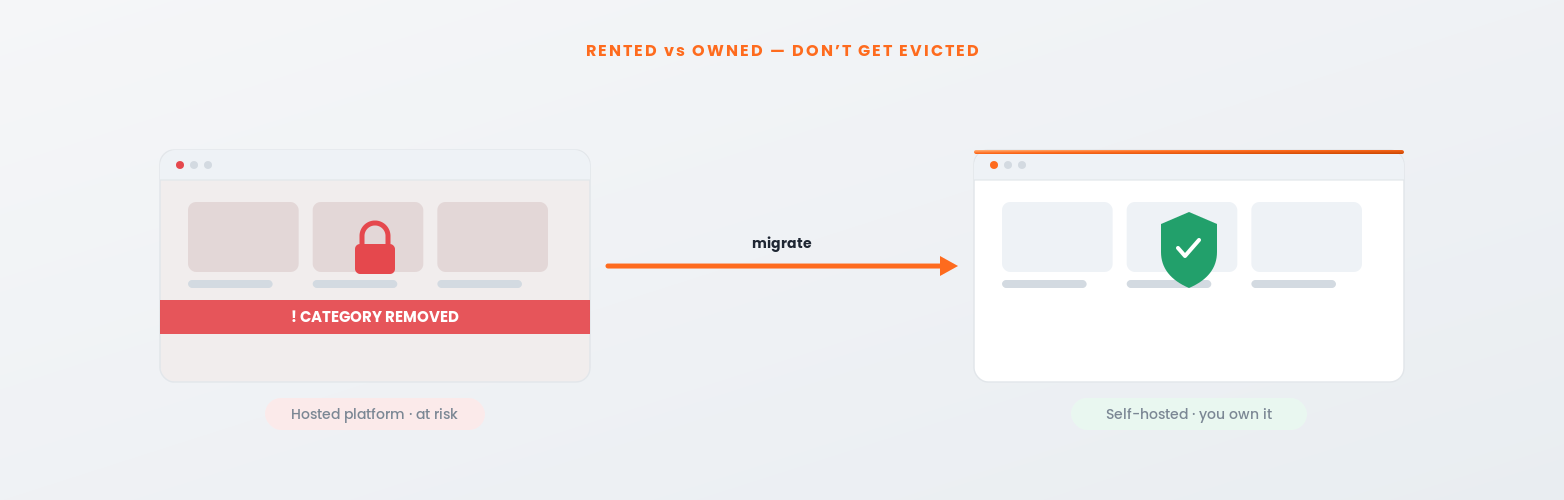
On a hosted, closed platform like Shopify, you are a tenant. The platform sets the rules, and it can change them for commercial, legal or reputational reasons with little notice. Your storefront, your customer-data access, your payment relationship and your ability to trade all sit on someone else’s terms of service. When those terms change, as vape merchants just found out, you can be given days to comply or leave.
Owning your platform flips that. With a self-hosted solution, the software runs on hosting you control, nobody can remove your product category by policy, and you choose your own payment provider. For an industry that is legal but politically sensitive and heavily regulated, that independence is not a nice-to-have. It is the whole point.
There is no single right answer; it depends on your size, catalogue and resources. Here is how the realistic options compare for a UK vape retailer.
| Platform | Model | Eviction risk | Best for |
|---|---|---|---|
| Shopify | Hosted, closed | High. Vape category now removed. | No longer a viable home for vape retail. |
| BigCommerce | Hosted, more open | Medium. More tolerant historically, but still a third-party host that can change policy. | Retailers who want a hosted experience and accept residual platform risk. |
| WooCommerce | Self-hosted (WordPress) | Low. You own it. No category eviction. | Small to mid-size shops wanting control and lower licence costs, with some upkeep. |
| Adobe Commerce (Magento) | Self-hosted / owned | Low. You own it. No category eviction. | Larger or scaling catalogues, complex pricing/duty, multi-store or B2B needs. |
The key split is hosted versus owned. Moving from Shopify to another hosted platform reduces your immediate problem but keeps the underlying risk: you are still a tenant. Moving to a self-hosted platform removes the eviction risk entirely. If you are weighing the two owned options, our WooCommerce vs Magento comparison breaks down which suits which kind of store.
Whichever platform you choose, two things make or break a compliant UK vape store.
Mainstream processors exclude vape, so you will need a high-risk merchant account and gateway through a specialist acquirer. The good news: these specialists integrate with WooCommerce, Adobe Commerce, BigCommerce and custom builds, so your platform choice does not lock you out of payments. Line up the payment provider early, as underwriting can take time.
A self-declared “are you 18?” tick box is not enough in the UK. Online retailers are expected to run a genuine age check against an independent data source before dispatch. Whatever platform you move to, budget for a proper age-verification integration, not just an age gate. With the age-of-sale of 18 extending to zero-nicotine vapes and other nicotine products from 29 October 2026, this only becomes more important.
We are platform-agnostic and we will always recommend what fits the business, but for UK vape retailers coming off Shopify the logic is fairly clear.
In every case, pair the platform with a high-risk payment gateway and a real age-verification step, and build your pricing and reporting around the incoming vape duty. Not sure which partner fits? Our guide to choosing the right eCommerce agency covers what to look for.
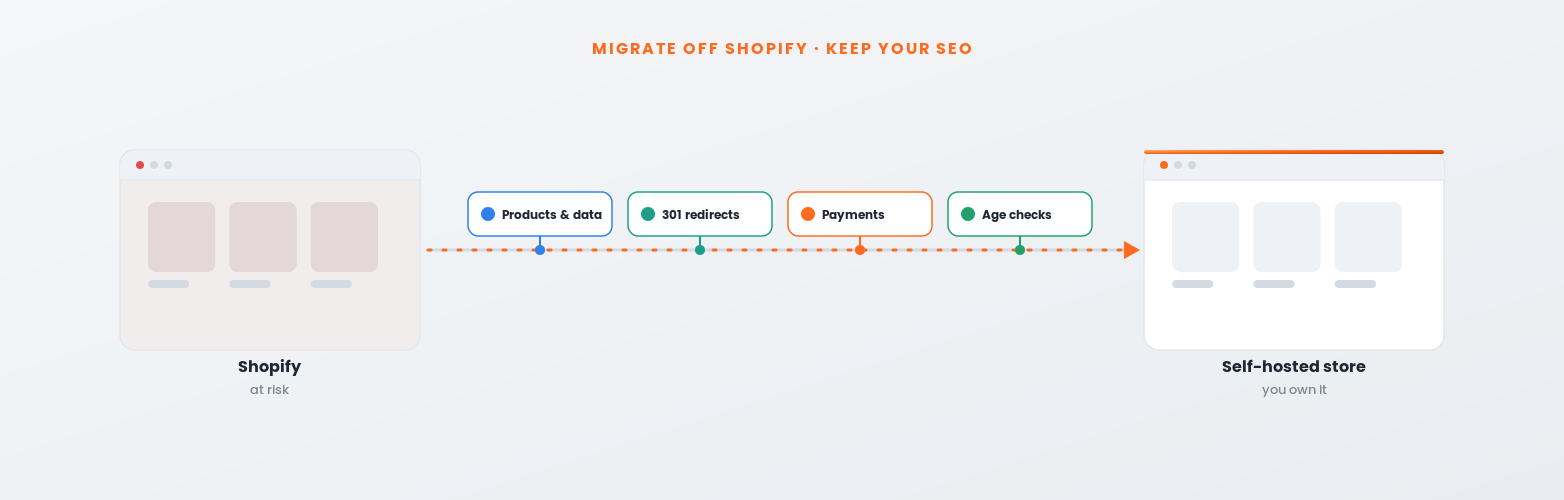
A vape store migration is very doable, and it is mostly project management. A typical move runs about 4 to 8 weeks depending on catalogue size, custom features and integrations. For a sense of how a larger migration is handled end to end, see our large-catalogue Magento migration write-up. The main workstreams:
Done properly, with a full redirect map and clean data, a migration protects your search rankings. The risk is doing it in a panic after a suspension, which is exactly why planning now matters.
In June 2026 Shopify told merchants to remove all vape and e-cigarette (ENDS) products by 7–8 July 2026, triggered by US state regulators. Whether it applies to UK stores is disputed, Shopify has not confirmed a global rollout, so UK vape retailers should treat their store as at risk and plan a migration. Because mainstream payment processors already exclude vape and UK law is tightening (disposables ban, Tobacco and Vapes Act 2026, and a £2.20 per 10ml vape duty from 1 October 2026), the resilient answer is a self-hosted platform you own, such as Adobe Commerce (Magento) or WooCommerce, paired with a high-risk payment gateway and proper age verification. A planned migration of 4 to 8 weeks, with a full 301 redirect map, protects your SEO and removes the risk of category eviction.
Common questions about the Shopify vape ban and moving a UK vape store. Get in touch if yours is not here.
Shopify moved to remove vape and e-cigarette (ENDS) products from stores in 2026, with removal deadlines of 7–8 July 2026. The policy was triggered by US regulators and its global scope is disputed, as Shopify has not confirmed it applies worldwide. UK vape retailers should treat their Shopify store as at risk and plan to migrate rather than rely on continued tolerance.
It is unclear. The ban was triggered by US state regulators, and some coverage describes it as US-only. However, a US attorney general’s spokesperson has said it applies globally, and Shopify reportedly declined to confirm the scope when asked. Given that uncertainty, UK retailers should plan as though they are affected rather than assume they are exempt.
For resilience, a self-hosted platform you own is best because it cannot evict your product category by policy. Adobe Commerce (Magento) suits larger or scaling retailers with complex needs; WooCommerce suits small to mid-size shops wanting control and lower costs. BigCommerce is an option but is still a hosted third party. Whatever you choose, pair it with a high-risk payment gateway and proper age verification.
Both are self-hosted, so neither can evict your category. Choose WooCommerce if you are a small to mid-size shop wanting control and lower running costs with a bit more hands-on upkeep. Choose Adobe Commerce (Magento) if you are larger or scaling, with a big catalogue, complex duty-aware pricing, wholesale/B2B or multi-store needs. Our WooCommerce vs Magento guide compares them in detail.
A typical migration takes 4 to 8 weeks and covers data migration (products, customers, orders), a full 301 redirect map to protect SEO, high-risk payment gateway setup, age-verification integration, duty-aware pricing, and thorough QA on a staging site before launch. Planning ahead avoids an emergency move after a suspension.
Yes. A self-declared age tick box is not sufficient. UK online retailers are expected to verify age against an independent data source before dispatch. With the age-of-sale of 18 extending to zero-nicotine vapes and other consumer nicotine products from 29 October 2026 under the Tobacco and Vapes Act 2026, robust age verification is essential.
From 1 October 2026 the UK introduces a Vaping Products Duty of £2.20 per 10ml of e-liquid, applied to both nicotine and zero-nicotine liquids, with VAT charged on top. Duty stamps are required on packaging, with a grace period for pre-duty stock running into 2027. Pricing, product data and reporting all need to account for it.
Not if it is done properly. A full 301 redirect map from every old Shopify URL to its new equivalent, plus clean data migration, preserves your rankings and backlinks. The real SEO risk is a rushed, unplanned move after a suspension, which is exactly why setting up the migration now, on your terms, matters.
→How we migrate a large-catalogue store without losing SEO
→How to choose the right eCommerce agency
Sources: GOV.UK single-use vapes ban guidance and GOV.UK: Tobacco and Vapes Bill becomes law. Legal dates change, re-check GOV.UK before publishing.
By the 5MS team, UK eCommerce agency and multi-platform migration partner. This article is general information, not legal or tax advice, and reflects the 2026 regulatory position at the time of writing. Last updated: July 2026.