
Magento Support Services:
The Complete Guide for Ecommerce Leaders
Everything you need to know about Magento support services, maintenance plans, SLA expectations, retainer models, and how to choose the right UK partner — before your store pays the price.
In This Guide
What Are Magento Support Services?
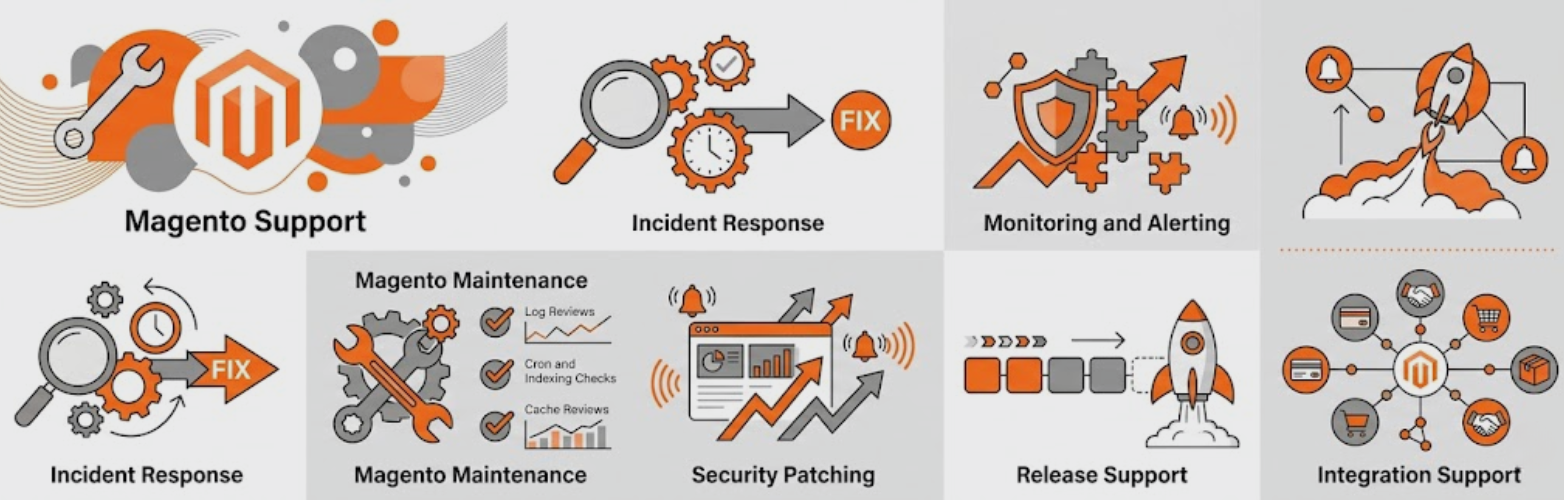
Magento support services are ongoing technical and strategic services provided to merchants running Adobe Commerce (Magento) storefronts. Unlike a one-off development project, support services provide the continuous care that keeps your store secure, performant, and competitive — month after month.
For ecommerce leaders, a well-structured Magento support plan is the operational backbone of your platform investment. It bridges the gap between your team’s capacity and the specialised expertise Magento demands — from security patches and extension compatibility to caching configuration and infrastructure scaling.
Magento’s open-source architecture means unparalleled flexibility — but that flexibility comes with complexity. Unlike SaaS platforms, Adobe Commerce does not manage updates, security patches, infrastructure, or performance tuning on your behalf. That responsibility falls entirely to you, or to a qualified managed Magento support partner.
Adobe Commerce (formerly Magento 2 Enterprise Edition) and Magento Open Source both require active support and maintenance. Adobe Commerce cloud hosting includes infrastructure management, but application-layer support — security patches, custom extensions, performance — still requires a specialist partner or in-house team.
What Is Included in Magento Support Services?
What is included in Magento support services?
Good Magento support services typically include the following core components:
- Security patch management — applying Adobe’s quarterly and emergency security patches
- Performance monitoring & optimisation — uptime checks, load-time audits, caching tuning
- Bug investigation & resolution — fixing errors in core, custom code, and third-party extensions
- Extension & dependency updates — keeping Composer packages, modules, and integrations current
- Server & infrastructure management — PHP, MySQL, Redis, Elasticsearch, Varnish monitoring
- Backup & disaster recovery — scheduled backups, tested restore procedures
- Developer on-call response — SLA-backed access to certified developers for urgent issues
- Quarterly technical reviews — strategic roadmap alignment, performance benchmarking
Security & Patch Management
Adobe releases security patches on a quarterly cycle, with out-of-band emergency patches for critical vulnerabilities. Adobe’s security bulletin page lists every patch — but reading it is the easy part. Applying patches across custom codebases, verifying compatibility with installed extensions, staging, testing, and deploying requires expertise and discipline that most in-house teams lack.
A comprehensive Magento support service monitors Adobe’s releases and applies security patches within defined SLA windows — typically within 24 hours for critical (CVSS 9+) and within 7 days for high-severity patches.
Performance Monitoring & Optimisation
Page load time is one of the highest-leverage variables in ecommerce conversion. Research from Google’s web.dev team consistently shows that every 100ms improvement in load time correlates with measurable lift in conversion rate. Good Magento maintenance includes:
- 24/7 uptime monitoring with immediate alerting
- Core Web Vitals tracking (LCP, FID/INP, CLS)
- Full-page cache (FPC) health monitoring and tuning
- MySQL slow query analysis and index optimisation
- PHP-FPM and OPcache configuration reviews
- CDN cache hit ratio monitoring
Bug Fixes & Development Support
Bugs in a live store cost money every minute they persist. Whether it’s a broken checkout flow, a misbehaving product filter, or a silent payment gateway failure, your support team should be able to triage, diagnose, and resolve issues rapidly. Retainer-based Magento support packages typically include a bank of developer hours per month — enough to handle reactive issues and leave room for small proactive improvements.
Extension & Integration Management
Most production Magento stores run 30–80+ third-party extensions. Extension updates introduce compatibility risks, especially after Magento core upgrades. A managed Magento support partner tracks extension release notes, tests updates in staging, and coordinates upgrades to minimise disruption.
Stores that go 12+ months without extension updates accumulate compatibility debt that can make future Magento upgrades extremely expensive — or force complete rebuilds of custom functionality.
SLA Expectations for Magento Support Plans
A Service Level Agreement (SLA) defines the contractual response and resolution time commitments your support partner makes. Without clear SLAs, “24/7 support” is a marketing phrase, not a binding commitment.
The industry-standard priority framework for Magento support is a four-tier system (P1–P4), aligned to business impact:
| Priority | Definition | Response Time | Resolution Target | Example |
|---|---|---|---|---|
| P1 — Critical | Site down or checkout broken | ≤ 1 hour | ≤ 4 hours | 500 errors on all pages, payment gateway failing |
| P2 — High | Major feature non-functional | ≤ 4 hours | ≤ 24 hours | Search not returning results, account login broken |
| P3 — Medium | Minor feature impaired | ≤ 24 hours | ≤ 5 business days | Wishlist not saving, PDF invoice formatting issue |
| P4 — Low | Cosmetic or informational | ≤ 72 hours | Next sprint | Minor layout misalignment, report discrepancy |
What to Look for in an SLA
Strong Magento support plans do more than state response times. Look for SLAs that specify:
- Business hours vs. 24/7: Is P1 coverage genuine round-the-clock, or only during UK/US business hours?
- Named contacts vs. ticket queues: Does escalation reach a human or a helpdesk bot?
- SLA credits: What compensation do you receive if the partner misses their commitments?
- Uptime guarantees: Is there a stated infrastructure availability SLA (e.g. 99.9%)?
- Communication cadence: How are you kept informed during an active incident?
An SLA without financial or service credits for breach is a promise without teeth. Any credible Magento support partner should be willing to back their commitments with meaningful remedies.
Managed Magento Support vs. Ad-Hoc Development
Many merchants try to handle Magento maintenance through ad-hoc freelancer or agency relationships — calling for help only when something breaks. This reactive model seems cheaper on paper, but consistently proves more expensive in practice.
| Factor | Managed Magento Support | Ad-Hoc / Reactive Only |
|---|---|---|
| Security patching | ✓ Proactive & tracked | ✗ Applied only after breach |
| Incident response | ✓ SLA-guaranteed | ⚡ Best-effort, variable |
| Monthly cost | £1,500–£8,000/mo retainer | £0 until crisis (then £3k–£20k+) |
| Store knowledge | ✓ Deep, accumulated context | ✗ Rebuilt each engagement |
| Performance monitoring | ✓ Continuous | ✗ None until complaints |
| Upgrade planning | ✓ Proactive roadmap | ✗ Forced, rushed upgrades |
| Technical debt accumulation | ✓ Actively managed | ✗ Compounds unchecked |
The fundamental advantage of managed Magento support is institutional knowledge. A retained partner understands your codebase, your integrations, your traffic patterns, and your business cycle. When a P1 incident hits at 11pm on the night of your biggest sale, that context is priceless.
What Unmanaged Magento Stores Risk
Running a Magento store without active support is not a neutral position. The longer a store goes without maintenance, the more it accumulates technical debt, security exposure, and performance degradation — each compounding the others.
⚡ Magecart & Skimming Attacks
Outdated stores are primary targets for Magecart-style JavaScript injection, silently harvesting customer card data. Adobe Commerce has been specifically targeted in multiple high-profile attacks. Unpatched vulnerabilities in checkout pages remain the most common entry point.
📉 Performance Degradation
Without proactive monitoring, caches fill with stale data, MySQL tables fragment, and log files grow unchecked. A store that loads in 2 seconds today may load in 6+ seconds within 18 months — silently eroding conversion rates and SEO rankings.
💰 Upgrade Debt & Rebuild Costs
Every major Magento version skipped makes the eventual upgrade geometrically more expensive. Extensions on incompatible versions, deprecated APIs, and accumulated customisations can turn a manageable upgrade into a full-scale rebuild costing £80,000+.
⚠️ PCI DSS Non-Compliance
PCI DSS compliance requires that ecommerce platforms run supported, patched software. Unmanaged Magento stores routinely fail PCI scans — exposing merchants to fines, card brand penalties, and potential loss of payment processing rights.
📦 Extension Incompatibility Cascade
When one critical extension becomes abandoned or incompatible, it can block all other updates — including security patches. Without a managed approach to dependency tracking, this cascade can lock stores into insecure configurations indefinitely.
🔍 SEO Regression
Core Web Vitals are a confirmed Google ranking factor. Unmonitored Magento stores frequently suffer LCP and CLS regressions after extension updates, costing organic traffic without anyone noticing until rankings have already dropped.
IBM’s Cost of a Data Breach Report puts the average ecommerce breach at $4.88 million globally — including regulatory fines, customer notification, brand damage, and remediation. A fully managed Magento support retainer costs a fraction of a single incident.
Magento Support Packages: Retainer Tier Comparison
Not every store needs enterprise-grade support, and not every budget can sustain it. Good Magento support packages are tiered to match business scale, risk tolerance, and growth stage. Below is a representative framework:
- Security patch monitoring & application
- Monthly performance report
- Uptime monitoring (99.5% SLA)
- P1 response within 4 hours
- 5 developer hours/month
- Extension update tracking
- Proactive optimisation sprints
- Dedicated account manager
- Quarterly technical reviews
- Everything in Essentials
- P1 response within 1 hour (24/7)
- 15 developer hours/month
- Quarterly technical strategy review
- Core Web Vitals monitoring
- Extension & dependency audits
- Staging environment management
- Dedicated account manager
- Custom SLA terms
- Everything in Growth
- P1 response within 30 minutes
- 40+ developer hours/month
- Custom SLA & penalty terms
- Dedicated lead developer
- Monthly architecture reviews
- Proactive A/B & CRO support
- Infrastructure design input
- Executive reporting
The tiers above are a starting framework. A credible support partner will scope your specific store — extension count, traffic profile, integration complexity, and team capabilities — before recommending a tier. Be wary of partners who quote without auditing.
Full Service Magento Retainers vs. Project-Based Work
Most ecommerce businesses have encountered the project-based agency model at some point. A large upfront fee, a defined scope, a delivery date, and then silence. The store launches, momentum briefly spikes, and then gradually decays because nobody is actively improving it. This is sometimes called the black box model: money goes in, deliverables come out, and the workings stay hidden.
A Magento support retainer is the structural opposite. Rather than a series of disconnected projects, you have one accountable team running and improving your store continuously, month after month. The difference in commercial outcome is significant , ecommerce is not a one-time build problem, it is an ongoing operations and optimisation problem.
As a retained team builds deep knowledge of your codebase, traffic patterns, customer behaviour, and seasonal cycles, their interventions become faster and more accurate. A team encountering your store for the first time during a crisis is rebuilding context under pressure. A retained team already has it , and that context is worth more than any individual fix.
The specific problems with project-only models
- Point-in-time results. A project delivers a snapshot. A store that is never optimised after launch gradually loses ground to competitors who are iterating continuously.
- No accountability for outcomes. An agency paid for a deliverable is accountable for the deliverable, not for what it does to your revenue. A retained partner’s relationship depends on demonstrable results.
- Lost knowledge. Every new project , especially with a new vendor , starts cold. The accumulated understanding of your store’s quirks, integrations, and customer patterns is rebuilt each time at your cost.
- Opaque cost. A single project fee with no breakdown makes it impossible to judge value. A good retainer shows you exactly where every hour went each month.
- Slow to respond. Every change needs a new scope and a new quote. When you need to move quickly , before a sale period, after a platform update , that process works against you.
What a full service Magento retainer should include
Not all retainers are built the same. A genuine full service retainer is proactive and covers the whole platform , not just reactive fixes. Here is what it should include:
Full Service Retainer Checklist
If your current retainer only fixes what breaks and never proactively improves your store or shows you where the time went, it is a support contract with a full service label on it. Ask to see the last three monthly reports. If they do not show hours by task and a trend on your key metrics, that is your answer.
How to judge whether a Magento retainer is worth it
The right question is not “what does it cost?” but “what does it return?” A £3,000 retainer that consistently lifts revenue is cheap. A £1,200 retainer that produces nothing measurable is expensive. Judge a retainer on:
- Revenue attribution. Can you tie retainer activity , CRO work, performance improvements, SEO , to measurable revenue changes?
- Transparency of time. You should see exactly where every hour goes. No black box.
- Proactivity ratio. What proportion of the month’s work did the agency initiate versus what you had to chase them for?
- Responsiveness within SLA. Track whether P1 and P2 incidents are resolved within committed windows. Slippage here reveals the real shape of the support operation.
- Trend on core metrics. Load time, checkout conversion, organic traffic, and uptime should trend in the right direction quarter over quarter.
Why a Local UK Magento Agency Wins
The global agency market offers a wide range of Magento expertise. Offshore teams can be technically competent and significantly cheaper per hour than UK alternatives. But for merchants whose stores are central to their business, the case for a local UK Magento agency goes beyond code quality , it comes down to commercial alignment, response speed, and the kind of relationship that produces results over time.
Timezone alignment is not a small thing
When your checkout breaks at 11pm on the Tuesday before Black Friday, the speed of your support partner’s response is determined first and foremost by whether anyone is awake. A UK Magento agency operating in your timezone means P1 incidents get eyes on them immediately, not six hours later when an offshore team starts their day. For merchants where downtime has a direct, measurable cost , and most do , this is not an abstract concern.
Local market knowledge that travels into the work
A UK Magento agency understands the specific commercial context your store operates in: UK payment preferences, consumer protection expectations, VAT handling, courier integrations, seasonal patterns tied to the UK retail calendar, and the regulatory environment relevant to your sector. This is not knowledge you have to brief them on repeatedly , it is embedded in how they approach your store from day one.
What to look for in a local Magento support partner
Not every local agency is the right local agency. Proximity is a necessary condition, not a sufficient one. When evaluating a UK Magento agency for ongoing support, the factors that matter most:
Proven Magento track record
Review their portfolio specifically for Magento and Adobe Commerce projects, not general ecommerce work. Ask for case studies showing how they handled complex integration, migration, or high-traffic incidents. Speak to reference clients directly, not just read testimonials.
Adobe certification and partnership
Adobe Commerce certification signals developers have passed standardised assessments. Verify partnership status via the official Adobe Solution Partner Directory, claimed partnerships are easy to check. Partnership tiers indicate sustained investment in the ecosystem.
Named contacts, not ticket queues
A local agency should be able to tell you exactly who will manage your account and who will pick up a P1 call at 2am. Generic helpdesk routing is not a support relationship, it is the same black box problem in a different container.
Transparent reporting culture
Ask for a sample monthly report before signing. It should show hours by task, incidents raised and resolved versus SLA, performance metric trends, and upcoming risks. If they cannot produce this, the proactive monitoring they promise is probably not happening.
Onboarding depth
A credible agency will invest in a proper technical discovery before committing to scope: codebase audit, extension inventory, server configuration, security posture. Partners who skip this discover your store’s quirks reactively during incidents, when it costs you most.
Clear contract terms
The contract should define SLA response and resolution times with penalty provisions, explicit scope, hour allocation and rollover terms, escalation paths, IP ownership, and notice and transition periods. Vague scope definitions are where support relationships break down.
One practical benefit of a local UK agency that is often underrated: you can meet the team. Visiting the office, seeing the working environment, and getting a direct sense of how the team communicates tells you more about how they will operate during a P1 incident than any proposal can.
How to Evaluate a Magento Support Partner
Choosing a Magento support partner is a long-term relationship decision. The wrong partner costs you more in reactive scrambling, escalating technical debt, and erosion of trust than you’d ever save on a lower retainer fee. Here’s how to evaluate candidates rigorously:
1. Certifications & Adobe Partnership Status
Adobe Commerce certification signals that developers have passed standardised assessments covering Magento architecture, customisation, and best practices. Look for partners with certified Adobe Commerce Developers, Solution Specialists, and — for enterprise engagements — Adobe Solution Partners. Check the Adobe Solution Partner Directory to verify claimed partnership status.
2. Industry Experience & Reference Clients
Ask for at least three reference clients in a similar vertical (B2B vs. B2C, similar order volume, similar tech stack). Speak to those references directly. Ask specifically about incident response experience — how the partner performed under pressure is more revealing than how they perform during normal operations.
3. Onboarding Process & Technical Discovery
A thorough onboarding process is a positive signal. Partners who invest in a deep technical audit — reviewing your codebase, extension inventory, server configuration, and security posture — before committing to a scope are demonstrating the diligence that makes them trustworthy long-term. A partner who wants to sign you up without understanding what they’re taking on should raise flags.
4. Transparency & Reporting
Monthly reporting should show: hours consumed vs. contracted, incidents raised and resolved (with resolution times vs. SLA), security patch status, performance metrics trend, and upcoming risks on the roadmap. If a partner can’t produce a clear monthly report, they can’t demonstrate the value of the retainer — and likely aren’t running the proactive processes they’ve promised.
5. Communication Culture
How a potential partner communicates during the sales process is a proxy for how they’ll communicate during a 2am incident. Do they respond quickly? Are their answers specific and technical, or vague and salesy? Do they proactively share relevant information, or wait to be asked?
Partner Evaluation Checklist
Magento Maintenance: The Technical Essentials

Magento maintenance encompasses the recurring technical activities that keep a production store healthy. Understanding these activities helps ecommerce leaders hold their support partners accountable — and identify gaps in current coverage.
Security Maintenance
- Adobe Security Patches: Applied within defined SLA windows; tested in staging before production deployment
- Dependency audits: Composer packages audited for known CVEs via tools like
composer auditandroave/security-advisories - Admin panel hardening: Two-factor authentication, IP allowlisting, custom admin URL rotation
- WAF & bot protection: Application-layer firewall rules tuned for Magento-specific attack patterns
- PCI DSS scan compliance: Regular ASV scans; remediation of findings
Infrastructure & Server Maintenance
- PHP version management (following PHP supported versions lifecycle)
- MySQL / MariaDB table optimisation, slow query log analysis
- Redis cache health monitoring and memory management
- Elasticsearch / OpenSearch index health and reindexing management
- Varnish cache hit ratio monitoring and VCL tuning
- Log rotation, disk space management, cron health
Application Maintenance
- Full page cache (FPC) warm-up and invalidation management
- Magento cron job health monitoring and error alerting
- Indexer status monitoring and automated reindex scheduling
- Database deadlock detection and resolution
- Order queue and message queue health monitoring
How Often Should Maintenance Happen?
| Task | Frequency | Who Performs It |
|---|---|---|
| Uptime & performance monitoring | Continuous (automated) | Support team tooling |
| Security patch review | Weekly check; apply as released | Support engineer |
| Extension update review | Monthly | Support engineer |
| Database optimisation | Monthly | Support engineer |
| Log review & cleanup | Monthly | Support engineer |
| Backup verification | Monthly | Support engineer + client sign-off |
| Core Web Vitals audit | Quarterly | Support engineer |
| Security penetration test | Annually (minimum) | Specialist third party |
| Full architecture review | Annually | Senior architect |
Ready to Compare Magento Support Tiers?
See exactly what each tier includes, what SLAs are guaranteed, and which level matches your store’s scale and risk profile.
Frequently Asked Questions: Magento Support Services
Conclusion: What Good Magento Support Actually Looks Like
This guide has covered the full picture of Magento support services — from what a well-structured plan includes and the SLA standards you should hold partners to, through the real risks of leaving a store unmanaged, and onto the choices that determine whether your support relationship compounds value or simply treads water.
The tier comparison shows what different levels of investment buy you: entry-level coverage for security and uptime, growth-tier support with proactive optimisation and a dedicated account manager, or enterprise arrangements with sub-30-minute response times and embedded development resource. None of these is universally correct — the right tier depends on your store’s revenue, complexity, and risk profile.
The distinction between a retainer and a project-based model is not just commercial — it is structural. Project work resets knowledge with every engagement. A retained partner builds understanding of your codebase, your seasonal patterns, your customers, and your risks over time. That compounding institutional knowledge is what makes the difference between a support team that is always one step behind and one that catches problems before they cost you anything.
For UK merchants specifically, the case for a local agency goes beyond convenience. Timezone alignment means P1 incidents get immediate attention. Local market knowledge means UK payment preferences, VAT handling, and consumer regulation are understood rather than briefed repeatedly. And the ability to meet the team in person before committing to a long-term relationship is something no video call fully replaces.
The evaluation checklist and the numbered criteria in the local agency section give you a practical framework for due diligence. The strongest signal of a credible support partner is not their sales process — it is whether they can produce a detailed technical discovery, a clear monthly report template, and reference clients willing to speak about how the relationship performed under pressure.
If your current Magento support setup does not give you confidence that someone is actively watching your store, applying patches promptly, and improving the platform month after month — rather than waiting for you to raise a ticket — it is worth reviewing what you are actually paying for. The right partner makes your store a stable, fast, commercially competitive platform. The wrong one is an overhead that leaves you exposed every time something goes wrong. 5MS has supported Magento and Adobe Commerce stores since 2011 as an Adobe Solution Partner — if you want an honest view of where your store stands, start with a conversation.
Talk to 5MS About Your Magento Support
5MS has supported Magento and Adobe Commerce stores since 2011. If you want an honest view of where your store stands and what level of support it actually needs, start with a conversation.
Further Resources
Adobe & Official Resources
- Adobe Commerce Security Bulletins — official patch releases and CVE notifications
- Adobe Solution Partner Directory — verify partner status
- Adobe Commerce Developer Documentation — architecture, APIs, best practices
Performance & Security Standards
- Google web.dev: Performance — Core Web Vitals guidance
- PCI DSS documentation library — compliance requirements for ecommerce
- OWASP Top 10 — web application security risks relevant to Magento