
Paid social is the easiest place in eCommerce to spend a lot and get very little back. Meta and TikTok can put your products in front of huge, well-targeted audiences, but the platforms will happily burn your budget whether or not it turns a profit. Half of eCommerce stores run below a 2.0x return on ad spend, and the difference between a channel that scales your store and one that drains it comes down to structure, creative and measurement, not luck. This guide shows how to actually get ROAS from paid social, and when a paid social advertising agency is worth the money.
It is written for store owners and marketers who want a straight answer on Meta versus TikTok, the campaign structure that works, and whether to run it in-house or hire help. No platform jargon, just what moves the number.
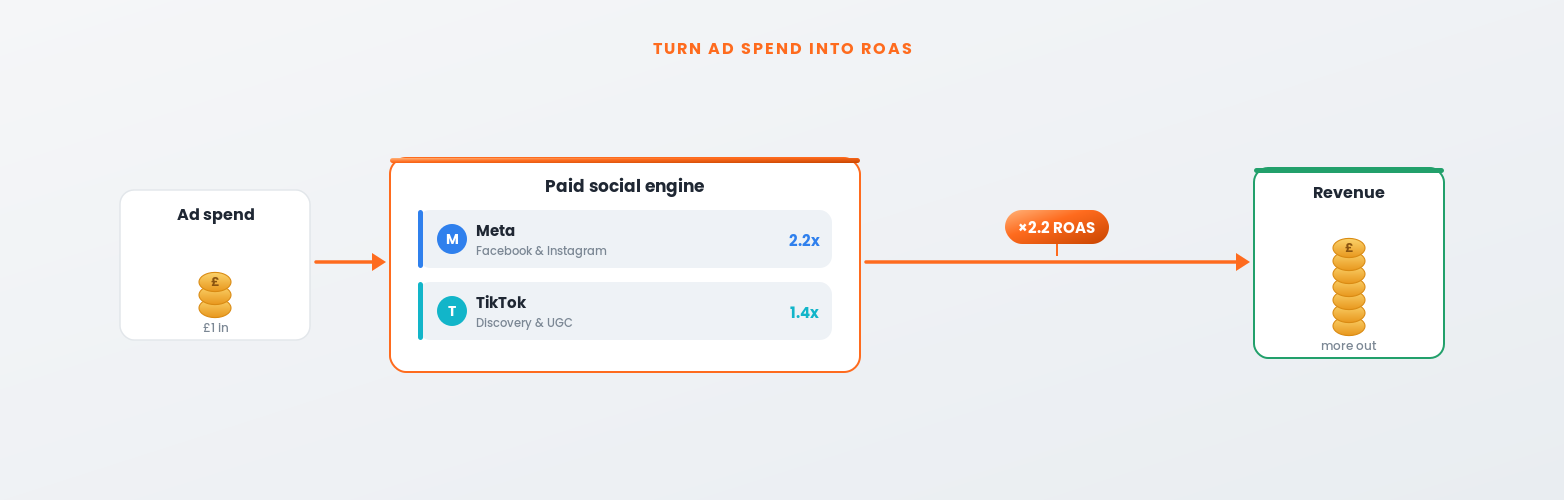
Typical Meta eCommerce ROAS
2026 benchmarks
Typical TikTok ROAS
Improving with creative
Of stores run below 2.0x ROAS
Most are leaking budget
Campaign tiers that get ROAS
Prospect, retarget, retain
To get ROAS from paid social, run a three-tier structure, prospecting to reach new audiences, retargeting to re-engage visitors, and retention to sell again to buyers, feed it broad, signal-led targeting and strong native-style creative, and measure true return, not platform-reported numbers. Meta typically returns around 2.2x for eCommerce and TikTok around 1.4x, so creative and structure matter more than the platform. A paid social advertising agency is worth hiring when you are past a few thousand pounds a month in spend, cannot keep creative fresh, or are not sure your tracking is telling the truth.
Why Paid Social Quietly Wastes Budget
Paid social is not hard to start; it is hard to make profitable. You can launch a campaign in an afternoon, and the platform will happily spend your money and report flattering numbers. But the average eCommerce return on ad spend sat around 2.87x in 2025 and has been drifting down, and roughly half of stores run below 2.0x, which for many is below break-even once product and fulfilment costs are counted.
The waste comes from a few predictable places: no clear structure, so prospecting and retargeting fight each other; weak creative that the platform cannot make work at any price; and measurement that trusts platform-reported ROAS instead of real, blended numbers. Fix those three and paid social becomes a reliable growth channel rather than a monthly gamble, whether you run it yourself or through a paid social advertising agency.
Meta and TikTok both claim credit for sales they only influenced. Judge performance on blended ROAS (total revenue divided by total ad spend) and your real cost per new customer, not the number in the dashboard.
Meta vs TikTok for eCommerce
Most eCommerce paid social budget goes to Meta, with TikTok a fast-growing second. They are not interchangeable, so match the platform to your product, audience and creative capacity.
| Factor | Meta (Facebook & Instagram) | TikTok |
|---|---|---|
| Typical ROAS | Around 2.2x; the workhorse channel | Around 1.4x; improving fast with the right creative |
| Best for | Broad reach, retargeting, proven direct response | Discovery, younger audiences, trend-led products |
| Creative | Native video and UGC beat polished ads | Authentic, native-first video is non-negotiable |
| Targeting | Broad, signal-led (Advantage+) outperforms manual | Broad plus interest signals; creative drives delivery |
For most UK stores, start where the money already works, usually Meta, get the structure and creative right, then test TikTok as a discovery channel once you can feed it native video. For a deeper Meta-specific playbook, see our guide to Meta ads for eCommerce.
The Campaign Structure That Actually Gets ROAS
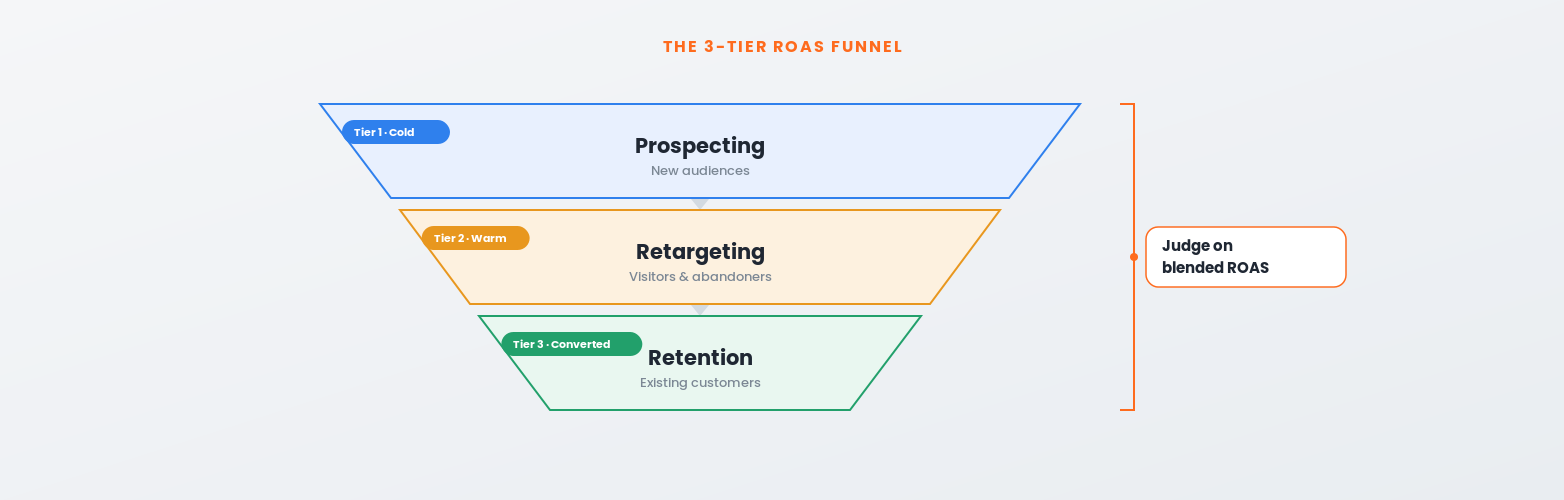
Almost every profitable paid social account runs the same three tiers. Each has a different job, a different audience and a different creative, and keeping them separate is what stops your budget cannibalising itself.
Reach new audiences who have never heard of you. Broad, signal-led targeting and your strongest hook-first creative. This is where you feed the top of the funnel, judged on cost per new customer, not last-click ROAS.
Re-engage people who visited, viewed a product or abandoned a basket. Dynamic product ads and social proof do the heavy lifting here. This tier posts the highest ROAS, but it only scales as far as prospecting fills it.
Sell again to existing customers with new products, bundles and loyalty offers. Cheap, high-return, and where paid social compounds, but often the tier stores forget. Pair it with email and SMS for the best result.
Retargeting always looks like your best-performing campaign because it harvests demand prospecting created. Do not cut prospecting to chase its ROAS, or you starve the whole funnel. Judge the account on blended return, not tier by tier.
Creative and Measurement: The Real Levers
With broad targeting now the norm on both platforms, creative has become the main performance lever. The algorithm finds the audience; your job is to give it ads worth serving. And none of it matters if you cannot measure what actually happened.
Get creative and measurement right and paid social stops being a black box. It becomes a system you can scale with confidence, which is exactly what it should be within your wider eCommerce growth strategy.
When to Hire a Paid Social Advertising Agency
You can run paid social in-house, and plenty of stores do it well at small scale. A paid social advertising agency earns its fee when the account gets big or complex enough that expertise, creative volume and proper measurement pay back more than they cost. These are the signs it is time.
A good paid social advertising agency should be transparent on what it spends and returns, tie its work to your blended ROAS and new-customer cost, produce or direct the creative volume the channel needs, and never lock you out of your own ad accounts or data. If a paid social marketing agency cannot show you real numbers or hands your account to juniors after the pitch, keep looking.
Not sure your paid social is actually profitable?
Paid Social for eCommerce, in Short
To get ROAS from paid social, run a three-tier structure, prospecting for new audiences, retargeting for visitors, and retention for existing customers, feed it broad signal-led targeting and strong native-style creative, and measure blended ROAS and new-customer cost rather than platform-reported numbers. Meta typically returns around 2.2x for eCommerce and TikTok around 1.4x, so creative and structure matter more than the platform, and about half of stores sit below a 2.0x return. Hire a paid social advertising agency when you are past a few thousand pounds a month in spend, cannot keep creative fresh, or are unsure your tracking is telling the truth.
Frequently Asked Questions
Common questions about paid social for eCommerce. Get in touch if yours is not here.
What is a good ROAS for paid social in eCommerce?
It depends on your margins, but as a rough benchmark Meta returns around 2.2x and TikTok around 1.4x for eCommerce, and the average across stores has been near 2.87x and drifting down. About half of stores sit below 2.0x. What matters is your break-even ROAS: the return you need once product, fulfilment and fees are covered. Beat that on blended numbers and you are winning.
Meta or TikTok, which is better for eCommerce?
For most stores Meta is the workhorse, with higher typical ROAS and mature direct-response tools, while TikTok is a strong discovery channel for younger audiences and trend-led products. Start where the money already works, usually Meta, get structure and creative right, then test TikTok once you can feed it authentic native video. Many stores run both.
How should I structure paid social campaigns?
Use three tiers: prospecting to reach new audiences, retargeting to re-engage visitors and abandoners, and retention to sell again to existing customers. Keep them as separate campaigns with their own creative, and judge the account on blended ROAS. Do not cut prospecting to chase retargeting’s high return, or you starve the funnel.
Why is my paid social ROAS dropping?
The most common cause is creative fatigue: the same ads shown too long stop working. Others include over-tight targeting that starves the algorithm, no prospecting so retargeting audiences shrink, and rising competition. Refresh creative constantly, keep targeting broad, and check your tracking is intact so you are optimising to real results.
Do I need a paid social advertising agency?
Not always. At small scale you can run paid social in-house. A paid social advertising agency pays off once you are spending more than a few thousand pounds a month, cannot keep creative fresh, are unsure your tracking is accurate, or keep plateauing when you try to scale. At that point the expertise, creative volume and measurement usually return more than the fee.
What should a paid social advertising agency do for me?
Set up and manage a clean three-tier structure, drive the creative volume and testing the channel needs, get measurement right with server-side tracking and blended reporting, and optimise to your real profit and new-customer cost. It should be transparent on spend and results, and leave you owning your ad accounts and data.
How much should I spend on paid social to start?
Enough to let the platform learn without burning through it before you have data, which for most small stores means a few hundred pounds a week as a starting point, weighted to prospecting and retargeting. Scale only once you have a positive, blended-profitable result and creative you can keep refreshing. Increase budgets gradually so the algorithm can adjust.
Is paid social still worth it in 2026?
Yes, for most eCommerce brands it remains one of the biggest growth channels, but it is less forgiving than it used to be. Rising costs and privacy changes mean sloppy accounts lose money, while well-structured, creative-led, properly measured accounts still scale profitably. The bar has risen, which is exactly why structure and expertise matter more now.
Related Reading
Paid MediaThe eCommerce paid media pillar guide
StrategyWhere paid social fits in a growth strategy
Source: industry ROAS benchmarks for Meta, TikTok and eCommerce. Figures are third-party 2025-2026 estimates and vary by source and vertical, verify against your own account before acting.
By the 5MS team, UK eCommerce agency and Adobe Solution Partner. Last updated: August 2026.