
Most brands try to grow by doing more of one thing, usually spending more on ads. Real, durable growth comes from a system: a converting store, a channel mix that compounds, and the discipline to build it in the right order. This is the 5MS playbook for eCommerce growth strategy, the same framework we use to take brands from stuck to scaling. When we apply it, the results follow: one client grew revenue 60% and purchases 74% without simply buying more traffic.
This pillar guide covers how eCommerce growth actually works, why you fix the foundation first, the five levers that compound over time, platform, conversion, email and retention, paid media and data, and the sequence and roadmap that turn them into a machine. It is long because growth is not one tactic; it is how the parts fit together.
Revenue uplift for a 5MS client
5MS client data
More purchases after foundation work
Same client
Compounding growth levers
One system
Average cart abandonment to win back
Baymard
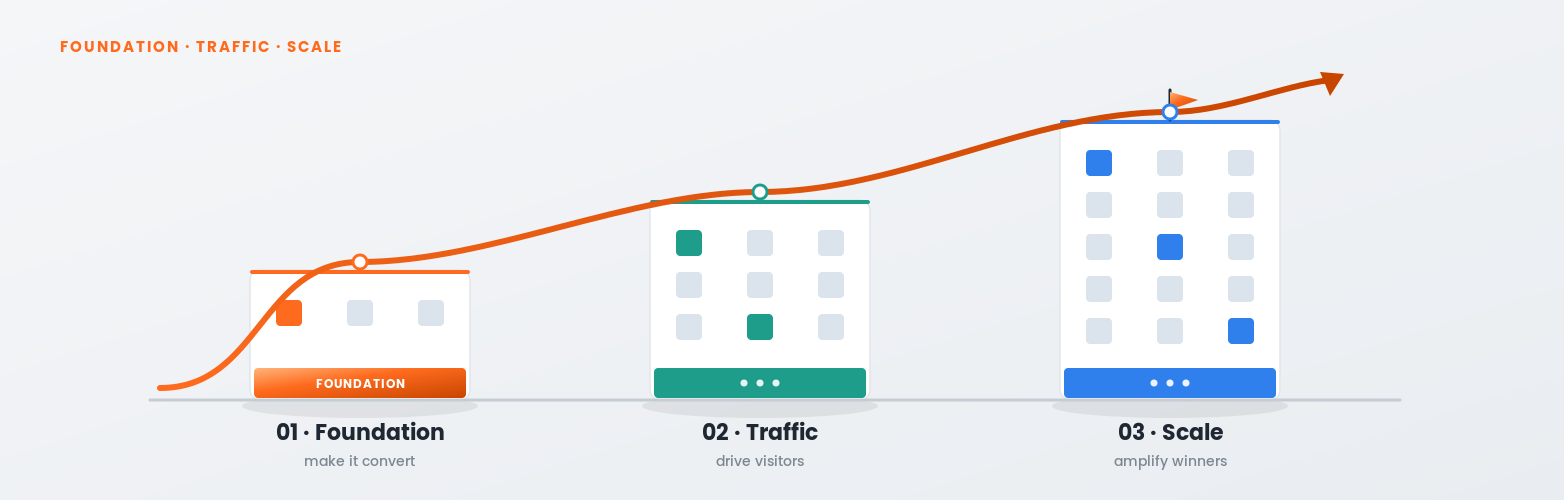
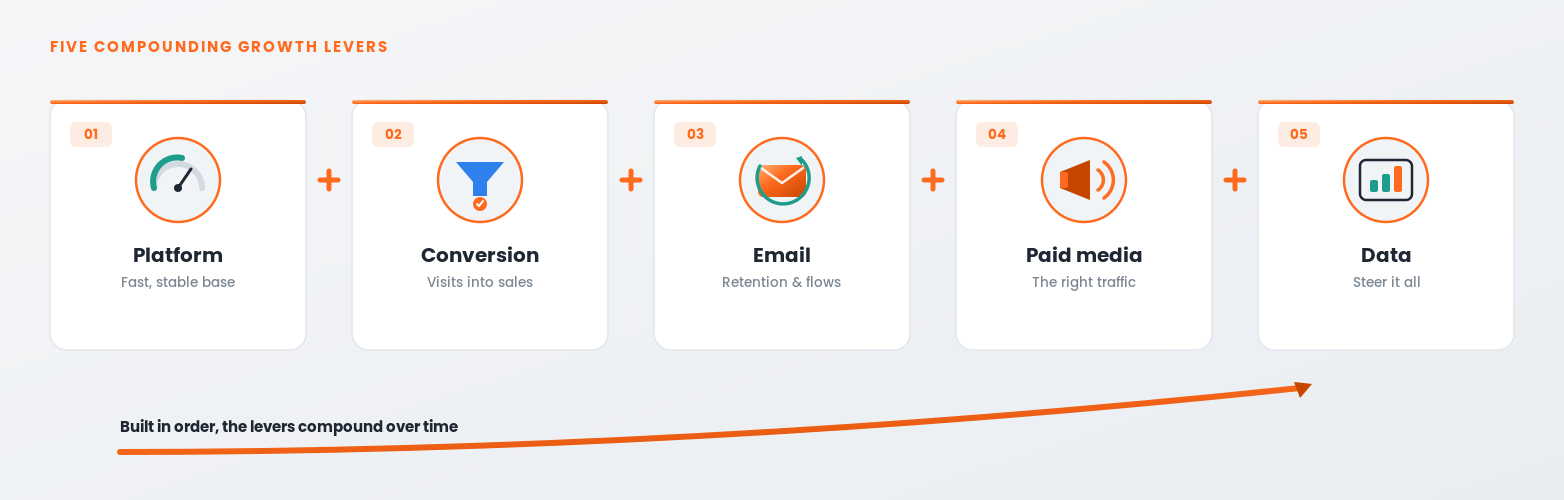
To grow an eCommerce business, build a system rather than chase one tactic. A sound eCommerce growth strategy fixes the foundation first, your platform, speed, UX and checkout, so the store converts, then compounds five levers over time: a fast, stable platform; conversion and UX optimisation; email and retention; paid media and traffic; and the data to steer it all. Build them in sequence, foundation, then traffic, then scale, so each pound of spend lands on a store built to make the most of it. Growth that lasts comes from these parts reinforcing each other, not from a bigger ad budget alone.
📄 In This Playbook
Strip eCommerce growth back to its maths and it is almost embarrassingly simple. Revenue is traffic multiplied by conversion rate multiplied by average order value multiplied by purchase frequency. Grow any one of those four and revenue grows; grow several at once and the effect multiplies. The mistake most brands make is pouring everything into the first term, traffic, while ignoring the other three, which are cheaper to move and compound across every visitor you will ever have.
This matters because the four terms are not equal in cost. Traffic is rented: you pay for every click, prices rise every year, and growth stops the moment the budget does. Conversion rate, order value and frequency are owned: once you improve them, the gain applies to all your traffic, paid and organic, and it keeps paying. A one-point lift in conversion is worth far more than the same percentage lift in traffic, because it costs a fraction as much and never switches off.
Three of the four terms are cheaper to move than traffic, and they compound
A growth strategy, then, is a plan for moving all four terms in the right order and letting them reinforce each other. That is what the rest of this playbook lays out: fix the foundation so conversion is healthy, then build the levers that lift order value and frequency, and only then scale traffic into a machine that is ready for it.
The foundation is everything that decides whether a visitor becomes a buyer: your platform and speed, your UX, your product pages, your checkout, and your retention. Until those convert well, spending on traffic is like filling a leaking bucket, you pay for more water and most of it drains away. The average cart abandonment rate sits at around 70%, most of it caused by fixable friction, which is a vivid measure of how much revenue a weak foundation quietly loses.
Fixing the foundation is the cheapest growth you will ever buy, because it works on the visitors you have already paid for. It is why one 5MS client grew revenue 60% and purchases 74% by making the store convert better rather than buying more clicks. Foundation work also compounds: every improvement applies to all future traffic and makes every future campaign more profitable, so the earlier you do it, the more it returns.
This is the non-negotiable first move, and we cover the philosophy and the conversion maths in depth in our companion guide, why fixing your foundation beats more ad spend. The rest of this playbook assumes you are committed to that order, and shows how the five levers build on it.
Everything else sits on your platform, so it has to be fast, stable and able to scale. A slow site loses sales before UX even gets a chance: shoppers abandon pages that take too long to load, and search engines rank them lower, so a performance problem is both a conversion problem and a traffic problem. Core Web Vitals, mobile speed and reliable uptime are not technical vanity, they are revenue infrastructure.
The right platform depends on your stage and complexity. Large catalogues, complex pricing and high order volumes are well served by Magento and Adobe Commerce; leaner operations often do better on Shopify or WooCommerce. What matters is that the platform is not holding you back with slow pages, fragile integrations or a checkout you cannot optimise. If it is, a platform migration can itself be a growth lever, though only when done carefully to protect existing rankings and revenue.
Performance is not a one-off project either. It decays as you add apps, images and third-party scripts, so it needs ongoing attention. Keeping the store fast, secure and up to date is exactly the kind of proactive work that a good eCommerce partner handles month after month, protecting the foundation the other four levers depend on.
Conversion rate optimisation is the highest-leverage lever you have, because it multiplies the value of every visitor at once. On a store receiving three million visitors a year, lifting conversion from 1% to 2% is the difference between 30,000 and 60,000 orders, a doubling of sales from the same traffic and the same spend. To achieve that through traffic alone you would have to double your ad budget and absorb rising click costs, which is why CRO is almost always the better first investment.
Good CRO is not guesswork or a pile of best-practice tips; it is a disciplined cycle of finding where the store leaks, forming a hypothesis, testing a change and measuring the result. The usual suspects are product pages that fail to answer buyer questions, a checkout with too many fields or forced account creation, and a mobile experience that lags desktop, mobile typically converts around 2.9% against 3.9% on desktop, despite carrying most of the traffic. Closing that gap is often the single biggest win available.
Conversion and UX are two sides of the same coin: UX makes the store easy and trustworthy to use, and CRO proves which changes actually lift revenue. Our eCommerce UX guide and conversion rate optimisation guide go deep on both, but the principle for your growth strategy is simple: treat CRO as an ongoing habit, not a one-off, because it is the lever that makes every other lever pay off more.
Acquisition gets the attention, but retention is where the profit is. Winning a new customer costs money; selling again to one you already have costs almost nothing, and repeat customers spend far more over their lifetime than first-time buyers. This is why email and retention are a core growth lever rather than a marketing afterthought: they raise two of the four revenue terms, order value and frequency, at the lowest cost of any channel.
Email does the heavy lifting. Top brands generate 30 to 40% of total revenue from email and SMS, and automated flows, abandoned cart, welcome, post-purchase and win-back, earn roughly 18 times more per recipient than one-off campaigns. For most B2C stores that runs through Klaviyo, and setting it up properly on Magento is a fast, high-return project; our Klaviyo for Magento guide covers the flows to build first.
Retention also makes the other levers stronger. A higher repeat purchase rate and lifetime value mean you can afford to spend more to acquire a customer, which lets you outbid competitors when you turn on paid media. In other words, retention is not just a channel, it is the fuel that makes acquisition profitable. Build it with a strong post-purchase experience, loyalty, and consistent, segmented email marketing.
Traffic is the lever everyone reaches for first, and it belongs last for a reason. Paid media, search, social and shopping ads, SEO and content, is genuinely powerful, but only once the store converts and retains. Drive traffic into a leaking store and you amplify the leak; drive it into a converting one and every pound works several times harder. Sequence is everything: the same campaign that loses money on a broken store makes money on a fixed one.
When you are ready, balance the mix. Paid search and shopping capture existing demand; paid social and creator content create it; SEO and content compound over time as the cheapest long-term traffic you can build. The right blend depends on your margins, product and audience, and it should be steered by what actually converts and retains, not by which channel is fashionable. Our eCommerce paid media guide covers how to balance TikTok, Meta and Google spend.
The discipline that separates profitable scaling from burning budget is knowing your numbers. Once you know your conversion rate, average order value and customer lifetime value, you can calculate what you can afford to pay to acquire a customer and still profit. Scale the channels that clear that bar, and pause the ones that do not. That is only possible with good data, which is the fifth lever.
Data is the lever that steers all the others. Without reliable analytics you are guessing: you cannot tell which traffic converts, where the checkout leaks, or whether a change helped. With it, every decision becomes a measured bet rather than a hunch. This is why a proper analytics setup, accurate GA4 tracking, clean attribution and a clear reporting cadence, is not back-office admin but the control system for growth.
Focus on the metrics that point to an action rather than a wall of numbers. The conversion gap between mobile and desktop tells you where to invest development; email-attributed revenue tells you whether your flows are working; the lifetime value to acquisition cost ratio tells you whether scaling is profitable. Our guide to the eCommerce KPIs that actually matter covers the seven to track, and our eCommerce analytics guide covers how to set them up.
Good data closes the loop. It confirms which foundation fixes worked, which CRO tests to keep, which flows to expand and which paid channels to scale, so the whole system improves with each cycle instead of drifting. A growth strategy without measurement is just a set of opinions; with it, it becomes a compounding machine.
The levers are powerful alone, but the real growth comes from how they reinforce each other. A fast platform lifts conversion and SEO. Higher conversion makes paid media profitable. Profitable paid media brings customers that retention turns into repeat buyers. Higher lifetime value lets you spend more to acquire, which lets you scale traffic further. Data steers the whole loop. Built in the right order, each lever makes the next one work harder, which is why the growth accelerates over time rather than plateauing. Here is the sequence.
Audit and fix the platform, speed, UX and checkout, and set up clean analytics. Stand up the core email flows. The goal is a store that converts and a dashboard you can trust.
Run a continuous CRO programme, close the mobile gap, and deepen retention with post-purchase, loyalty and segmentation. Prove the store converts and keeps customers before you scale spend.
With a converting, retaining store and trusted data, turn on and scale paid media, expand SEO and content, and reinvest the higher margins. Now growth compounds, because every lever is pulling together.
This is exactly the sequence we run for clients, and it is why the results compound rather than spike and fade. If you would like us to map it to your store, our eCommerce growth team does precisely this, foundation, levers and roadmap, as one joined-up programme.
To grow an eCommerce business, build a system, not a single tactic. Fix the foundation first, your platform, speed, UX and checkout, so the store converts, because that works on traffic you already pay for and the average cart abandonment rate of around 70% shows how much a weak foundation loses. Then compound five levers: a fast, stable platform; conversion and UX optimisation; email and retention; paid media and traffic; and the data to steer it all. Build them in sequence, foundation, then convert and retain, then scale traffic, so each pound of spend lands on a store ready for it. Growth that lasts comes from the parts reinforcing each other, which is how one 5MS client grew revenue 60% and purchases 74%.
Common questions about eCommerce growth strategy. Get in touch if yours is not here.
Build a system rather than chase one tactic. Fix the foundation first so the store converts, then compound five levers: platform and performance, conversion and UX, email and retention, paid media and traffic, and data and analytics. Build them in sequence, foundation, then convert and retain, then scale traffic, so each pound of spend lands on a store ready to make the most of it.
The most reliable strategy is foundation first, then compound the levers. Improving conversion, order value and frequency is cheaper and more durable than buying more traffic, because it works on visitors you already have and keeps paying after you stop spending. Traffic comes last, once the store converts and retains, so your spend amplifies a machine that works rather than a leak.
Fix the site first in almost every case. Driving more paid traffic to a store that converts poorly wastes most of that spend. Improving conversion applies to all your traffic at once and keeps working after the budget stops, whereas ad-driven growth ends the moment you stop paying. Only scale ads once the store converts and retains profitably.
Expect foundation work and early conversion wins within the first three months, deeper CRO and retention gains by month six, and compounding growth from scaled traffic through months six to twelve. It is a programme, not a campaign: the returns build as the levers start reinforcing each other, which is why the trajectory accelerates rather than spiking and fading.
After the foundation, start with the lever showing the biggest, cheapest gap. For most stores that is conversion, usually closing the mobile gap, or email, if the core flows are missing. Both work on traffic you already have, so they pay back fastest. A growth audit will tell you which lever to prioritise for your specific store.
Because it raises order value and purchase frequency at almost no cost, and it makes acquisition profitable. Repeat customers spend far more over their lifetime than first-time buyers, and a higher lifetime value lets you afford to spend more to acquire customers, so you can outbid competitors when you scale paid media. Retention is both a channel and the fuel for acquisition.
Not always. You only need to migrate if your current platform is genuinely holding you back with slow pages, fragile integrations or a checkout you cannot optimise. If it is, a careful migration can be a growth lever in itself, but it must protect your existing rankings and revenue. For many stores, fixing performance and UX on the current platform is enough.
You are ready when your conversion rate is healthy for your sector, you know your numbers (conversion, average order value and lifetime value), retention is working, and a test campaign is profitable. At that point scaling amplifies a machine that works. A free growth audit will show exactly where your foundation stands and which lever to pull next.
→eCommerce conversion rate optimisation: turn more visitors into buyers
→The complete eCommerce guide to paid media
→The complete guide to eCommerce analytics that drives growth
Source: Baymard Institute, Cart Abandonment Rate Statistics.
By the 5MS team, UK eCommerce agency and Adobe Solution Partner. Last updated: July 2026.