
SEO vs paid media sits at the centre of most ecommerce budgeting decisions. SEO builds steady demand you do not pay per click for. Paid media buys attention fast, then stops the moment spend stops. The right split depends on margins, stock reliability, growth strategies, and how well your site turns visits into orders.
This article gives a practical way to allocate budget, plus examples and tracking signals you can trust.
Table of Contents
What Does SEO vs Paid Media Mean In Ecommerce?
SEO vs paid media compares two ways to win ecommerce traffic and sales.
SEO grows unpaid visibility through technical SEO, stronger category and product pages, internal linking, and content that supports buying decisions. Paid media drives traffic through platforms like Google Ads (Shopping, Search, Performance Max) and paid social.

Quick difference that matters in budgeting:
- SEO spend pays for capability and assets on your site
- Paid media spend pays for clicks and impressions through an ad platform
SEO vs Paid Media: Which One Drives Revenue Faster?
Paid media usually drives revenue faster because targeting, bids, budgets, and creative can change quickly. SEO usually takes longer because rankings need time to build, plus search engines need to crawl and trust your pages.
A clean way to think about SEO vs paid media:
- SEO brings compounding returns and lower marginal acquisition cost later
- Paid media brings speed and control
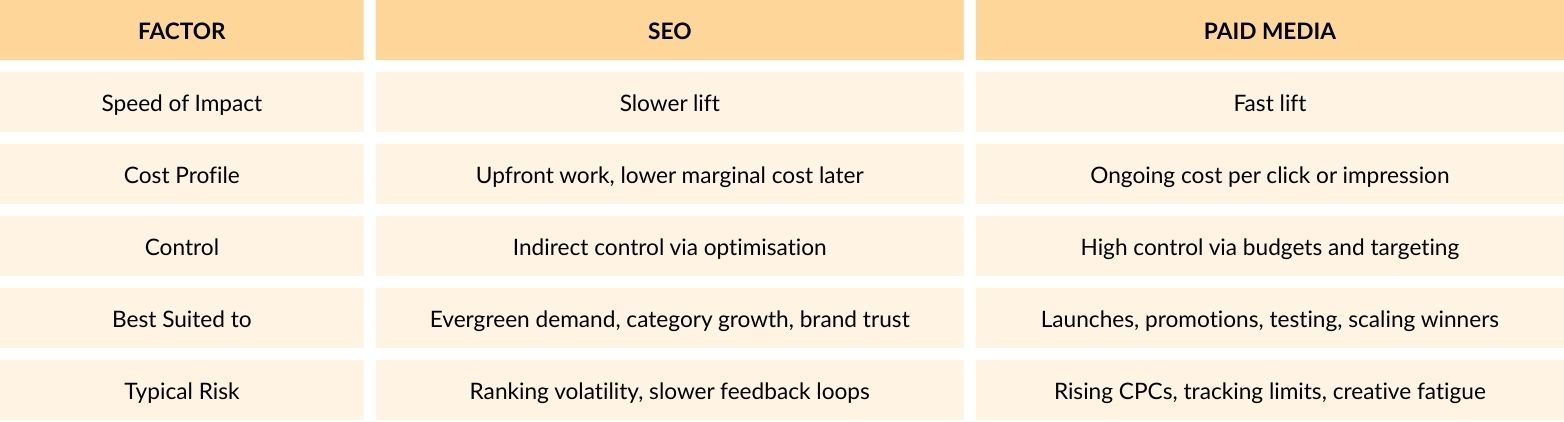
For many ecommerce brands, the strongest outcome comes through a blended approach where SEO and paid media support each other on the same landing pages and product range.
When SEO Deserves More Budget
SEO deserves more budget when your store can benefit from durable demand capture and stronger profitability over time.
You Sell Products With Stable Search Demand
Evergreen categories thrive with SEO. Think “running shoes”, “office chairs”, “silver earrings”, “protein powder”, “workwear trousers”. People search for these categories year-round, then compare options before purchasing.
SEO work that tends to move the needle:
- Optimised category pages with clear intent matching
- Internal linking that pushes authority into priority categories
- Structured data and clean indexation
- Product page content that answers buyer questions quickly
Your Margins Need Lower Acquisition Cost
If paid media requires heavy discounting to convert, SEO can reduce reliance on aggressive offers. Organic clicks still require investment, yet no cost per click sits on each order.
Your Site Already Converts Well
Strong conversion rate makes SEO returns more attractive because each extra organic click has a higher chance of turning into revenue. Before pushing spend hard into paid media, check product page clarity, delivery info, returns messaging, trust signals, and checkout friction.
You Want Better Resilience Against Ad Cost Volatility
Paid media costs can rise with competition and seasonality. Organic rankings add balance. A brand with consistent organic demand tends to handle price swings in paid channels with less stress.
When Paid Media Deserves More Budget
Paid media deserves more budget when speed, testing, or targeting precision matters most.
You Need Demand Fast For A Launch Or Seasonal Push
Paid media can put a new range in front of buyers quickly, especially through Shopping and paid social. That speed helps when launching products, clearing stock, or supporting seasonal peaks.
You Need Clear Testing Signals
Paid media helps test:
- New product positioning and offers
- Price sensitivity
- Category expansion ideas
- Creative hooks and messaging angles
Those learnings can feed back into SEO decisions, especially on-page copy, category naming, and content priorities.
You Have Strong Stock Control And Fast Fulfilment
Paid can scale quickly, so fulfilment needs to keep up. A smooth operation makes paid growth far safer.
Your Category Runs On Visual Discovery
Fashion, home decor, beauty, and gift-led products often benefit heavily from paid social discovery, then paid search catches high intent demand. SEO still matters, yet paid media often carries more of the growth load.
How To Split Budget Without Overcomplicating It
Start with two baselines, then allocate the remaining budget to the biggest profit opportunity.
Step 1: Set A Baseline SEO Budget
This baseline keeps organic growth moving and prevents technical decay.
Include:
- Technical monitoring and fixes (crawl errors, canonicals, indexation, speed)
- Category page optimisation for priority ranges
- Product page improvements for top sellers
- Internal linking maintenance
- Content updates tied to buying intent
Step 2: Set A Baseline Paid Media Budget
This baseline keeps the engine running on what already performs.
Include:
- Branded search protection
- Profitable Shopping or Search segments
- Remarketing with caps tied to margin and refund risk
- Ongoing feed health work
Step 3: Allocate The Remaining Budget Based On Marginal Profit
Ask one question: Where will the next £1,000 create the biggest uplift in gross profit, not revenue?
Good candidates often look like this:
- Fixing feed issues blocking Shopping visibility
- Improving conversion rate on a high-traffic category page
- Scaling a proven paid segment with stable CPA
- Building category content that targets high intent modifiers such as “best”, “top”, “size guide”, “comparison”
- Strengthening internal links into a profitable range sitting near page one
This keeps the SEO vs paid media decision tied to commercial outcomes, not channel preference.
Five Underused Angles That Change The Split
1) Stock Risk Should Shape Budget Allocation
Low stock plus rising traffic creates waste and frustration. Paid media can throttle quickly when stock dips. SEO investment still makes sense, yet priority categories should align with stock depth and fulfilment reliability.
Practical rule:
- Stable stock categories earn higher SEO priority
- Volatile stock categories lean more on paid media that can scale up and down
2) Landing Page Quality Impacts Both Channels
Weak landing pages harm paid performance and organic performance at the same time. The budget split matters less than page quality once traffic arrives.
High-impact fixes that support SEO vs paid media together:
- Clearer delivery and returns messaging above the fold
- Stronger product imagery and variant clarity
- Trust signals near add-to-basket
- Faster mobile performance
- Better internal linking between related products and categories
3) Paid Search Terms Can Improve SEO Relevance
Paid search queries show how customers describe products in real language. That can guide:
- Category naming and headings
- Product page copy
- FAQs and comparison content
- Internal link anchor text
Many stores miss revenue by using internal jargon that customers never type into Google.
4) Attribution Can Mislead Budget Decisions
Paid platforms often over-credit themselves, especially with remarketing. Organic can look “too good” when brand demand rises due to paid social.
Better approach:
- Track blended efficiency such as MER
- Track contribution margin after ad spend
- Run controlled changes in spend and watch blended outcomes by category
5) AI-Driven Research Creates More Comparison Queries
More shoppers now research with longer, more specific queries and expect fast answers. That affects SEO vs paid media planning.
SEO actions that help:
- Comparison pages tied to categories
- Buyer-led FAQs on category pages
- “Best for” and “which one” content that links directly into products
Paid actions that help:
- Cleaner feed data so Shopping ads show the right attributes
- Ad copy that highlights delivery, warranty, returns, and key differentiators
- Landing pages aligned with the exact promise in the ad
How To Measure SEO And Paid Media Properly
What KPIs Matter Most For SEO vs Paid Media?
Use profit-led metrics, then segment reporting by category, brand vs non-brand, and new vs returning.
Core Metrics Worth Tracking
- Contribution Margin After Ad Spend
- Blended MER Across Marketing Spend
- New Customer Rate And Repeat Rate
- Organic Revenue By Category
- Paid Revenue Split By Brand Vs Non-Brand
- Landing Page Conversion Rate For Top Entry Pages
Helpful Reporting Habits
- Review Performance By Margin Tier, Not Only By Revenue
- Monitor Top Category Pages As Separate Mini Businesses With Their Own KPIs
Conclusion
SEO vs paid media is about balancing speed with compounding returns. Put more into SEO when you want durable category growth, stronger efficiency, and less reliance on rising ad costs, and lean more into paid media when you need fast demand, rapid testing, or precise targeting. The best approach is to set solid baselines for both, then allocate the remaining budget to the actions that create the biggest uplift in gross profit, so revenue keeps moving now while you build a stronger acquisition engine your store actually controls.
- By 5ms