

Growth marketing audit should be the first step before increasing marketing spend. Many ecommerce businesses reach a point where performance begins to plateau. Traffic may be stable, campaigns may appear active, and revenue may still be coming in, but growth becomes harder to sustain. At that stage, increasing the budget can seem like the obvious next move. In practice, that often leads to higher costs without meaningful improvement in return.
This article sets out a practical five-point framework to review before increasing budget, with a focus on helping ecommerce business owners and marketers make stronger commercial decisions.
What Is a Growth Marketing Audit?
A growth marketing audit is a structured review of the factors that influence marketing performance across the full customer journey. It assesses the quality of your tracking, the efficiency of your channels, the performance of your landing pages, the alignment between traffic and offer, and your organisation’s readiness to support growth.
This is an important distinction. Many audits review channels in isolation and stop at surface-level observations. A stronger audit connects acquisition, conversion, retention, and reporting so that budget decisions are made against a full commercial picture.

For ecommerce brands, that broader view is necessary. Performance rarely depends on one channel alone. Growth tends to come from the interaction between strategy, site experience, measurement, and execution.
Why Run a Growth Marketing Audit Before Increasing Budget?

A growth marketing audit should be completed before increasing the budget because more spend tends to amplify existing strengths and weaknesses.
If tracking is inaccurate, more spend produces more unreliable data. When landing pages convert poorly, it produces more expensive drop-off. If channel reporting is misread, the budget is often shifted towards the wrong activity.
In simple terms, higher spend does not automatically improve performance. It increases exposure. If the system behind that spend is not working efficiently, performance problems become more expensive rather than easier to solve.
This is particularly important in ecommerce, where small inefficiencies can have a significant effect on profitability. Margins, conversion rates, average order value, repeat purchase behaviour, and product mix all influence whether more traffic can actually deliver stronger returns.
A proper growth marketing audit answers one central question: is the business genuinely ready to scale, or is the budget being asked to compensate for underlying issues?
Point 1: Audit Measurement Before Marketing
A growth marketing audit should begin with measurement because every later decision relies on the quality of the data being used.
What Should You Check First in a Growth Marketing Audit?
Start by confirming that your reporting reflects reality. Review GA4 setup, revenue tracking, conversion events, attribution settings, channel grouping, and the relationship between ecommerce behaviour and reported outcomes.
Many businesses have access to large volumes of data but still lack clarity. Reports may look detailed, yet key decisions are being made on incomplete or distorted information. That creates risk immediately.
Areas to review include:
Event and Revenue Accuracy
Check that:
- Purchase revenue aligns closely with platform data
- Tax, shipping, and refunds are handled consistently
- Duplicate conversions are not inflating results
- Key ecommerce actions are tracked correctly
- Ad platforms are importing the right conversions
If purchase data is inaccurate, every decision built on return on ad spend or cost per acquisition becomes less reliable.
Attribution and Credit Allocation
One of the most common issues in a growth marketing audit is overconfidence in channel-level reporting. Channels are often reviewed at face value without considering how attribution settings affect reported performance.
For example, branded search may appear highly efficient, but closer review may show that other channels are creating the demand that later converts through branded queries. Without that context, budget decisions can become too narrow and short-sighted.
Search and Site Visibility
Measurement also includes understanding how users discover your site and which pages attract commercially useful traffic. Search visibility, click-through rates, and on-site behaviour can reveal where demand exists and where pages are underperforming.
This is where a broader ecommerce strategy becomes important. Businesses looking at SEO performance alongside commercial performance may also find value in reviewing eCommerce SEO services and how to choose the right ecommerce SEO agency.
Point 2: Audit Channel Efficiency, Not Channel Activity
A growth marketing audit should assess channels based on efficiency and scalability, not simply on whether they are generating activity.
How Do You Know If a Marketing Channel Is Ready for More Budget?
A channel is ready for more budget when it can absorb additional spend without a sharp decline in efficiency. Review customer acquisition cost, conversion quality, impression share, audience saturation, contribution margin, and the wider role the channel plays in the customer journey.
This is where many reviews fall short. It is easy to say a channel is performing because it is generating traffic, conversions, or visible platform activity. That alone is not enough. The real test is if an additional budget will produce proportionate commercial return.
A useful framework is below:
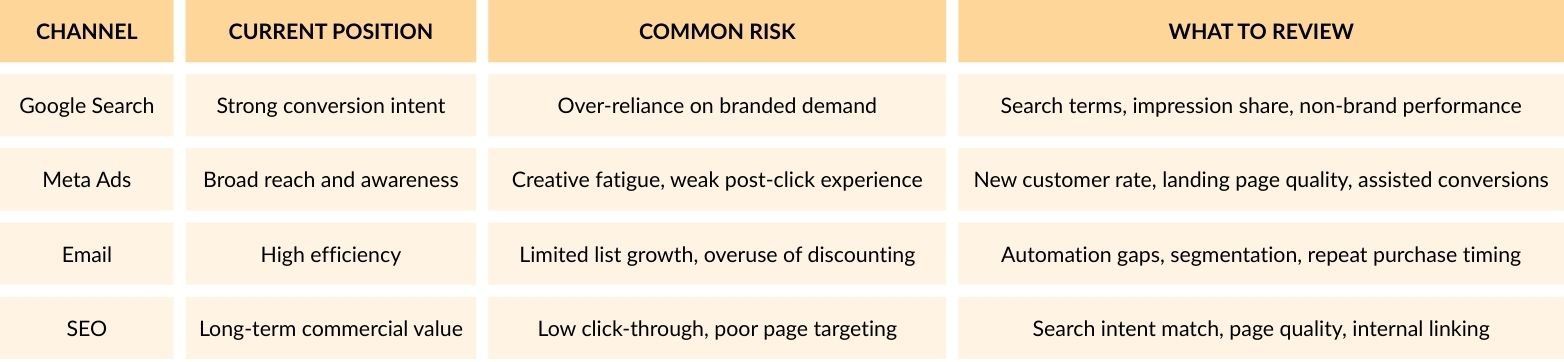
A growth marketing audit should also consider performance over time rather than reacting too quickly to short-term fluctuations. Some channels assist conversions earlier in the journey and may be undervalued when judged too narrowly.
For paid acquisition strategies, eCommerce PPC services can support a more structured view of scaling decisions and channel efficiency.
Point 3: Audit Landing Pages and Buying Paths
A growth marketing audit should examine what happens after the click, because traffic alone does not create commercial growth.
Why Do Landing Pages Matter Before You Increase Ad Spend?
Landing pages matter because if the on-site experience is weak, increasing traffic usually raises cost faster than revenue. In many cases, improving page performance delivers stronger results than increasing media spend.
This part of the audit is often overlooked because budgets and channels tend to dominate discussion. Yet site experience has a direct effect on conversion rate, average order value, and customer confidence.
Common issues include:
- Slow-loading mobile pages
- Unclear product or category messaging
- Poor internal navigation
- Weak product imagery
- Hidden delivery or returns information
- Lack of trust signals
- Avoidable checkout friction
- Excessive promotional distractions
A realistic example would be a retailer increasing paid spend into a category page that already attracts qualified traffic, but where conversion remains low because filters are confusing, the product order is poor, and the page gives little help to undecided buyers. In that case, the media is not the real constraint. The landing page is.
Point 4: Audit Offer-Market Fit and Traffic Intent
A growth marketing audit should test if the right traffic is being matched to the right offer at the right stage of the buying journey.
What Gets Missed Most in a Growth Marketing Audit?
One of the most overlooked areas is the relationship between user intent, product economics, and message fit. Businesses often review channel performance without properly assessing whether traffic is being directed to a commercially strong offer.
Not all traffic has the same value. Informational visitors, category browsers, returning customers, and high-intent branded search users should not be treated as one blended audience. Their behaviour differs, and so should the way they are analysed.
Key areas to review include:
Buyer Intent by Landing Page Type
Consider how users behave on:
- Informational content pages
- Category pages
- Product pages
- Promotional landing pages
- Branded search destinations
Different page types should support different levels of buying intent. If traffic intent and page intent are misaligned, performance will suffer even when acquisition looks healthy.
Offer Strength and Margin Suitability
A growth marketing audit should also ask whether the offer itself is strong enough to support scale.
Review:
- Product margin
- Pricing competitiveness
- Bundling opportunities
- Free shipping thresholds
- Promotional dependency
- Average order value by category
This is an area many businesses miss. Revenue growth is not always profitable growth. A channel may drive orders while still putting pressure on margin if the promoted products are too low-value or too reliant on discounting.
Message Match
The consistency between the ad, the search result, and the landing page matters. If messaging is too generic, too broad, or too disconnected from buyer intent, conversion performance weakens. Strong growth depends on relevance as much as reach.
Point 5: Audit Operational Readiness to Scale
A growth marketing audit should end with operational readiness, because increased demand only works when the business can support it effectively.
Can Your Team and Site Handle More Growth?
More growth requires more than available budget. It also requires the internal ability to respond quickly, manage demand, and maintain performance standards across the site and wider customer journey.
This part of the audit is often under-discussed, yet it has a direct impact on whether growth is sustainable.
Review the following:
- Stock availability to ensure key lines can support additional demand
- Creative production capacity to keep campaigns refreshed
- Development support to implement fixes and landing page updates quickly
- Reporting cadence so teams can respond to performance without delay
- Promotion planning to avoid reactive campaigns
- Retention infrastructure so acquired customers are nurtured properly
For example, there is little value in increasing spend on a best-selling product range if stock is shallow, page updates take too long, or creative assets are not available to support fresh campaigns.
Operational constraints often sit outside the marketing report, but they still affect marketing return. A complete growth marketing audit should surface those issues before scale is attempted.
What Should a Growth Marketing Audit Deliver?

A growth marketing audit should end with a prioritised action plan and not a list of disconnected observations.
The final output should include:
1. Measurement Fixes
Resolve tracking gaps, attribution issues, conversion accuracy problems, and reporting inconsistencies. This gives the business a more reliable foundation for reporting, forecasting, and budget decisions.
2. Channel Decisions
Identify which channels are ready to scale, which need refinement, and which should be capped or reviewed. The goal is to direct spend towards activity with stronger commercial potential and reduce waste where performance is limited.
3. Conversion Improvements
Highlight the pages, journeys, and friction points holding back commercial performance. This helps teams focus on the changes most likely to improve conversion rate, revenue, and overall efficiency.
4. Offer and Message Adjustments
Clarify which products, propositions, and landing pages are most suitable for growth. It should also show where messaging is too weak, too broad, or poorly aligned with buyer intent.
5. 90-Day Action Plan
Set out priorities, ownership, expected impact, and review timelines. This turns audit findings into a practical roadmap that can be acted on with accountability.
Without this level of structure, audit work often becomes descriptive rather than useful. The value comes from turning analysis into decisions.
Conclusion
A growth marketing audit helps ecommerce businesses decide if increasing budget is likely to drive profitable growth or simply increase inefficiency. Before scaling spend, brands should review five core areas: measurement, channel efficiency, landing page performance, offer and intent alignment, and operational readiness. If these areas are strong, an additional budget is far more likely to improve results. If they are weak, higher spend usually exposes existing problems faster. A clear growth marketing audit gives businesses a more reliable basis for decision-making, sharper priorities, and a practical route to better performance.
- By Victoria